Transcription of POLYPROTIC ACIDS AND BASES: Very important!
1 18-1 POLYPROTIC ACIDS AND BASES: Very important! -- ACIDS that can lose, and bases that can pick up, more than one H+ ( diprotic H2A and triprotic H3A ACIDS ). Ionization occurs stepwise, and each step has its own Ka. H3PO4 (aq) H+ (aq) + H2PO4- (aq) Ka1 = x 10-3 increasing H2PO4- (aq) H+ (aq) + HPO42- (aq) Ka2 = x 10-8 acid HPO42- (aq ) H+ (aq ) + PO43- (aq ) Ka3 = x 10-13 strength Note: (i) Ka1 > Ka2 > Ka3 Always true for POLYPROTIC ACIDS , , each ionization step is more difficult because it is more difficult to remove H+ from a molecule as its negative charge increases.
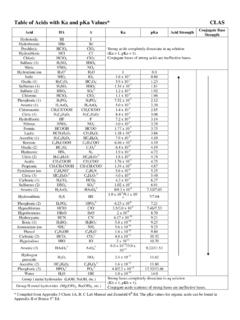
2 BUT this does not apply for ionic salts of these ACIDS , , Na3PO4, Na2SO4, etc. They dissociate 100% in one step. Na3PO4 (aq) 3 Na+ (aq) + PO43- (aq) (ii) The conjugate bases are POLYPROTIC bases, , PO43- is a triprotic base it can pick up 3 H+. 18-2 Table Successive Ka values for Some POLYPROTIC ACIDS at 25 C 18-3 Example Problem: Calculate the pH and concentration of each species in a M H3PO4 solution. (a) First dissociation: H3PO4 (aq) H+ (aq) + H2PO4- (aq) [init] M 0 0 Ka1 = x 10-3 [change] -x +x +x [equil] ( ) x x Ka = = = x 10-3 (assume x << ) x2 = ( )( x 10-3) x = M (Check assumption: % ionization = 100% = 4%.)
3 Also, = 694 > 400. Okay.) At equilibrium, [H3PO4] = ( ) = M = M [H+] = M and [H2PO4-] = M ]POH[]POH][H[4342 +) (x2 ]POH[18-4 (b) Second dissociation: H2PO4- (aq) H+ (aq) + HPO42- (aq) Ka2 = x 10-8 [init] M 0 [change] -y +y +y [equil] ( ) ( +y) y Ka2 = = = x 10-8 = y (assume y << ) y = x 10-8 (very small - assumption definitely okay !!) Note: (1) [H+] from second dissociation = Ka2 = [HPO42-] (2) [H+] from second dissociation is negligible!
4 (c) Third dissociation: HPO42- (aq) H+ (aq) + PO43- (aq) Ka3 = x 10-13 [init] x 10-8 M 0 [change] -z +z +z [equil] ( x 10-8)-z ( +z) z Ka3 = = = x 10-13 z = = x 10-19 M (assumption okay !!) [H+] from third dissociation completely negligible almost nothing. +4224 POH[]HPO][H[ () (y +]HPO[]PO][H[2434 +z) (z) (8 + 18-5 (d) Calculate [OH-], pH and pOH pH = -log[H+] = -log ( ) = pOH = -log[OH-] and pOH = pH via [OH-] [H+][OH-] = Kw = x 10-14 (at 25 C) [OH-] = = = x 10-14 pOH = -log[OH-] = -log( x 10-14) = (via pH pH + pOH = pOH = pH = = = Summary: In a M H3PO4 solution: [H3PO4] = M [H+] = [H3O+] = M [H2PO4-] = M [OH-] = x 10-14 M [HPO42-] = x 10-8 M pH = [PO43-] = x 10-19 M pOH = ** Remember.))]
5 (1) The [H3O+] is determined by Ka1. [H3O+] from other dissociations (Ka2, Ka3) is negligible, and is ignored. (2) [HPO42-] from second dissociation = Ka2 ** ][H10 x + x = [H+][OH-]pH pOHpH = -log[H3O+] pOH = -log[OH-]pH + pOH = + OH-18-6 Section : Weak Base Equilibria We will consider weak bases that are molecules containing a N with a lone pair: NH3, RNH2, etc. (Other weak bases also known, however.)
6 General equilibrium for a weak base in water This is a base-dissociation reaction or base-ionization reaction (NOTE: The base doesn t actually dissociate!) Kb = base-dissociation (ionization) constant Kb = ([H2O] is a constant and contained within Kb) Question. Write the base-ionization and Kb eqns for ammonia (NH3) NH3 (aq) + H2O (aq) NH4+ (aq) + OH- (aq) Kb = = x 10-5 ** Solve calculations similarly to weak ACIDS ! ** B(aq) + H2O(aq) BH+(aq) + OH-(aq)(base) ( acid ) ( acid ) (base)conjugate pairconjugate pair[B]]][OH[BH-+18-7 Figure Abstraction of a proton from water by the base methylamine.
7 Lone pair of N pair binds H+ 18-8 Example 1. What is Kb for quinine (anti-malarial drug) if the pH of a x 10-3 M solution is (NOTE: pH > quinine is a base) Qui (aq) + H2O (aq) HQui+ (aq) + OH- (aq) [init] x 10-3 M 0 0 [change] -x +x +x [equil] ( x 10-3)-x x x Kb = = pH = pOH = [OH-] = x = x 10-5 M (check: x = [OH-] << x10-3 ( ) assumption okay) Kb = = x 10-6 Example 2.
8 Calculate the pH of a M solution of NH3 (Kb = ) NH3 (aq) + H2O (aq) NH4+ (aq) + OH- (aq) [init] M 0 0 [change] -x +x +x [equil] x x Kb = = = x 10-5 x2 = x 10-4 x = x 10-2 (<< assumption okay) [OH-] = x 10-2 M pOH = pH = - = 12. 20 [Qui]]][OH[HQui-+x) (x32 3-2-510 x )10 x ( ]NH[]OH][NH[34 +) (x2 NOTE: (i) pKb = -log Kb (ii) just like pKa, strength of base increases with decreasing pKb (See Table 18.)
9 6) The bigger is Kb, the more OH- is generated. The smaller is pKb, the more OH- is generated. base formula Kb pKb Diethylamine NHEt2 x 10-4 Methylamine NH2Me x 10-4 Ammonia NH3 x 10-5 Pyridine C5H5N x 10-9 Relationship Between Ka and Kb of a conjugate acid /base Ka = acid dissociation constant ( for NH4+) Kb = base dissociation constant ( for NH3) Since NH3 and NH4+ are a conjugate acid /base pair, it is not surprising that Ka for NH4+ and Kb for NH3 are related. KaKb = Kw = x 10-14 (at 25 C) (Ka for a weak acid )(Kb for its conjugate base) = Kw same as (Kb for a weak base)(Ka for its conjugate acid ) = Kw 18-10 Table Kb Values for Some Molecular (Amine) Bases at 25 C 18-11 Example 1: Ka for HF is x 10-4.
10 What is Kb for F- ? F- is the conjugate base of HF, therefore its Kb is related to the Ka of HF by KaKb = Kw Kb = = = x 10-11 Note: Kb very small do not get much [OH-] in a solution of NaF. Example 2: What is the pH of a M solution of sodium acetate (NaAc)? Ka for acetic acid (HAc) is x 10-5. Acetate (Ac- = CH3 COO-) is the conjugate base of acetic acid (HAc = CH3 COOH). Ac- (aq) + H2O(l) HAc(aq) + OH- (aq) [init] M 0 0 [change] -x +x +x [equil] ( ) x x Kb = = (assume x << ) We need Kb.