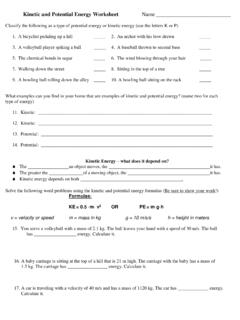
Transcription of Potential and Kinetic Energy - Paulding County School …
1 Potential and Kinetic EnergyVELOCITYV elocity is a measure of how fast an object is traveling in a certain direction. Example: A bus traveling North at 150 m/s Example: A car is traveling 45 mph South. Example: A truck is traveling 60 mph East. VELOCITYV elocity = distance time plus a direction Car on a circular track = may have constant speed, but cannot maintain a constant velocity as it s direction is always Speed is a measure of how fast something is moving, but there is not a directional element to it Speed is the distance an object moves over a period of time. Speed = Distance Time (S = D / T)Gravity The force that pulls objects towards each other. The force of gravity on Earthis meters per second (m/s2) The force of gravity between two objects depends on the mass of each object and distance between the two objects.
2 Motion Objects "tend to keep on doing what they're doing" In fact, it is the natural tendency of objects to resist changes in their state of motion. Without some outside influence, an object in motion will remain in motion and an object at rest will remain at rest. All objects need Energy to change their Energy : is the ability to do work Work is being done whenever a force moves an object in the same direction as the force being means that birds can fly, tigers can roar, wind can blow, sun can shine, cars can go fast, factories can make things, light bulbs can glow and your computer can work. Without Energy , there would be nothing: no life, no movement, no light, .. nothing Energy There are 2 types of Energy Potential Energy Kinetic Energy Energy changes from Potential to Kinetic , but is never destroyed or created.
3 Kinetic Energy The amount of Kinetic Energy is dependent on the massand speed of an object. Kinetic Energy is the Energy of Kinetic energyIf we know the mass of an object and its velocity we can determine the amount of Kinetic Energy = 1/2 (mass of object)(velocity of object)2or KE = 1/2 mv2 orKE = SI unit for Kinetic Energy is the Joule (J). A Joule is a kilogram x meters/secondsCalculating Kinetic EnergyA 1200 kg automobile is traveling at a velocity of 100 m/s northwest. What is the Kinetic Energy of the automobile?KE = mv2= (1200kg)(100 m/s)2= (1200 kg)(10000 m/s)= (600kg)(10000 m/s)= 6000000 kg x m/s= 6000000 Joules (J) You TryA bicycle with a mass of 14 kg traveling at a velocity of m/s east has how muchkinetic Energy ?
4 KE = bicycle with a mass of 14 kg traveling at a velocity of m/s east has how much Kinetic Energy ?KE = (14kg)(3m/s)2= (7kg)(3m/s)2=(7kg)(9m/s)= 63 kg x m/s=63 JPotential Energy Stored Energy The Energy of position The amount of Energy contained in an object at restDetermining Potential EnergyDetermined by its position and its mass(mass X gravity X height)PE = (mass)(gravity)(height) = mgh where m is mass in kg g is the force of gravity = m/s2 h is the height The SI unit that represents Potential Energy is the Joule (J) = (kg x m/s). Example of Potential Energy ProblemA flower pot with a mass of 15 kg is sitting on a window sill 15 meters above the ground. Howmuch Potential Energy does the flower pot contain?
5 PE = (mass)(gravity)(height) = (15 kg)( m/s)(15 m) = (147kg)(15m/s) = 2205 kg X m/s = 2205 JoulesYou Try If the flower pot is lowered to a window sill that is 10 meters from the ground. What is the Potential Energy now?PE = (mass)(gravity)(height)*gravity = m/s2 Examine an example of Potential Energy If the flower pot is lowered to a window sill that is 10 meters from the ground. What is the Potential Energy now?PE = (mass)(gravity)(height)= (15 kg)( m/s)(10 m)= (147 kg x m/s)(10m)= 1470 kg x m/s)= 1470 JoulesPotential or Kinetic Energy ? Moving car _____ Tree branch _____ Bent car fender _____ Balloon filled with air _____ Balloon floating around a room _____ Person inside a moving car _____ What type of Energy does the space shuttle mostly have after liftoff?
6 What type of Energy did the space shuttle mostly have before liftoff?Law of Conservation of Energy Energy is NEVER created or destroyed; it just CHANGES forms. Energy can change from one form to another. Energy is all around us and is constantly changing from one form to of Law of Conservation of Energy Parked car begins moving = Energy of the car changes from Potential to Kinetic . A ball rolling across a field hits a rock and stops moving = Energy of the car changes from Kinetic to Potential . A rock at the top of a hill begins to roll down the hill = Energy changes from Potential to of Potential to Kinetic Energy As one type of Energy increases another type of Energy decreases. In this picture the people are slowing down as they reach the top of the hill, so as Potential Energy increases, Kinetic Energy decreases.
7 Objects slowing down are constantly increasing in Potential Energy and decreasing in Kinetic Energy . Object speeding up are constantly in Kinetic Energy and decreasing in Potential how the roller coaster is an example of the law to conservation of Energy ?Total amount of Energy stays the same, Energy only changes forms as the roller coaster speeds up and slows down. What position do you think the pendulum has the most Kinetic Energy ? Least Kinetic Energy ? What position do you think the pendulum has the most Potential Energy ? Least Potential Energy ?Suppose the pendulum started moving at position 1 and continued to position 5. with greatest Kinetic Energy ? with least Kinetic Energy ?
8 With greatest Potential Energy ? with least Potential Energy ? ____