Transcription of PowerPoint Presentation - Overview of Child Development
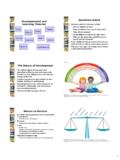
1 MondayNotesTuesday in Lifespan Development Complete the study guide using your books and your notes. Study for testThings you need to know aboutChild DevelopmentReview Child Development Changes over time Similar for all Orderly Simple to complex Changes/growth usually beneficial/usefulDomains Physical Cognitive Social EmotionalReview People didn t recognize childhood as different The Reformers saw children as being born evil/sinful and sought to teach them. Printing. The Enlightenment brought the idea of a blank slate-children developed through nurturing. The age of reason-children seen as Noble Industrial Revolution-Darwin and biological comparisons to the rest of the animal kingdom 20thCentury Psychoanalytical Theories (Freud/Erikson) Behavioral Theories (Skinner) Social Learning theory (Bandura) Biological and Maturationist Theories Ethology Cognitive theory (Piaget) Child Development Definition: Change in the Child that occurs over time.
2 Changes follow an orderly pattern that moves toward greater complexity and enhances survival. Periods of Development : Prenatal period: from conception to birth Infancy and toddlerhood: birth to 2 years Early childhood: 2-6 years old Middle childhood: 6-12 years old Adolescence: 12-19 years oldDomains of DevelopmentDevelopment is described in three domains, but growthin one domain influences the other domains. Physical Domain: body size, body proportions, appearance, brain Development , motor Development , perception capacities, physical health. Cognitive Domain: thought processes and intellectual abilities including attention, memory, problem solving, imagination, creativity, academic and everyday knowledge, metacognition, and language. Social/Emotional Domain: self-knowledge (self-esteem, metacognition, sexual identity, ethnic identity), moral reasoning, understanding and expression of emotions, self-regulation, temperament, understanding others, interpersonal skills, and What is a theory ?
3 Orderly set of ideas which describe, explain, and predict behavior. Why are theories important? To give meaning to what we observe. As a basis for action --finding ways to improve the lives and education of of Child Development Theories6th -15th centuriesMedieval period Preformationism: children seen as little adults. Childhood is not a unique phase. Children were cared for until they could begin caring for themselves, around 7 years old. Children treated as adults ( their clothing, worked at adult jobs, could be married, were made into kings, were imprisoned or hanged as adults.)16th CenturyReformation period Puritan religion influenced how children were viewed. Children were born evil, and must be civilized. A goal emerged to raise children effectively. Special books were designed for CenturyAge of Enlightenment John Locke believed in tabula rasa Children develop in response to nurturing.
4 Forerunner of CenturyAge of Reason Jean-Jacques Rousseau children were noble savages, born with an innate sense of morality; the timing of growth should not be interfered with. Rousseau used the idea of stages of Development . Forerunner of maturationist beliefs19th CenturyIndustrial Revolution Charles Darwin theories of natural selection and survival of the fittest Darwin made parallels between human prenatal growth and other animals. Forerunner of ethology20th CenturyTheories about children's Development expanded around the world. Childhood was seen as worthy of special attention. Laws were passed to protect children, Psychoanalytical TheoriesBeliefs focus on the formation of personality. According to this approach, children move through various stages, confronting conflicts between biological drives and social expectations. Sigmund FreudPsychosexual theory Was based on his therapy with troubled adults.
5 He emphasized that a Child 's personality is formed by the ways which his parents managed his sexual and aggressive EriksonPsychosocial theory Expanded on Freud's theories. Believed that Development is life-long. Emphasized that at each stage, the Child acquires attitudes and skills resulting from the successful negotiation of the psychological s 8 Stages of Development Identified 8 stages: Basic trust vs mistrust (birth -1 year) Autonomy vs shame and doubt (ages 1-3) Initiative vs guilt (ages 3-6) Industry vs inferiority (ages 6-11) Identity vs identity confusion (adolescence) Intimacy vs isolation (young adulthood) Generativity vs stagnation (middle adulthood) Integrity vs despair (the elderly)More on EriksonErikson taught at Harvard and engaged in a variety of clinical work, widening the scope of psychoanalytic theory to take greater account of social, cultural, and other environmental factors.
6 In his most influential work, Childhood and Society (1950), he divided the human life cycle into eight psychosocial stages of for imageGesellFreudEriksonSkinnerBanduraVyg otskyPiagetBehavioral and Social Learning TheoriesBeliefs that describe the importance of the environment and nurturing in the growth of a Developed as a response to psychoanalytical theories. Behaviorism became the dominant view from the 1920's to 1960' Watson Early 20th century, "Father of American Behaviorist theory . Based his work on Pavlov's experiments on the digestive system of dogs. Researched classical conditioning Children are passive beings who can be molded by controlling the stimulus-response F. Skinner Proposed that children "operate" on their environment, operational conditioning. Believed that learning could be broken down into smaller tasks, and that offering immediate rewards for accomplishments would stimulate further Learning TheoryAlbert Bandura Stressed how children learn by observation and imitation.
7 Believed that children gradually become more selective in what they imitate. Biological TheoriesBelief that heredity and innate biological processes govern growth. Maturationists: G. Stanley Hall and Arnold Gesell Believed there is a predetermined biological timetable. Hall and Gesell were proponents of the normative approach to Child study: using age-related averages of children's growth and behaviors to define what is Examines how behavior is determined by a species' need for survival. Has its roots in Charles Darwin's research. Describes a "critical period" or "sensitive period, for learningKonrad Lorenz Ethologist, known for his research on theory John Bowlby applied ethological principles to his theory of attachment. Attachment between an infant and her caregiver can insure the infant s TheoriesBeliefs that describe how children learnJean PiagetCognitive Development theory Children "construct" their understanding of the world through their active involvement and interactions.
8 Studied his 3 children to focus not on what they knew but how they knew it. Described children's understanding as their "schemas and how they use: assimilation s Cognitive Development Stages Sensori-motor Ages birth -2: the infant uses his senses and motor abilities to understand the world Preoperation Ages 2-7: the Child uses metal representations of objects and is able to use symbolic thought and language Concrete operations Ages 7-11; the Child uses logical operations or principles when solving problems Formal operations Ages 12 up; the use of logical operations in a systematic fashion and with the ability to use abstractionsLev VygotskySocio-Cultural theory Agreed that children are active learners, but their knowledge is socially constructed. Cultural values and customs dictate what is important to learn. Children learn from more expert members of the society.
9 Vygotsky described the "zone of proximal Development ", where learning occurs. Processing theory Uses the model of the computer to describe how the brain works. Focuses on how information is perceived, how information is stored in memory, how memories are retrieved and then used to solve problems. Systems TheoryThe belief that Development can't be explained by a single concept, but rather by a complex BronfenbrennerEcological Systems theory The varied systems of the environment and the interrelationships among the systems shape a Child 's Development . Both the environment and biology influence the Child 's Development . The environment affects the Child and the Child influences the s Ecological Model The microsystem -activities and interactions in the Child 's immediate surroundings: parents, school, friends, etc. The mesosystem -relationships among the entities involved in the Child 's microsystem: parents' interactions with teachers, a school's interactions with the daycare provider The exosystem -social institutions which affect children indirectly: the parents' work settings and policies, extended family networks, mass media, community resources The macrosystem -broader cultural values, laws and governmental resources The chronosystem -changes which occur during a Child 's life, both personally, like the birth of a sibling and culturally, like the Iraqi war.
10 Outline of 20th Century Theories Psychoanalytical Theories Psychosexual: Sigmund Freud Psychosocial: Erik Erikson Behavioral & Social Learning Theories Behaviorism: Classical Conditioning -John Watson & Operant Conditioning Skinner Social Learning -Albert Bandera Biological Theories Maturationism: G. Stanley Hall & Arnold Gesell Ethology: Konrad Lorenz Attachment: John Bowlby Cognitive Theories Cognitive Development : Jean Piaget Socio-cultural: Lev Vygotsky Information Processing Systems Theories Ecological Systems: Urie BronfenbrennerOutline of 20th Century Theories