Transcription of Practical Guide to Writs of Execution
1 I Second Edition December 2021 Published by the Texas Justice Court Training Center An educational endeavor of the Justices of the Peace and Constables Association of Texas, Inc. Funded by the Texas Court of Criminal Appeals Copyright 2021 Texas Justice Court Training Center All rights reserved. No part of this work may be reproduced or transmitted in any form or by any means, electronic or mechanical, including photocopying and recording, or by any information storage or retrieval system without the prior written permission of the Texas Justice Court Training Center unless copying is expressly permitted by federal copyright law. Address inquiries to: Permissions Texas Justice Court Training Center 1701 Directors Blvd. Suite 530 Austin, TX, 78744 i Table of Contents User Notes .. 1 Chapter 1: Writs of Execution .. 2 A. What is a writ of Execution ? .. 2 B. Types of Writs of Execution .. 3 1. No Writs of Execution on Dormant Judgments .. 4 C. Property.
2 5 1. Real Property vs. Personal Property .. 5 2. What is Non-Exempt Property? .. 5 a. Exempt Property Bench Card .. 6 3. Levy on Property .. 6 Chapter 2: Officer s Duties .. 8 A. Accepting the writ .. 8 1. writ of Supersedeas .. 9 2. Stay of Execution .. 10 3. Activity Log .. 10 B. Determining the Amount Due .. 11 1. Pre-Judgment Interest and Post-Judgment Interest on Cases Prior to 1987 .. 11 2. Post-Judgment Interest .. 13 3. Partial Payments .. 17 C. Determining What Property to Levy On .. 18 1. Talk to the Judgment Creditor .. 19 a. Conversation with the Judgment Creditor s Attorney .. 21 2. Use Your Resources .. 22 D. Serving the Judgment Debtor .. 22 1. Demand Letter .. 22 2. Serve the Judgment Debtor in Person or by Mail .. 23 3. Require Judgment Debtor to Designate Non-Exempt Property .. 24 E. Tricky Issues Before Levy .. 25 1. What if One of the Parties Dies? .. 25 2. What if One of the Parties Changes Their Name? .. 26 Chapter 3: Levy and Sale .. 27 A. Levy.
3 27 ii 1. What Does it Mean to Levy on Property? .. 27 2. Restrictions and Limitations .. 28 3. Levy on Particular Types of Property .. 28 a. Livestock .. 28 b. Shares of Stock .. 29 c. Goods Pledged or Mortgaged .. 29 d. Large and Cumbersome Property .. 29 4. Writs Issued for Multiple People or Entities .. 30 5. Keep the Property Safe .. 31 6. When Levy is Not Possible .. 33 7. writ of Venditioni Exponas .. 33 B. Right to Replevy .. 34 C. Property Sale .. 34 1. Notice and Location of Sale .. 35 a. Sale of Real Property .. 35 b. Sale of Personal Property .. 38 2. Auction .. 38 a. How to Determine the Opening Bid .. 38 b. Who Are Eligible Purchasers? .. 39 c. Purchase by Judgment Debtor or Judgment Creditor .. 40 3. Tips for a Successful Execution Sale Handout .. 41 D. Post-Sale Procedure .. 41 1. Collecting Funds .. 41 a. What if the Top Bidder Doesn t Pay? .. 42 2. Drafting the Bill of Sale and Deed .. 42 E. What if the Judgment is Not Satisfied? .. 44 F. Return of Execution .
4 44 Chapter 4: Liability of the Constable .. 46 A. Immunity .. 46 B. Liability for Constables Related to Deputies Conduct .. 47 C. Best Practices to Avoid Liability .. 48 D. Statutory Duties of Constables .. 49 1. Duty to Act in Good Faith .. 49 2. Duties Under Local Government Code Chapter 86 .. 50 a. Duty to Deliver Money Collected .. 51 iii b. Failure or Refusal to Execute Process .. 51 3. Duties Under Civil Practice and Remedies Code Chapter 34 .. 52 a. Duty Related to Seized Personal Property .. 52 b. Duty of Successor Officer .. 53 c. Duty to Endorse writ Properly .. 53 d. Duty to Return writ Properly .. 54 e. Duty to Levy and Sell .. 54 f. Improper Sale .. 56 E. Criminal Liability .. 56 1. Abuse of Official Capacity and Official Oppression .. 56 2. Assaultive Offenses .. 57 3. Criminal Trespass .. 58 Chapter 5: Resources .. 60 A. TJCTC Resources .. 60 B. Statutes and Rules .. 60 Chapter 6: Appendix of Cases and Authority .. 61 A. Cases .. 61 B. Attorney General Opinions.
5 61 1 User Notes This Practical Guide to Writs of Execution (2nd ed. December 2021) is intended to offer a Practical and readily accessible source of information relating to issues you are likely to encounter in executing Writs of Execution . This manual is not intended to replace original sources of authority, such as the Civil Practice and Remedies Code or the Texas Rules of Civil Procedure. We strongly recommend that you refer to the applicable statutory provisions and rules when reviewing issues discussed in this book. Please note that all references to Rule are to the Texas Rules of Civil Procedure. Rather than including the citations to cases in the text of the manual, we have listed only the case name in the text but have included the entire citation in the appendix of cases. This manual represents the Texas Justice Court Training Center s ongoing commitment to provide resources, information and assistance on issues of importance to Texas Justices of the Peace and Constables and their court personnel, and continues a long tradition of support for judicial education in the State of Texas by the Justices of the Peace and Constables Association of Texas, Inc.
6 The Texas Justice Court Training Center thanks all of the constables and deputies who helped provide insight and material for this publication. Special thanks to Deputy Constable Roy Hart, Former Constable Bobby Gutierrez, Deputy Constable Wayne Rhodes, Deputy Constable Carl Eller, Deputy Constable Julien Smith, Former Deputy Constable Alfred Taylor, Constable Matt Wylie, Constable Michael Truitt, and all of the members of the Constable s Education Committee that helped to make this manual possible. Also note that, while these materials were developed for the use of constables and their deputies, all chapters except Chapter 4 also apply generally to sheriffs and their deputies. We hope you will find it to be a valuable resource in providing fair and impartial justice to the citizens of Texas. Please do not hesitate to contact us should you have any questions or comments concerning any of the matters discussed in Practical Guide to Writs of Execution . Texas Justice Court Training Center December 2021 2 Chapter 1: Writs of Execution A.
7 What is a writ of Execution ? A writ of Execution is a writ signed by a judge directing the enforcement of a judgment. It orders the constable or sheriff to levy on (or seize) the judgment debtor s non-exempt property, sell it, and deliver the proceeds of the sale to the judgment creditor to be applied toward satisfaction of the judgment. Writs of Execution can be issued by justice courts, county courts, and district courts in the State of Texas. They must be served by a sheriff, constable, or their deputies, and may be served anywhere in the state. Rules 103, , 621, 629. Generally, a writ of Execution may not issue until 30 days after the judgment to be executed was signed. However, an Execution may issue within that original 30 days if the judge finds that the judgment debtor is about to remove or hide personal property subject to Execution for the purpose of defrauding their creditors. Rules 627, 628. While Writs may look different in format, they should all comply with the requisites of Execution in Rule 629.
8 All Writs of Execution should be styled The State of Texas. They should be directed to any sheriff or any constable within the State of Texas. They should also be signed by the clerk or justice officially and bear the seal of the court (if issued by a district or county court). There should be a description of the judgment, stating the court, date, and time that it was rendered. There should also be a copy of the bill of costs taxed against the judgment debtor in Execution attached to the writ . The time limit for return of the writ should also be listed on the writ . Rule 629. What is a writ ? A writ is a formal legal document from a court ordering a person to take or refrain from taking a specific action. Writs are issued by the court where the original judgment was ordered. However, Writs are directed to any sheriff or constable within the State of Texas, because they should be executed in the county where the property awarded in the judgment is located. Issuance vs.
9 Execution 3 B. Types of Writs of Execution Writs of Execution can direct the officer to satisfy a judgment in several different ways listed below. Types of Writs of Execution Execution on a Judgment for Money This type of writ requires the officer to seize non-exempt property in an amount to satisfy the judgment along with costs and any interest due. Rule 630. This type of writ will not list specific property, and the officer will have to determine what property to be seized (discussed further on page 18). Execution for Sale of Particular Property This type of writ will specifically list and describe property, either real or personal, that the officer is ordered to seize and sell. Rule 631. Execution for Delivery of Certain Property This type of writ will order the officer to take possession of property and deliver the possession to a person designated in the writ (usually the judgment creditor). Rules 308, , 632. This writ will also specifically list and describe any personal or real property to be seized.
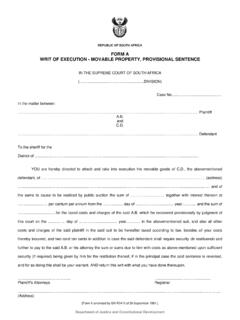
10 These Writs are often called special Writs in justice court. Execution for Possession or Value of Personal Property This type of writ commands the officer to levy and collect the value of specific personal property listed in the writ . Rule 633. There are other types of process that an officer may receive where they are ordered to handle property as under an Execution . Two examples of this are an Order of Sale of Sequestered Property or in a Turnover Order. When an officer receives an order like this, they should follow the rules for executions discussed in this manual. Rule 711, Civil Practice and Remedies Code 4 CLICK HERE 1. No Writs of Execution on Dormant Judgments Writs of executions must generally be issued within 10 years after the judgment is entered or the last writ of Execution has been issued, whichever is later. Civil Practice and Sample forms and other resources can be found on the TJCTC Constable Resources page. A writ for delivery of specific property will look something like this: TO ANY SHERIFF OR CONSTABLE OF ANY COUNTY OF THE STATE OF TEXAS GREETINGS: WHEREAS, in the above number and entitled cause, heretofore, and on the 1st day of May, 2019, ABC MORTGAGE COMPANY AS SERVICER FOR 123 BANK, plaintiff, recovered a Final Judgment in the District Court of New County, Texas, against JOHN DOE, defendant, for the sum of $25, plus interest at the rate of per annum from May 1, 2019, until paid; Attorney s fees of $1,500 for trial of the matter, and all costs of suit; together with a foreclosure of a lien on the following certain property, bounded and described as follows, TO-WIT: 1995 Globe Manufactured Home, Serial No.