Transcription of Practice Guidelines for Chronic Pain Management
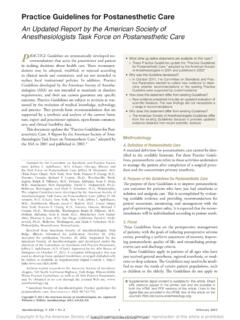
1 SPECIAL ARTICLESA nesthesiology 2010; 112:1 1 Copyright 2010, the American Society of Anesthesiologists, Inc. Lippincott Williams & WilkinsPractice Guidelines for Chronic Pain ManagementAn Updated Report by the American Society of Anesthesiologists Task Force onChronic Pain Management and the American Society of Regional Anesthesia andPain Medicine*PRACTICEG uidelinesare systematically developed recom-mendations that assist the practitioner and patient in mak-ing decisions about health care. These recommendations maybe adopted, modified, or rejected according to clinical needs andconstraints and are not intended to replace local institutionalpolicies.
2 In addition, Practice Guidelines developed by theAmerican Society of Anesthesiologists (ASA) are not intended asstandards or absolute requirements, and their use cannot guar-antee any specific outcome. Practice Guidelines are subject torevision as warranted by the evolution of medical knowledge,technology, and Practice . They provide basic recommendationsthat are supported by synthesis and analysis of the current liter-ature, expert and practitioner opinion, open forum commen-tary, and clinical feasibility document updates the Practice Guidelines forChronic Pain Management , adopted by the ASA in 1996and published in Definition of Chronic PainFor these Guidelines , Chronic pain is defined as pain of anyetiology not directly related to neoplastic involvement.
3 Asso-ciated with a Chronic medical condition or extending in du-ration beyond the expected temporal boundary of tissue in-jury and normal healing, and adversely affecting the functionor well-being of the Purposes of the GuidelinesThe purposes of these Guidelines are to (1) optimize paincontrol, recognizing that a pain-free state may not be attain-able; (2) enhance functional abilities and physical and psy-chologic well-being; (3) enhance the quality of life of pa-tients; and (4) minimize adverse FocusThese Guidelines focus on the knowledge base, skills, andrange of interventions that are the essential elements of effec-tive Management of Chronic pain and pain-related Guidelines recognize that the Management of chronicpain occurs within the broader context of health care, includ-ing psychosocial function and quality of life.
4 These Guide-lines apply to patients with Chronic noncancer neuropathic,somatic ( , myofascial), or visceral pain syndromes. TheGuidelines do not apply to patients with acute pain from aninjury or postoperative recovery, cancer pain, degenerativemajor joint disease pain, headache syndromes ( , migraineand cluster), temporomandibular joint syndrome, or trigem-inal or other neuralgias of the head or face. In addition, theGuidelines do not apply to pediatric patients and do notaddress the administration of intravenous drugs or surgicalinterventions other than implanted intrathecal drug deliverysystems and nerve stimulators.
5 * Developed by the American Society of Anesthesiologists TaskForce on Chronic Pain Management : Richard W. Rosenquist, (Chair), Iowa City, Iowa; Honorio T. Benzon, , Chicago, Illi-nois; Richard T. Connis, , Woodinville, Washington; Oscar Leon-Casasola, , Buffalo, New York; D. David Glass, ,Lebanon, New Hampshire; Wilhelmina C. Korevaar, , BalaCynwyd, Pennsylvania; Nagy A. Mekhail, , , Cleveland,Ohio; Douglas G. Merrill, , Iowa City, Iowa; David G. Nicki-novich, , Bellevue, Washington; James P. Rathmell, ,Boston, Massachusetts; Christine Nai-Mei Sang, , , Bos-ton, Massachusetts; and Dana L.
6 Simon, , Des Moines, Task Force thanks Timothy R. Deer, for his early contri-butions (September 2006-June 2008) to the development of thesePractice from American Society of Anesthesiologists, Park Ridge,Illinois. Submitted for publication October 22, 2009. Accepted forpublication October 22, 2009. Supported by the American Society ofAnesthesiologists and developed under the direction of the Com-mittee on Standards and Practice Parameters, Jeffrey L. Apfelbaum, (Chair), and the American Society of Regional Anesthesiaand Pain Medicine (ASRA). Approved by the ASA House of Dele-gates on October 21, 2009.
7 Approved by the ASRA Board of Direc-tors on September 19, 2009. A complete bibliography used todevelop these Guidelines , arranged alphabetically, is available asSupplemental Digital Content 1, correspondence to the American Society of Anesthesiol-ogists: 520 North Northwest Highway, Park Ridge, Illinois 60068-2573. These Practice Guidelines , as well as all ASA Practice Param-eters, may be obtained at no cost through the Journal Web site, Supplemental digital content is available for this article. DirectURL citations appear in the printed text and are available inboth the HTML and PDF versions of this article.
8 Links to thedigital files are provided in the HTML text of this article on theJournal s Web site ( ).Anesthesiology, V 112 No 41 April 2010D. ApplicationThese Guidelines are intended for use by anesthesiologistsand other physicians serving as pain medicine specialists. TheGuidelines recognize that all anesthesiologists or other phy-sicians may not have access to the same knowledge base,skills, or range of modalities. However, aspects of the Guide-lines may be helpful to anesthesiologists or other physicianswho manage patients with Chronic pain in a variety of prac-tice settings.
9 They may also serve as a resource for otherphysicians, nurses, and healthcare providers ( , rehabilita-tion therapists, psychologists, and counselors) engaged in thecare of patients with Chronic pain. They are not intended toprovide treatment algorithms for specific pain Task Force Members and ConsultantsThe ASA appointed a Task Force of 12 members, includinganesthesiologists in both private and academic Practice fromvarious geographic areas of the United States and two con-sulting methodologists from the ASA Committee on Stan-dards and Practice Task Force developed the Guidelines by means of aseven-step process.
10 First, they reached consensus on the criteriafor evidence. Second, original published research studies frompeer-reviewed journals relevant to Chronic pain were reviewedand evaluated. Third, expert consultants were asked to (1) par-ticipate in opinion surveys on the effectiveness of variouschronic pain Management recommendations and (2) reviewand comment on a draft of the Guidelines . Fourth, opinionsabout the Guidelines recommendations were solicited from asample of active members of the ASA and the American Societyof Regional Anesthesia and Pain Medicine (ASRA).