Transcription of Practicum Goals, Objectives and Competencies Form - CGPS
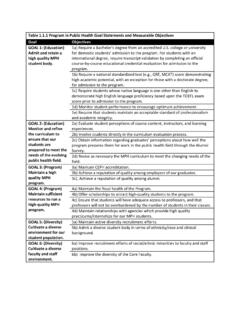
1 1 | P a g ePracticum goals , Objectives and Competencies form To be completed by the student with guidance from the preceptor. Return via email to or Student Name: Date: Practical Experience Site: Preceptor: Section 1: Overview of your project(s) Briefly describe your project(s) including purpose and expected outcomes. (~200 words) 2 | P a g e Section 2. goals and Objectives (See the Practicum Manual for an example.) List your goals for the Practical Experience. goals should include what you want to achieve by the end of the Practical Experience. There should only be one goal for each project. If you have a second project, please add an additional goal. For each goal, list 1-3 Objectives . Objectives should be measurable and may include specific deliverables that you will be working on as part of your Practical Experience. Include a date for the completion of each objective. Goal Objectives Tasks Completion Date Objective Objective Objective 3 | P a g e Section 3: Data The Practical Experience is intended to provide students with an opportunity to learn professional responsibility as well as public health skills.
2 To facilitate this, it is important for the preceptor to have a discussion with the student to clarify expectations, rules, and regulations that govern the activities the student will be performing on behalf of the host organization. The following questions should be completed jointly with the preceptor and student. A. Human Subjects Research ( ) Does the project entail research* involving human subjects and/or use of identifiable data? yes no not sure (please contact the Course Instructor if you have questions) If yes, has the project been reviewed and approved by the appropriate Institutional Review Board? yes no If yes, the IRB determination letter must accompany this form . B. Access to and Use of Data 1. Will the student use data supplied by the host organization? yes no If yes, describe the source and format of the data. Will the student have access to identifiable information? Be specific.
3 2. Will the student generate data for the host organization? yes no If yes, what data will be collected? How will it be collected? Be specific. 3. Does the preceptor have authority to grant student use of data? yes no 4. May the student take the data offsite from the agency/organization? yes no 5. Will the student be allowed to report the data or the results of their analysis in a final report or Capstone? yes no 6. Have confidentiality issues and data use restrictions been discussed with the student? yes no *Research means a systematic investigation, including research development, testing, and evaluation, designed to develop or contribute to generalizable knowledge. Not everything that involves contact with people is considered research. For example, interviewing participants of an intervention program conducted by an agency in order to evaluate and improve the program would not be considered research, unless the results were going to be used to be generalizable to other programs or agencies.
4 4 | P a g e Section 4: Competencies Instructions: List the 3 5 specific Competencies (see next page for a list of program Competencies ) that you expect to gain from your experience. Note: Do not include more than 5 Competencies . You and your preceptor will be asked to rate how well you were able to meet these Competencies so they should be the Competencies most relevant to your project(s). Be sure to list specific Competencies and not just the general topic area. Competency 1: Competency 2: Competency 3: Competency 4: Competency 5: ======================================== ========================== I have read and approved the project described above. Preceptor Signature: Date: Course Instructor: Date: 5 | P a g e UNE MPH Program Competencies Domain 1: Analytical/Assessment Skills Program Competency #1: Utilize quantitative and qualitative data to identify and analyze factors affecting the health of a community.
5 Domain 2: Policy Development/Program Planning Skills Program Competency #2: Analyze policies, programs, and services to evaluate their demonstrated or potential impact on the health of a community. Domain 3: Communication Skills Program Competency #3: Utilize effective communication skills to convey public health data and information to professionals and the public . Domain 4: Cultural Competency Skills Program Competency #4: Promote policies, programs, and services for diverse populations that demonstrate cultural proficiency and community collaboration. Domain 5: Community Dimensions of Practice Skills Program Competency #5: Assess the role of community relationships and diverse perspectives in the development or implementation of public health polices, programs, and services. Domain 6: public health Sciences Skills Program Competency #6: Utilize evidence to support decision-making in the development and evaluation of public health initiatives.
6 Domain 7: Financial Planning and Management Skills Program Competency #7: Evaluate public health programs use of financial resources and management techniques to achieve goals and sustainability. Domain 8: Leadership & Systems Thinking Skills Program Competency #8: Incorporate ethical standards in professional practice to promote healthy communities. Program Competency #9: Articulate the role and value of public health in the social, political, and economic development of a community.