Transcription of PRE- AND POST-HARVEST HANDLING AND …
1 Box 1390, Skulagata 4 120 Reykjavik, Iceland Final Project 2007 PRE- AND POST-HARVEST HANDLING AND PROCESSING PROCEDURES FOR THE PRODUCTION OF SAFE AND HIGH QUALITY FRESH FISHERIES PRODUCTS IN BANGLADESH Hasan Ahmmed Department of Fisheries 11th Floor, Matsya Bhaban, Dhaka-1000 Bangladesh. Supervisors Prof. Hjorleifur Einarsson Arnheidur Eythorsdottir University of Akureyri ABSTRACT Fisheries play a significant role in Bangladesh providing 63% of the animal protein supply and 10% direct or indirect employment for 150 million people, and are the second highest export earning source of the country.
2 The fish processing sector has not achieved expected export returns with respect to the growth rate of aquaculture and overall fish production. Lack of technical production knowledge on high quality and safe products prevents proper utilisation of the available carp and catfish from aquaculture. To improve fish processing in Bangladesh, the limitations of current practices were studied in comparison to processing practices in Iceland. Long, complicated fish supply chains, shortage of technical skills, and weak safety and quality management systems were identified as the major obstacles in the Bangladesh fish processing industry.
3 Based on information gained in Iceland, a comprehensive HANDLING , processing and quality management system has been suggested for Bangladesh and a set of recommendations made to implement this practice. Key words: HANDLING , processing, quality, safety, carp, catfish Ahmmed 2 UNU-Fisheries Training Programme TABLE OF CONTENTS 1 INTRODUCTION .. 5 Global fisheries overview .. 5 World fisheries production 5 Utilisation of fisheries production .. 6 World fish trade and export-import .. 6 Changing demands of consumers, quality and food safety issues .. 7 Icelandic fisheries .. 7 Bangladesh fisheries overview .. 7 Bangladesh: general situation .. 7 Bangladesh fisheries resources.
4 8 Bangladesh fishery production .. 10 Export trends of fishery products .. 11 Fisheries export commodity .. 12 Processing industry sector in Bangladesh .. 12 Existing problems of processing industry .. 12 Marketing of fish and shrimps .. 13 Justification .. 14 Goal and objectives .. 15 2 MATERIALS AND METHODS .. 15 Information collection .. 15 Visiting the Icelandic fish processing industry .. 16 Documentation of suggested practice for Bangladesh .. 16 3 RESULTS .. 16 Food safety regulations .. 16 Food safety regulation of Bangladesh (FIQC Ordinance, 1983, amend. 1997) .. 16 General aspects of food regulations .. 17 General Food Law .. 18 Food business operator s obligations.
5 18 What is a food business? .. 19 Registration and 19 General 19 Hygiene requirements .. 20 Food safety management system (HACCP) .. 20 Training .. 20 Traceability .. 21 Notifications .. 21 Fish and fish processing in Bangladesh .. 21 Important fish species .. 21 Feeding habit and growth of carp and catfish .. 22 Chemical composition of carp and catfish .. 22 Fish supply chain in Bangladesh .. 22 Current fish processing practice in Bangladesh .. 25 Quality control and food safety .. 26 Hazard factors involved in production steps .. 26 Limitations of existing POST-HARVEST HANDLING and processing practices .. 28 Ahmmed 3 UNU-Fisheries Training Programme Fish HANDLING and processing practice in Iceland.
6 28 Production planning for processing of fish and fisheries products .. 28 Onboard HANDLING of marine catch .. 29 Processing techniques .. 29 Quality monitoring and control .. 33 Traceability .. 33 4 SUGGESTED PRACTICE FOR BANGLADESH .. 34 Production planning for HANDLING and processing of fresh fish .. 34 Generic HANDLING steps of fresh fish .. 34 Harvesting .. 34 HANDLING of aquaculture farmed fishes .. 35 Icing or cooling of fishes .. 36 Container of fish .. 37 Generic processing steps of fresh fish .. 37 Receiving of fish raw materials .. 37 Information regarding raw materials .. 37 Quality checking of fish raw materials before processing .. 37 Grading of fish raw 38 Processing of fresh fish.
7 39 Safety and quality control .. 41 5 DISCUSSION RECOMMENDATIONS AND CONCLUSION .. 41 General discussions .. 41 Recommendations for 44 Introduce good HANDLING of fish .. 44 Improve processing of fresh 44 Food safety and quality assurance programme .. 44 Conclusion .. 46 LIST OF REFERENCES .. 48 Appendix 2: Total quality management (TQM) Handbook of an Icelandic Fish Processing Industry.. 51 Ahmmed 4 UNU-Fisheries Training Programme LIST OF FIGURES Figure 1: Global fisheries production (1996-2005) capture and aquaculture, fish and other animals.. 5 Figure 2: Utilisation of world fisheries supply in 1983 and 1992-2004 (FAO 2006c).. 6 Figure 3: Resource wise fisheries production of Bangladesh from 1997-2006 (DoF 2006).
8 10 Figure 4: Catch composition of the total fisheries production of Bangladesh (DoF 2006).. 11 Figure 5: Catch composition of the fresh water fisheries production of Bangladesh (DoF 2006).. 11 Figure 6: Shrimp and fish export trends of Bangladesh from 1993 to 2006 (DoF 2006).. 11 Figure 7: Fish supply chain from producer level to processing plant or consumers in Bangladesh.. 25 Figure 8: Processing flow-charts for production of fresh and frozen products from Icelandic fish species (cod, haddock, Pollock, ocean perch).. 31 Figure 9: Processing flow-charts for production of fresh and frozen products from Bangladesh fish species (carp and catfish).
9 40 LIST OF TABLES Table 1: Annual total catch and area productivity by fisheries resources of Bangladesh (DoF 2006).. 9 Table 2: Chemical composition of some important fresh water carps and catfish of Bangladesh (Chakraborty et al. 2003) .. 23 Ahmmed 5 UNU-Fisheries Training Programme 1 INTRODUCTION Global fisheries overview Fisheries play an important role in many countries contributing to livelihood, food security and trade as well broad aspects of national economies. In developing countries, fisheries resources management and aquaculture are considered to be the most effective tools for poverty eradication through employment and income generation, increased nutrition and livelihood improvement.
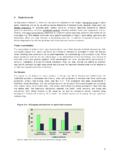
10 During the last three decades, involvement of fisheries in the global food production for domestic use has increased considerably. This progress has been achieved through the development of aquaculture. Beside this development, some issues have been raised regarding the global distribution, utilisation and trade of the fisheries resources as well as quality, safety and future sustainability. World fisheries production trends World fish production increased from 40 million tonnes in the early 1960s to nearly 142 million tonnes (t) in recent years (FAO 2006a). During the last decade, this increase is mostly from growing aquaculture production amounting to 48 million t along with the stable catch of capture fisheries, about 94 million t (Figure 1).