Transcription of PREFACE - navygirl.org
1 PREFACE . This study guide was developed to assist sailors in studying for the positions of both recruiter and Leading Petty Officer. I hope it is very useful to you. Please remember that although it was created using the current Cruitman that this information changes often, so it should be constantly checked for updates. Also, please keep in mind that this guide was created to assist you in obtaining these positions, however, it cannot obviously replace the training from an experienced mentor, nor was it created with the purpose of being the only source of information to be used during this process. The current version of the CRUITMAN and any supplements mentioned in the PQS should also be utilized. NOTES. MARKET SHARE. The Navy market population consists of individuals of recruitment ages 17-34 years of age. For ease of use, the Navy has three markets. They are: (1) Primary Market. 17-21 year olds.
2 The applicant is in high school or has dropped out of high school and is attending an accredited post-secondary school. (2) Work Force Market. 17-34 population not attending school. (3) Secondary Market. 22-34 year old population that is not in high school. SMART. STATION MARKET ANAYLSIS AND REVIEW TECHNIQUE. CONSISTS OF SIX PARTS: 1.) Territorial map 2.) DOD ASAD. 3.) Goal Recap 4.) School Folders 5.) SOARs 6.) DEP Status Board. STEAM. Standardized Territory Evaluation and Analysis for Marketing. Consists of five reports: 1.) Totals- Mkt totals 2.) Quality- Mental groups 3.) History- Contracts per zip code 4.) Population- Total types of demographics that are in an area. SALES. THE 6 SALES PHASES OF THE RECRUITING ROADMAP ARE. a. ENGAGE A PROSPECT. b. ASSESS THE POTENTIAL. c. CONNECT THE OPPORTUNITIES. d. REVEAL THE VALUE. e. WIN THE COMMITMENT. f. MENTOR THE FUTURE SAILOR/COLLEGIATE. 2. WHEN THE APPLICANT MAKES THE DECISION TO ADVANCE, THE STEPS ARE.
3 A. DISCOVERY. b. ALIGNMENT. c. POSITIONING. d. DISTINCTION. e. COLLABORATION. 3. IN PROSPECT ENGAGEMENT SKILLS, DISCOVERY IS IMPORTANT SO THAT YOU HAVE AN. a. UNDERSTANDING OFTHE PROSPECTS WANTS, NEEDS AND DECISION CRITERIA BY ASKING VALUE- FOCUSED QUESTIONS. 4. IN PROSPECT ENGAGEMENT SKILLS, ALIGNMENT'S IMPORTANT SO YOU CAN. a. BUILD AUTHENTIC RELATIONS BY CONNECTING THE NAVY'S OPPORTUNITIES WITH THE PROSPECTS. PRESSURES, PLANS AND PROBLEMS. 5. IN PROSPECT ENGAGEMENT SKILLS, POSITIONING IS SO IMPORTANT TO. a. CREATING A POSITIVE PERCEPTION OF THE NAVY'S OPPORTUNITIES BY HELPING THE PROSPECT. RECOGNIZE THE NAVY'S ADVANTAGES. 6. IN PROSPECT ENGAGEMENT SKILLS, DISTINCTION IS SO IMPORTANT IN. a. DEVELOPING A PROSPECT'S PREFERENCE FOR THE NAVY BY DISTINGUISING THE UNIQUENESS OF THE. NAVY'S VALUE FOR THEM. 7. IN PROSPECT ENGAGEMENT SKILLS, COLLABORATION'S IMPORTANT FOR. a. WORKING TOGETHER WITH YOUR PROSPECT THROUGHOUT THE RECRUITING PROCESS AND.
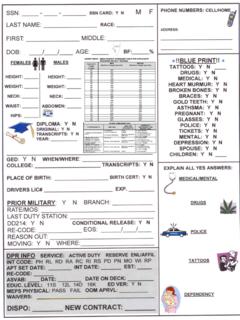
4 MENTORING THEM THOURGHOUT THE DEP. 8. THE 4 DIFFERENT TYPES OF DISCOVERY QUESTIONS ARE. a. OPEN-ENDED. b. CLOSED-ENDED. c. THOUGHT-PROVOKING. d. VALUE-FOCUSED. 9. THE 5 R'S OF HANDLING PROSPECT OBJECTIONS ARE. a. RECOGNIZE. b. RELATE. c. REALIZE. d. RESPOND. e. RE-INFORCE. 10. PROSPECT OBJECTIONS: a. APATHY - I DON'T CARE . b. DOUBT - I DON'T BELIEVE . c. CONFUSION - I DON'T UNDERSTAND . d. OBSTACLE - I DON'T LIKE . 11. THE NAVY'S UNIQUE VALUES: a. TRAINING. b. RESOURCES. c. EXPERIENCE. d. BENEFITS. e. RELATIONSHIPS. f. BRAND AND REPUTATION. 12. STANDS FOR. a. PURPOSE. b. OUTCOMES. c. INTELLIGENCE. d. NEEDS. e. TEAMS. f. STRATEGY. 13. DRAW A WHITEBOARD: 1. PROSPECT'S PRESSURES. 2. PROSPECT'S PLANS. 3. PROSPECT'S PROBLEMS. NAVY'S REFERENCES. 5. NAVY'S UNIQUE VALUE. 6. NAVY'S OPPORTUNITIES. 7. NAVY'S ADVANTAGES. RTOOLS. Rtools consists of eleven tabs on the applicant record, they are: -1 Screen -Additional -Sales -Remarks -Blueprint -Medical -Employment -Tests -Education -Prior Service -Feedback (LEADS).
5 There are also eight market segments: -None -School -Workforce -College -In Service -Inactive -Prior Service -Female Working ticklers: a.) Loaded on the last day of the current week, based upon the goaling letter. b.) Should have no more than 50 records on a single day. c.) Future Sailor records should be maintained in a working tickler through RTC graduation. LEADS: a.) Contacted within 24hrs b.) Disposition within 30 days to avoid overdue status. c.) Maintained in a working tickler for four months, or until a valid disposition occurs. ADDITIONAL RTOOLS NOTES: a.) Applicant records will be maintained for four years after high school graduation. b.) Blueprinting is done to reduce call reluctance. CIRIMS. Have six main groups on the main menu: a.) Home -Displays updates to applications -Logout -Change password. b.) Modules -Contact management and Kit tracking. - Reservations bought in this section under action.
6 C.)Utilities -Tools and Downloads. d.) Search -Contact, recruiter , Station, police and UIC. e.) Messages -Can send messages to other users. f.) Help - Access online help. ADDITIONAL CIRIMS NOTES: - CIRIMS is used for processing applicants as well as a lead tracking system. - Ensuring quick fill is filled out will allow auto fill of many of the documents. DELAYED ENTRY PROGRAM. 1.) Leading Petty Officer Responsibilities: a.) Ensure recruiters comply with instructions and local policies. b.) Schedule and coordinate DEP activities and functions. c.) Solicit Referrals d.) Ensure accuracy and maintenance of future sailor's residual folders. e.) Ensure 72hrs, IMC's 30 day preships, 7 day preships and 24 hr preships are conducted as required. 2.) recruiter Responsibilities: a.) Mentor and provide guidance to Future Sailors. b.) Conduct DEP in accordance with instructions and local polices. c.) Maintain at least 3 phone contacts, and two mentor sessions a month with all Future Sailors.
7 D.) Maintain accurate Rtools maintenance on all Future Sailors. e.) Respond promptly to Future Sailors Needs. f.) Notify LPO of any issues/ concerns with Future Sailors. g.) Solicit Referrals. 72 Hour Indoctrination a.) Purpose is to eliminate buyer's remorse. b.) Must be performed at Future Sailors house, with parents/ significant others present. c.) Leading Chief Petty Officer must give written permission for any 72hr indoc, held not at the Future Sailors home, prior to the event occurring. d.) Must be performed 72hrs after enlistment, (weekends count as days), unless a scheduling conflict with the parents, spouse or significant other prevents this. In this case, a 72 hour can be performed up to 5 days after enlistment. The following items should be covered during the 72hr Indoc: a.) Explain official titles and communication now that they are in the Navy. b.) Review Contract. c.) Explain reporting requirements and DEP meeting schedule.
8 A DEP schedule should be given to the Future Sailor at this time. d.) Reinforce the Navy's Zero tolerance policy. e.) Explain the FS is a representative of the USN in the community now. f.) Stay in school policy for 11S's. g.) Notification of FS status. h.) Referral Recognition Program. i.) Advanced Pay program. j.) DEP PQS. k.) Your commitment to helping your FS. Remember you must also have an Initial Mentoring Contact at least 7 days after the 72 hr with your FS; although the Recruiting Manuel states a minimum of seven days after enlistment, most commands want this done at the seventh day. Also please remember that the SAPR-D video and Page 13 must be initiated at the IMC and the appropriate entry made in RTOOLs. The SAPR-D Page 13 is then placed in Section I of the Future Sailors residual record that is maintained at the station. DEP MEETINGS. a.) Attendance should be 100%!!! However the CRUITMAN allows for a minimum of 80%.
9 Attendance to be passing. b.) Held at a minimum of one time per month. c.) FS must sign muster report and fill out a recertification. d.) Flex Deps can be utilized. e.) Encourage FS bring family and friends. f.) Recertifications must include BF% for any FS within 5lbs of max wt. Remember a FS must receive a boot camp letter from their recruiter that is sent no later than one week prior to shipping to RTC. A copy of this letter should be maintained in the FS's residual folder and also an entry made in Rtools for the FS. DEP RECERTS. a.) Must be filled out at a minimum for the following: b.) 30 days, 7 days, 72 hrs, IMC's, FS dep custody Turnovers and monthly mentoring contacts. c.) Drug Modules and NIDT's should be noted on the Recerts. Verification of will grad status is required upon enlistment, as well as mid-year. Also, DEP audits will be conducted whenever excessive losses occur in DEP. This normally includes around 13% out month attrition and 2% in month attrition.
10 DEP Custody Turnover a.) LPO must meet each FS face to face. b.) Letter must be sent to parents upon turnover. c.) Conducted within 30 days of LPO transfer of command. Spec Ops FS. a.) Must pass the PST prior to placement in any of these categories. b.) Must attend practice sessions with FS Spec ops coordinator every 45 days c.) Must pass 14 day PST. d.) Not successfully completing these items will render a FS ineligible for these programs. PQS. PQS has two phases: a.) Training b.) Signoff phase. ENLSITED recruiter PRODUCTION AND MANAGEMENT SYSTEM. (ERPMS). -Soon to be called RPMS as OPO and EPO combine. Consists of Planners, Applicant Log and PATE. Planners must be maintained for twelve months plus current month. PATES must be maintained for current plus twenty four months. Applicant Logs must be maintained for current plus twelve months. STATION PLANNER. Developed using recruiter 's planners. All previously scheduled and known activity (includes shippers).