Transcription of Preventing Medication Errors: A $21 Billion Opportunity
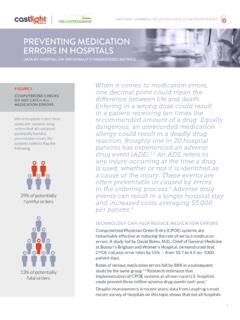
1 Targeting the $21 Billion spent annually on preventable Medication errors requires building on proven practices and implementing policy actions that target the root causes of the problem.$700 Billion Waste1$21 BTHE PROBLEMS cope of Medication Errors Each year in the , serious preventable Medication errors occur in million inpatient admis-sions and million outpatient ,3 The Institute of Medicine, in its report To Err Is Human, estimated 7,000 deaths in the each year are due to preventable Medication of Medication Errors Inpatient preventable Medication errors cost approximately $ Billion Outpatient preventable Medication errors cost approximately $ Billion ,7 Prescription Errors Dosing errors make up 37 percent of all preventable Medication drug allergies or harmful drug interactions account for 11 percent of preventable Medication Preventable Medication reconciliation errors occur in all phases of care.
2 22 percent during ad-missions, 66 percent during transitions in care and 12 percent during Approximately 100 undetected dispensing errors can occur each day as a result of the signifi-cant volume of medications of Care Only 13 percent of primary care physicians reported that they communicated with a pharmacist regarding new of Information Technology Infrastructure EMR systems that are described as fully functional and had a prescribing function were reported by only 4 percent of Electronic prescribing is used by only 32 percent of physicians in ambulatory care Care Coordination Proven Practice: Improved communication among physicians, pharmacists and nurses prevented 85 percent of serious Medication Proven Practice: Including a pharmacist on routine medical rounds led to a 78 percent reduc-tion in Medication Adding a pharmacist to a physician rounds team in an intensive care unit led to annual savings of $270, Medication errors represent a significant source of wasteful health care spend-ing.
3 The causes of Medication errors are complex and sys-temic, resulting from the frag-mented nature of the care de-livery system and the failure to effectively share and use health care on backPreventing Medication Errors: A $21 Billion Opportunity Reducing preventable Medication errors requires building on a coordinated set of proven practices in the field coupled with policy actions in the public and private sectors. Improve Care Coordination Facilitate Patient Engagement Require Pharmacist Follow-up Enhance Technology Interventions Increase Incentive Payments Update Accreditation/CertificationSOLUTIONSF acilitate Patient Engagement Proven Practice: Medication errors can be reduced through active engagement of patients and family caregivers with the care team, the use of patient safety checklists, and increased aware-ness of publicly reported hospital safety records.
4 Policy Action: Adopt Joint Commission recommendations for Medication reconciliation, ensur-ing that medications are reconfirmed and reviewed with the patient at each transition in ,19 Policy Action: Empower patients and family caregivers to manage their medications by keeping PHRs and personal Medication lists and informing them about the purpose, effects, and side ef-fects of their Pharmacist Follow-up Proven Practice: Patients who received pharmacist follow-up calls were 88 percent less likely to have a preventable Medication error resulting in an ED visit or Technology Interventions Proven Practice: e-Prescribing systems reduced Medication errors by 85 percent and generated net cost savings of $403,000 in ambulatory care ,23 Proven Practice: Verifying the correct drug dosage with Bar Code Electronic Medication Ad-ministration System (eMAR) technology led to a 51 percent reduction in Medication errors and annual savings of $ million in a large academic ,25 Proven Practice: Computerized Physician Order Entry (CPOE) with clinical support reduced serious Medication errors by 81 Incentive Payments Policy Action.
5 Assist health professionals and hospitals in adopting clinical IT tools (EHRs, e-prescribing, CPOE and eMAR), achieving meaningful use standards (drawn from HIT Policy Committee recommendations) and earning federal incentive payments. Policy Action: Provide private and state payer-based financial incentives to providers using evidence-based practices that reduce Medication errors and using EHRs that generate key patient Medication information (active Medication lists, Medication allergy lists). Policy Action: Encourage providers to participate in the CMS Electronic Prescribing (eRx) In-centive Accreditation/Certification Proven Practice: Certifying providers as trained and proficient in teamwork. Policy Action: Have specialty societies encourage providers to participate in the CMS Physician Quality Reporting Initiative (PQRI) for documenting current medications in the medical record.
6 Policy Action: Set standards and require public reporting of Medication errors as a condition for state PROBLEM1. NEHI. (2008). How Many More Studies Will It Take? A Collection of Evidence That Our Health Care System Can Do Better. Retrieved from Last accessed October Massachusetts Technology Collaborative and NEHI. (2008). Saving Lives, Saving Money: The Imperative for CPOE in Massachusetts. Retrieved from Last accessed on October 2011. 3. Center of Information Technology Leadership. (2007). The Value of Computerized Provider Order Entry in Ambulatory Settings. Retrieved from Last accessed October Institute of Medicine. (1999). To Err Is Human: Building a Safer Health System. Washington, DC: National Academy Press. 5. Massachusetts Technology Collaborative and NEHI.
7 Center of Information Technology Leadership. Burton, , Hope, C., Murray, , et al. (2007). The cost of adverse drug events in ambulatory care. AMIA Annu Symp Proc, 90-93. 8. Bobb, A., Gleason, K., Husch, M., et al. (2004). The epide-miology of prescribing errors. Arch Intern Med, 164(7), Bobb, Gleason, Husch, et al. Santell, (2006). Reconciliation failures lead to medi-cation errors. Jt Comm J Qual Patient Saf, 32(4), Cina, , Gandhi, , Churchill, W., et al. (2006). How many hospital pharmacy Medication dispensing errors go undetected? Jt Comm J Qual Patient Saf, 32(2), Ranelli, , Biss, J. (2000). Physicians perception of communication with and responsibilities of pharmacists. J Am Pharm Assoc, 40(5), Hsiao, , Burt, , Rechtsteiner, E.
8 , et al. (2008). Preliminary Estimates of Electronic Medical Records Use by Office-Based Physicians. Atlanta, GA: National Center for Health Statistics (NCHS). Retrieved from Last accessed October Grossman, (2006). Even When Physicians Adopt E-Prescribing, Use of Advanced Feature Lags. Washington, DC: Center for Studying Health System Change. Issue Brief No. 133. Retrieved from Last accessed October Fortescue, , Kaushal, R., Landrigan, , et al. (2003). Prioritizing strategies for Preventing Medication errors and adverse drug events in pediatric inpatients. Pediatrics, 111(4 Pt 1), 722 Kucukarslan, , Peters, M., Mlynarek, M., et al. (2003). Pharmacists on rounding teams reduce preventable adverse drug events in hospital general medicine units.
9 Arch Intern Med, 163(17), Leape, , Cullen, , Clapp, , et al. (1999). Phar-macist participation on physician rounds and adverse drug events in the intensive care unit. JAMA, 282(3), Joint Commission on Accreditation of Healthcare Orga-nizations. (2006). Using Medication reconciliation to prevent errors. Sentinel Event Alert, 35, National Priorities Partnership. (2008). National Priori-ties and Goals: Aligning Our Efforts to Transform America s Healthcare. Washington, DC: National Quality Forum. 20. Sabogal, F., Coots-Miyazaki, M., Lett, (2007). Ten effective care transitions interventions: improving patient safety and healthcare quality. CAHQ Journal, 31(2), 15-19. 21. Schnipper, , Kirwin, , Cotugno, , et al. (2006). Role of pharmacist counseling in Preventing adverse drug events after hospitalization.
10 Arch Intern Med, 166(5), Kaushal, R., Kern, , Barr n, Y., et al. (2010). Elec-tronic prescribing improves Medication safety in community-based office practices. J Gen Intern Med, 25(6), Weingart, , Simchowitz, B., Padolsky, H., et al. (2009). An empirical model to estimate the potential impact of Medication safety alerts on patient safety, health care uti-lization, and cost in ambulatory care. Arch Intern Med, 169(16), Poon, , Keohane, , Yoon, , et al. (2010). Effect of bar-code technology on the safety of Medication administration. N Engl J Med, 362(18), Maviglia, , Yoo, , Franz, C., et al. (2007). Cost-benefit analysis of a hospital pharmacy bar code solution. Arch Intern Med, 167(8), Bates, , Teich, , Lee, J., et al. (1999). The impact of computerized physician order entry on Medication error prevention.