Transcription of Primary vs Secondary Emotions
1 PTS PSYCHOLOGY Empowering People Through Insightful Psychology Results PTS PSYCHOLOGY (ABN: 4610 2374 667) Primary vs Secondary Emotions : The Distinction That Could Positively Change Your Life Forever! Sebastian Salicru Registered Psychologist Board-Approved Supervisor PTS Psychology, Canberra, ACT, Australia Do you often feel anxious or depressed? Or do you ruminate (continuously think about the same issues) or procrastinate? Or do you perhaps find yourself blaming others and/or complaining more that you would like to? If so, the chances are that you re unable to identify, get in touch with, understand, process, and express your Primary Emotions effectively. The distinction between Primary and Secondary Emotions is often elusive to most people. Yet, understanding and acting upon this distinction can be life changing. But first, let s look briefly at why understanding our Emotions is critical.
2 Sebastian Salicru PTS Psychology, Canberra 2 Three Main Reasons Why Emotions Are Important 1. Emotions convey information that signals what s important in our lives (our needs and wants), as they are linked to our biological states and nervous system. 2. They connect us to action by facilitating movement towards what we need or want. The term emotion derives from French motion, from mouvoir, excite based on Latin emovere, out and movere move . 3. They also provide meaning, continuity, and wholeness in our lives. Emotions play a critical role in the evolution of consciousness and functioning of all our mental processes. Hence, blocking, ignoring or misreading our Emotions preclude us from: experiencing optimal mental health and psychological well-being; making smart life choices; forming and enjoying intimate relationships, and living a fulfilling and meaningful life.
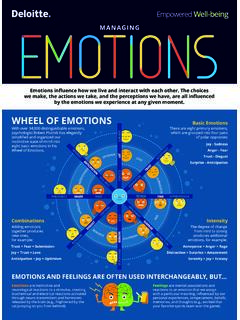
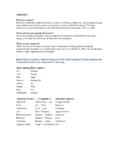
3 Primary Emotions Primary (or basic) Emotions are our most fundamental and direct initial reactions to an event or situation ( experiencing sadness following a loss, or fear when perceiving a threat). Primary Emotions are: Crucial for survival Functionally adaptive Innate and universal Distinct affective states Hardwired in our brains (don t require learning). Our key Primary Emotions are: fear; sadness; disgust; surprise; anger (although sometimes is Secondary ); contempt; and joy/happiness. Each Primary emotion has a distinct purpose and functionality, and can be either adaptive (healthy) or maladaptive (unhealthy), as depicted in the table below. More later on how Primary Emotions can be expressed adaptively or maladaptively. Sebastian Salicru PTS Psychology, Canberra 3 Secondary Emotions Secondary (or complex) Emotions are emotional responses that follow the Primary Emotions , unless these are processed effectively in the first instance.
4 They are defensive or inhibitory Emotions ( feeling guilty when angry and then turning the anger inwardly). Secondary Emotions are not necessarily recognised or expressed universally across cultures. Hence, they are socially constructed. They constitute the learned response from our family of origin and culture (socialisation process) on how to feel and react about our Primary Emotions . Common examples You may feel anxious (and likely depressed over time) when you experience anger ( Primary emotion). This could be because when you became angry as a child, you were punished. Alternatively, you were told either that anger is bad or dangerous , or that you need to control your anger . So, when you become angry now, you experience fear ( Primary emotion) about either being punished or that something bad will happen if you acknowledge and express your anger. You may feel shameful, angry, anxious, overwhelmed, numb or shut down when you experience sadness ( Primary emotion).
5 Likely this is because you re unable to cry or express your sadness, because as a child you were told either that crying is a weakness or, if you are a man, that real men don t cry . So, either you internalised this message as an implicit core belief/assumption (you are unaware of it), or you hold this message as an explicitly strong belief and way of being. Either way, it s very likely that since the time you absorbed this message, you have not allowed yourself to cry or become vulnerable a state in which the self possibly feels fragile, deeply ashamed or insecure. Yet, vulnerability is a universal aspect of the human condition (common humanity), and essential to achieve healing and develop intimacy in relationships. Anxiety, depression, passive aggression and/or resentment, for instance, are complex emotional states that can result from shrinking oneself, due to having learnt to be a people pleaser. This entails a deep fear of abandonment, rejection, disapproval and of disappointing others.
6 So, people pleasers do what it takes to make others happy, in order to avoid feeling rejected or disapproved of. Four Types of Emotional Responses Not all emotional responses are the same. Some are adaptive or constructive (healthy, useful or helpful). Others are maladaptive or destructive (unhealthy, not useful or unhelpful). Let s use anger as an example. 1. Primary Adaptive Responses Primary adaptive responses are natural, biological and evolutionary emotional responses. Adaptive, assertive or constructive anger, for example, used to set boundaries in response to violations, such as being humiliated, physically abused or injured, are examples of adaptive emotional responses. This entails acting in ways to help you protect yourself to maintain boundaries when your rights or boundaries have been threatened or violated ( you have been attacked, disrespected or your property has been damaged). Such types of responses indicate an assertive sense of self that demands respect and will not tolerate abuse.
7 They are the most direct and useful responses to a situation, and best way to shape an adaptive action. When we act this way, we don t get stuck ( ruminating, blaming or engaging in passive aggressive behaviours Secondary and unhealthy responses). Hence, they are useful, healthy and constructive emotional responses. Sebastian Salicru PTS Psychology, Canberra 4 2. Primary Maladaptive Responses These are, for example, destructive or damaging types of anger responses ( road rage, overreactive, harmful or damaging aggression). This type of anger tends to be rooted in the past (unfinished business or exposure to unconstructive role models). They are the product of a history of previous experiences or events, don t help us to cope, and they aren t useful because they keep us stuck, as they no longer fit our current situation.
8 3. Secondary Maladaptive Responses These relate to the experience and expression of Secondary or more complex Emotions , as outlined above ( responses to Primary Emotions ). For example, if someone puts you down or insults your pride, your Primary emotion is likely to be shame. Then, you may attack or retaliate ( Secondary reactive anger). Secondary Emotions , therefore, are reactive Emotions . They mask or cover up our Primary Emotions , and require exploration to transform them into more adaptive Emotions . 4. Instrumental Responses These are deliberate angry responses displayed to intentionally scare or intimidate others ( bullying). While such behaviour is generally manipulative and destructive, other types of instrumental aggressive responses can be useful as protective, deterrent or even lifesaving measures. For example, yielding to certain wild animals ( mountain lion) to avoid being attacked, or hitting a shark on the nose to avoid being hurt.
9 Six common maladaptive behaviours as responses to avoid Primary Emotions Rumination and procrastination are two maladaptive behaviours for ways to deal with fear of failure or even success ( fear is the Primary emotion avoided). Sebastian Salicru PTS Psychology, Canberra 5 1. Rumination the process of continuously thinking about the same thoughts, which tend to be sad or dark is a common way to avoid painful Emotions . However, it not mentally healthy, as it can prolong or intensify depression as well as impair your ability to think and process Emotions . 2. Procrastination, for example, is very common among people with perfectionistic tendencies. Think about it the best way of avoiding failure is not even trying to do or accomplish something in the first place. 3. Self-monitoring relates to over-regulating your behaviour to accommodate social situations by protecting yourself from social disapproval.
10 4. Blaming others, along passive aggression, is another maladaptive behaviour. It is a way to avoid being assertive, or to avoid criticism, receive negative feedback, fear of making mistakes, or fear of being humiliated or feeling rejected ( fear , again is the Primary emotion avoided). 5. Chronic complaining is another maladaptive behaviour people use to deal with the fear associated with accepting the reality of a situation, and taking responsibility for subsequent action. 6. Passive aggression is the pattern of indirectly expressing negative feelings instead of openly addressing them. Passive-aggressive individuals might appear to agree perhaps even enthusiastically with someone else s request. However, rather than complying with the request, the passive aggressive person might express anger or resentment by failing to follow through or missing deadlines. Specific signs of passive-aggressive behavior include: Blaming others Acting stubborn Acting hostile or cynical Being disagreeable or irritable Procrastinating or being forgetful Frequently criticising or protesting Being cynical, sullen or hostile attitude Complaining about being unappreciated Performing tasks inefficiently or making mistakes Resentment and opposition to the demands of others Displaying a cynical, pessimistic, or aggressive demeanour Frequently complaining about feeling underappreciated or cheated Procrastinating and intentionally making mistakes in response to others demands Displaying resistance, bitterness, or resentment toward the requests or demands from others Emotional Awareness Emotional awareness entails being aware of our Primary Emotions .