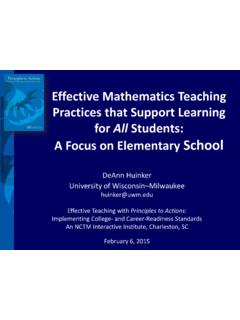
Transcription of Principles to Actions: Ensuring Mathematical Success
1 Principles to Actions: Ensuring Mathematical Successfor AllA 25-year History of Standards-Based Mathematics Education Reform2006 Curriculum Focal Points2010 Focus in High School Mathematics1989 Curriculum and Evaluation Standards for School Mathematics2000 Principles and Standards for School Mathematics2010 Common Core State Standards for MathematicsStandards Have Contributed to Higher Achievement The percent of 4thgraders scoring proficient or above on NAEP rose from 13% in 1990 to 42% in 2013. The percent of 8thgraders scoring proficient or above on NAEP rose from 15% in 1990 to 36% in 2013. Between 1990 and 2012, the mean SAT-Math score increased from 501 to 514 and the mean ACT-Math score increased from to in Grade 4 NAEP Mathematics ScoresNational Center for Education Statistics. (2013). The Nation s Report Card: A First Look: 2013 Mathematics and Reading(NCES 2014-451).
2 Institute of Education Sciences, Department of Education, Washington, We Have Made Progress, Challenges Remain The average mathematics NAEP score for 17-year-olds has been essentially flat since 1973. Among 34 countries participating in the 2012 Programme for International Student Assessment (PISA) of 15-year-olds, the ranked 26thin mathematics. While many countries have increased their mean scores on the PISA assessments between 2003 and 2012, the mean score declined. Significant learning differentials in Grade 4 Mathematics By Race/EthnicityNational Center for Education Statistics. (2013). The Nation s Report Card: A First Look: 2013 Mathematics and Reading(NCES 2014-451). Institute of Education Sciences, Department of Education, Washington, Standards are Necessary for Effective Teaching and Learning,But InsufficientThe Common Core does not describe or prescribe the essential conditions required to make sure mathematics works for all to Actions: Ensuring Mathematical Success for AllThe primary purpose of Principles to Actions is to fill the gap between the adoption of rigorous standards and the enactment of practices, policies, programs, and actions required for successful implementation of those (2014).
3 Principles to Actions: Ensuring Mathematical Success for , VA: to Actions: Ensuring Mathematical Success for AllThe overarching message is that effective teaching is the non-negotiable core necessary to ensure that all students learn mathematics. The six guiding Principles constitute the foundation of PtA that describe high-quality mathematics (2014). Principles to Actions: Ensuring Mathematical Success for , VA: Principles for School and and and Elementsof Effective MathematicsProgramsFor Each Principle Productive and Unproductive Beliefs are Listed Obstacles to Implementing the Principle are Outlined Overcoming the Obstacles Taking ActionoLeaders and PolicymakersoPrinciples, Coaches, Specialists, Other School LeadersoTeachersTeaching and Learning PrincipleTeaching and LearningAn excellent mathematics program requires effective teaching that engages students in meaningful learning through individual and collaborative experiences that promote their ability to make sense of Mathematical ideas and reason to Implementing High-Leverage Instructional PracticesDominant cultural beliefs about the teaching and learning of mathematics continue to be obstacles to consistent implementation of effective teaching and learning in mathematics About Teaching and Learning MathematicsEight High-Leverage Instructional Practices Establish mathematics goals to focus learning Implement tasks that promote reasoning and problem solving Use and connect Mathematical representations Facilitate meaningful Mathematical discourse Pose purposeful questions Build procedural fluency from
4 Conceptual understanding Support productive struggle in learning mathematics Elicit and use evidence of student thinkingEight Research-InformedInstructional PracticesEstablish mathematics goals to focus learning. Effective teaching of mathematics establishes clear goals for the mathematics that students are learning, situates goals within learning progressions, and uses goals to guide instructional High-Leverage Instructional PracticesImplement tasks that promote reasoning and problem solving. Effective teaching of mathematics engages students in solving and discussing tasks that promote Mathematical reasoning and problem solving and that allow for multiple entry points and varied solution Research-Informed Instructional PracticesUse and connect Mathematical representations. Effective teaching of mathematics engages students in making connections among Mathematical representations to deepen understanding of mathematics concepts and procedures and as tools for problem High-Leverage Instructional PracticesFacilitate meaningful Mathematical discourse.
5 Effective teaching of mathematics facilitates discourse among students in order to build shared understanding of Mathematical ideas by analyzing and comparing student approaches and arguments. Eight Research-Informed Instructional PracticesPose purposeful questions. Effective teaching of mathematics uses purposeful questions to assess and advance student reasoning and sense making about important Mathematical ideas and Research-Informed Instructional PracticesBuild procedural fluency from conceptual understanding. Effective teaching of mathematics builds fluency with procedures on a foundation of conceptual understanding so that students, over time, become skillful in using procedures flexibly as they solve contextual and Mathematical High-Leverage Instructional PracticesSupport Productive Struggle in Learning Mathematics. Effective teaching of mathematics consistently provides students, individually and collectively, with opportunities and supports to engage in productive struggle as they grapple with Mathematical ideas and Research-Informed Instructional PracticesElicit and use evidence of student thinking.
6 Effective teaching of mathematics uses evidence of student thinking to assess progress toward Mathematical understanding and to adjust instruction continually in ways that support and extend Essential Elements of Effective Mathematics ProgramsEffective teaching and learning, while the non-negotiable core of successful mathematics programs, are part of a system of essential elements of excellent mathematics Essential Elements of Effective Mathematics ProgramsAccess and EquityCurriculumTools and TechnologyAssessmentProfessionalismGuidi ng Principles for School Mathematics: CurriculumCurriculumAn excellent mathematics program includes curriculum that develops important mathematics along coherent learning progressions and develops connections among areas of Mathematical study and between mathematics and the real ObstacleGrade level mathematics curriculum standards are often treated as a checklist of topics.
7 When conceptualized as such, mathematics content becomes nothing more than a set of isolated skills, often without a Mathematical or real-world context and disconnected from related Principlesfor School Mathematics: AssessmentAssessmentAn excellent mathematics program ensures that assessment is an integral part of instruction .. and informs feedback to students, instructional decisions, and program ObstacleTraditionally assessment tends to emphasize the evaluation of student achievement ( , assigning grades), and more recently, the rating of schools and the performance of teachers the cultural perception that links assessment to grading and rating ..Teacher Action Steps to Support the Assessment PrincipleWork in collaborative teams, grade level or subject-based, to develop common assessments that will be used formatively, commit to their use, and use the results to advance student learning and improve Principles for School Mathematics: Access and EquityAccess and EquityAn excellent mathematics program requires that all students have access to high-quality mathematics curriculum, effective teaching and learning, high expectations, and the support and resources needed to maximize their learning Principles for School Mathematics.
8 Tools and TechnologyTools and TechnologyAn excellent mathematics program integrates the use of Mathematical tools and technology as essential resources to help students learn and make sense of Mathematical ideas, reason mathematically, and communicate their Mathematical to Tools and TechnologyOften students do not actually engage with technologies or tools in ways that promote Mathematical reasoning and sense making. Having students watch a computer presentation or tutorial in which Mathematical facts and examples appear, no matter how visually engaging, is not significantly different from having students watch a teacher write the same information on a white Principles for School Mathematics: ProfessionalismProfessionalismIn an excellent mathematics program, educators hold themselves and their colleagues accountable for the Mathematical Success of every student and for their personal and collective professional growth toward effective teaching and learning of ObstacleIn too many schools, professional isolation severely undermines attempts to significantly increase professional collaboration.
9 Some teachers actually embrace the norms of isolation and autonomy. A danger in isolation is that it can lead to teachers developing inconsistencies in their practice that in turn can create inequities in student Should Include An examination and prioritization of the mathematics content and mathematics practices students are to learn. The development and use of common assessments to determine if students have learned the agreed-on content and related Mathematical practices. The use of data to drive continuous reflection and instructional Should Include The setting of both long-term and short-term instructional goals. Development of action plans to implement when students demonstrate they have or have not attained the standards. Discussion, selection, and implementation of common research-informed instructional strategies and Small, Build Momentum,and PersevereThe process of creating a new cultural norm characterized by professional collaboration, openness of practice, and continual learning and improvement can begin with a single team of grade-level or subject-based mathematics teachers making the commitment to collaborate on a single lesson Title Is Principles to ActionsThe Title is Principles to ActionsGuiding Principles for School Mathematics1.
10 Teaching and Learning2. Access and Equity3. Curriculum4. Tools and Technology5. Assessment6. ProfessionalismPrinciples to Actions: Ensuring Mathematical Success for AllThe primary purpose of Principles to Actions is to fill the gap between the adoption of rigorous standards and the enactment of practices, policies, programs, and actions required for successful implementation of those (2014). Principles to Actions: Ensuring Mathematical Success for , VA: to Actions: Ensuring Mathematical Success for All Describes the supportive conditions, structures, and policiesrequired to giveall students the power of mathematics Focuses on teaching and learning Engages students in Mathematical thinking How to ensure that mathematics achievement is maximized for every student Not specific to any standards; it s universalAlternate templat