Transcription of Process categories [PROC] - gts-ev.de
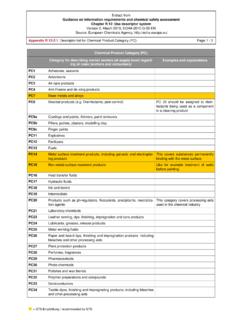
1 Extract from Guidance on information requirements and chemical safety assessment Chapter : Use descriptor system Version 2, March 2010, ECHA-2010-G-05-EN Source: European Chemicals Agency, Appendix : Descriptor-list for Process categories (PROC) Page 1 / 3 = GTS-Empfehlung / recommended by GTS Process categories [PROC] Process categories Examples and explanations PROC1 Use in closed Process , no likelihood of exposure Use of the substances in high integrity contained systemwhere little potential exists for exposures, any sampling via closed loop systems PROC2 Use in closed, continuous Process with occasional controlled exposure Continuous Process but where the design philosophy is not spe-cifically aimed at minimizing emissions It is not high integrity and occasional expose will arise through maintenance, sampling and equipment breakages PROC3 Use in closed batch Process (synthesis or formulation)
2 Batch manufacture of a chemical or formulation where the pre-dominant handling is in a contained manner, through en-closed transfers, but where some opportunity for contact with chemicals occurs, through sampling PROC4 Use in batch and other Process (synthe-sis) where opportunity for exposure arises Use in batch manufacture of a chemical where significant oppor-tunity for exposure arises, during charging, sampling or dis-charge of material, and when the nature of the design is likely to result in exposure PROC5 Mixing or blending in batch processes for formulation of preparations* and articles (multistage and/or significant contact) Manufacture or formulation of chemical products or articles using technologies related to mixing and blending of solid or liquid ma-terials, and where the Process is in stages and provides the op-portunity for significant contact at any stage PROC6 Calendering operations Processing of product matrix Calendering at elevated temperature an large exposed surface PROC7 Industrial spraying Air dispersive techniques Spraying for surface coating, adhesives, polishes/cleaners, air care products, sandblasting Substances can be inhaled as aerosols.
3 The energy of the aero-sol particles may require advanced exposure controls; in case of coating, overspray may lead to waste water and waste. PROC8a Transfer of substance or preparation (charging/discharging) from/to ves-sels/large containers at non-dedicated facilities Sampling, loading, filling, transfer, dumping, bagging in non- dedicated facilities. Exposure related to dust, vapour, aerosols or spillage, and cleaning of equipment to be expected. PROC8b Transfer of substance or preparation (charging/discharging) from/to ves-sels/large containers at dedicated facili-ties Sampling, loading, filling, transfer, dumping, bagging in dedicated facilities. Exposure related to dust, vapour, aerosols or spillage, and cleaning of equipment to be expected. PROC9 Transfer of substance or preparation into small containers (dedicated filling line, including weighing) Filling lines specifically designed to both capture vapour and aerosol emissions and minimise spillage PROC10 Roller application or brushing Low energy spreading of coatings Including cleaning of surfaces.
4 Substance can be inhaled as vapours, skin contact can occur through droplets, splashes, work-ing with wipes and handling of treated surfaces. PROC11 Non industrial spraying Air dispersive techniques Spraying for surface coating, adhesives, polishes/cleaners, air care products, sandblasting Substances can be inhaled as aerosols. The energy of the aero-sol particles may require advanced exposure controls. PROC12 Use of blowing agents in manufactureof foam Appendix : Descriptor-list for Process categories (PROC) Page 2 / 3 = GTS-Empfehlung / recommended by GTS PROC13 Treatment of articles by dipping andpour-ing Immersion operations Treatment of articles by dipping, pouring, immersing, soaking, washing out or washing in substances; including cold formation or resin type matrix. Includes handling of treated objects ( after dying, plating,).
5 Substance is applied to a surface by low energy techniques such as dipping the article into a bath or pouring a preparation onto a surface. PROC14 Production of preparations* or articles by tabletting, compression, extrusion, pel-letisation Processing of preparations and/or substances (liquid and solid) into preparations or articles. Substances in the chemical matrix may be exposed to elevated mechanical and/or thermal energy conditions. Exposure is predominantly related to volatiles and/or generated fumes, dust may be formed as well. PROC15 Use as laboratory reagent Use of substances at small scale laboratory (< 1 l or 1 kg present at workplace). Larger laboratories and R+D installations should be treated as industrial processes. PROC16 Using material as fuel sources, limited exposure to unburned product to be expected Covers the use of material as fuel sources (including additives) where limited exposure to the product in its unburned form is expected.
6 Does not cover exposure as a consequence of spillage or combustion. PROC17 Lubrication at high energy conditions and in partly open Process Lubrication at high energy conditions (temperature, friction) be-tween moving parts and substance; significant part of Process is open to workers. The metal working fluid may form aerosols or fumes due to rap-idly moving metal parts. PROC18 Greasing at high energy conditions Use as lubricant where significant energy or temperature is ap-plied between the substance and the moving parts PROC19 Hand-mixing with intimate contact and only PPE available Addresses occupations where intimate and intentional contact with substances occurs without any specific exposure controls other than PPE. PROC20 Heat and pressure transfer fluids in dis-persive, professional use but closed systems Motor and engine oils, brake fluids Also in these applications, the lubricant may be exposed to high energy conditions and chemical reactions may take place during use.
7 Exhausted fluids need to be disposed of as waste. Repair and maintenance may lead to skin contact. PROC21 Low energy manipulation of substances bound in materials and/or articles Manual cutting, cold rolling or assembly/disassembly of mate-rial/article (including metals in massive form), possibly resulting in the release of fibres, metal fumes or dust PROC22 Potentially closed processing operations with minerals/metals at elevated tem-perature Industrial setting Activities at smelters, furnaces, refineries, coke ovens. Exposure related to dust and fumes to be expected. Emission from direct cooling may be relevant. PROC23 Open processing and transfer operations with minerals/metals at elevated tem-perature Sand and die casting, tapping and casting melted solids, drossing of melted solids, hot dip galvanising, raking of melted solids in paving Exposure related to dust and fumes to be expected PROC24 High (mechanical) energy workup of substances bound in materials and/or articles Substantial thermal or kinetic energy applied to substance (includ-ing metals in massive form) by hot rolling/forming, grinding, me-chanical cutting, drilling or sanding.
8 Exposure is predominantly expected to be to dust. Dust or aerosol emission as result of direct cooling may be expected. PROC25 Other hot work operations with metals Welding, soldering, gouging, brazing, flame cutting Exposure is predominantly expected to fumes and gases. PROC26 Handling of solid inorganic substances at ambient temperature Transfer and handling of ores, concentrates, raw metal oxides and scrap; packaging, un-packaging, mixing/blending and weigh-ing of metal powders or other minerals23 Appendix : Descriptor-list for Process categories (PROC) Page 1 / 2 = GTS-Empfehlung / recommended by GTS PROC27a Production of metal powders (hot proc-esses) Production of metal powders by hot metallurgical processes (at-omisation, dry dispersion)24 PROC27b Production of metal powders (wet proc-esses) Production of metal powders by wet metallurgical processes (electrolysis, wet dispersion)25