Transcription of Process Safety Metrics - AIChE
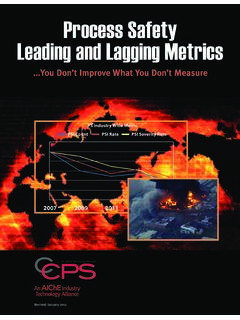
1 Process Safety Metrics Guide for Selecting Leading and Lagging Indicators 2018 PSE CountPSE RatePSE Severity Rate20132014201520162017 Version Process Safety Metrics : Guide for Selecting Leading and Lagging Metrics Page 2 of 63 Table of Contents Acronyms Preface 1 introduction 2 Process Safety Indicator Overview Process Safety Incident Designation Process Safety Indicator Criteria Process Involvement Reporting Thresholds Location Acute Release Process Safety Incident Flowchart Exclusions 3 Tier 1 - Process Safety Event Indicators Tier 1 Indicator Purpose Tier 1 Process Safety Event Thresholds Tier 1 Process Safety Event Severity Levels 4 Tier 2 - Process Safety Event Indicators Tier 2 Indicator Purpose Tier 2 Process Safety Event Thresholds 5 Reporting Process Safety Event Tier 1 and Tier 2 Metrics Rate Adjusted Metrics Industry Process Safety Metrics
2 PSE Metrics Interpretations and Examples 6 Tier 3 - Near Miss Incident Indicators Tier 3 Indicator Purpose Definition of a Process Safety Near Miss Examples of Process Safety Near Miss Incidents Challenges to Protection Layers Process Deviations or Excursions Management System Near Miss Incidents Maximizing the Value of Near Miss Reporting Process Safety Metrics : Guide for Selecting Leading and Lagging Metrics Page 3 of 63 7 Tier 4 - Operating Discipline and Management System Performance Indicators Tier 4 Indicator Purpose Incident Causation Models Reducing Process Safety Risks Defining Operational Discipline The Impact of Operational Discipline on Risk The Protection Layer Approach The Risk Based Process Safety Approach Examples from the "Commit to Process Safety " Pillar Examples from the Understand Hazards and Risk Pillar Examples from the "Manage Risk" Pillar Examples from the "Learn from Experience" Pillar Human Factors Examples from Process Safety System Audits Examples from Fatigue Risk Management 8 References Appendix A Glossary and
3 Definitions B Detailed Examples of PSE Indicators Process Safety Metrics : Guide for Selecting Leading and Lagging Metrics Page 4 of 63 Acronyms AIChE American Institute of Chemical Engineers ANSI American National Standards Institute API American Petroleum Institute CCPS Center for Chemical Process Safety COO Conduct of Operations DGL Dangerous Goods List DOT Department of Transportation EHS Environmental, Health, and Safety ITPM Inspection, Testing, and Preventive Maintenance Program LOPC Loss of Primary Containment MOC Management of Change OD Operational Discipline PRD Pressure Relief Device PSE Process Safety Event PSE1 Tier 1 Process Safety Event PSE2 Tier 2 Process Safety Event PSE1R Process Safety Event Rate Tier 1 Indicator PSE1SR Process Safety Event Severity Rate Tier 1 Indicator PSE2R Process Safety Event Rate Tier 2 Indicator PSI Process Safety Incident PSIE Process Safety Incident Evaluation tool RBPS Risk Based Process Safety SIS Safety Instrumented System TIH Toxic Inhalation Hazard TQ Threshold Quantity United States UNDG United Nations Dangerous Goods Process Safety Metrics .
4 Guide for Selecting Leading and Lagging Metrics Page 5 of 63 Preface The Center for Chemical Process Safety (CCPS) was established in 1985 by the American Institute of Chemical Engineers ( AIChE ) for the express purpose of assisting industry in preventing or mitigating Process incidents and in helping effectively manage Process Safety risks. More than 200 corporate members around the world drive the activities of CCPS today. In 2006, the CCPS Technical Steering Committee authorized the creation of a project committee to develop a guide for the development and use of leading and lagging Process Safety Metrics . That committee identified that a key breakthrough opportunity for industry was the development of industry leading and lagging Metrics that could be used to benchmark Process Safety performance measurements across the chemical and petroleum industry.
5 To achieve this objective, representatives and members from major chemical and petroleum trade associations as well as other key global stakeholders were engaged. The outcome of the 2006 CCPS effort was published in December 2007. Many companies and organizations used the definitions established in 2007. These definitions formed the basis and creation of a new ANSI/API recommended practice, API RP 754: Process Safety Performance Indicators for the Refining and Petrochemical Industries. This recommended practice was finalized and released in April 2010. CCPS and several members of the original CCPS Metric committee were involved in the API standard committee that developed API RP 754. In 2011, following the release of API RP 754, the CCPS updated its 2007 guide to align the CCPS guide with API RP 754.
6 The intent was to ensure that a company or organization could use either the CCPS or API documents for the top tier Process Safety event definitions and thus consistently classify incidents. In April 2016, API released the second edition of API RP 754 that included clarification of previous definitions, addition of new definitions, incorporation of optional severity weighting guidance, and revising the Tier 1 and Tier 2 thresholds [1]. Since the ultimate goal of the 2006 CCPS project was to develop and promote the use of common Metrics across the industry and around the world, CCPS is once again updating this guide to align with API RP 754 so as to continue its support of common industry performance Metrics .
7 Acknowledging that performance Metrics continue to evolve, CCPS has created an evergreen webpage resource for Process Safety Metrics and many other reports. The CCPS webpage contains various links to resources, research, announcements, and other publications and will continuously refresh to provide current information and resources for Process Safety performance Metrics . For additional information, please consult the CCPS Metrics webpage at: CCPS Metrics . Process Safety Metrics : Guide for Selecting Leading and Lagging Metrics Page 6 of 63 1 introduction CCPS member companies share the vision of industry-wide Process Safety Metrics , including a common set of definitions and threshold levels that will serve individual companies and industry as a whole by providing a mechanism to: indicate changes in company or industry performance, to be used to drive continuous improvement in performance perform company-to-company or industry segment-to-segment benchmarking, and serve as a leading indicator of potential Process Safety issues which could result in undesirable events.
8 This response was, in part, due to the BP Refineries Independent Safety Review Panel ( Baker Panel ) and Chemical Safety Board each recommended for improved industry-wide Process Safety Metrics in their final reports dealing with the 2005 explosion at the BP Texas City refinery [2, 3]. Process Safety Metrics have been separated in to different levels, as described in this report, with each level measured using indicators which can be monitored and evaluated. Hence, a company s Process Safety performance can be improved with changes implemented from their Process Safety Metrics evaluations. As noted, an essential element of any continuous improvement program is the measurement and trending of performance data.
9 Therefore, to continuously improve upon Process Safety performance, it is essential that companies in the chemical and petroleum industries implement effective leading and lagging Process Safety indicators. The characteristics of these Metrics are as follows [1]: Reliable: They are measurable using an objective or unbiased scale. To be measurable, an indicator needs to be specific and discrete. Repeatable: Similar conditions will produce similar results and different trained personnel measuring the same event or data point will obtain the same result. Consistent: The units and definitions are consistent across the company. This is particularly important when indicators from one area of the company are compared with those of another.
10 Independent of Outside Influences: The indicator leads to correct conclusions and is independent of pressure to achieve a specific outcome. Relevant: The indicator is relevant to the operating discipline or management system being measured; they have a purpose and lead to actionable response when outside the desired range. Comparable: The indicator is comparable with other similar indicators. Comparability may be over time, across a company, or across an industry. Process Safety Metrics : Guide for Selecting Leading and Lagging Metrics Page 7 of 63 This guide describes the recommendations compiled by the CCPS Process Safety Metric committee for a common set of company and industry leading and lagging Metrics . Please refer to additional CCPS guidance which has been published on selecting and managing Process Safety Metrics [4, 5].