Transcription of PRODUCING CLEAN FUEL GAS ON-SITE,
1 1 Reduce Emissions for Compressor Stations in Condensate-rich Shale Gas Plays by Reducing heavy Hydrocarbons in fuel Gas Authors: Sachin Joshi and Kaaeid Lokhandwala, Membrane Technology and Research, Inc. 1360 Willow Road, Menlo Park, CA 94025, Tel: (650) 543-3357 ABSTRACT In many shale-gas plays, especially wet- and/or condensate-rich shale gas plays, only raw and heavy shale gas is available as fuel for compressor drives and power generation turbines. As a result of the considerable richness (High Btu Value) of the raw gas in such shale-gas plays, operators are finding it increasingly challenging to meet the regulatory requirements on the emissions levels for the local compressor stations apart from having to run their engines running on substantial de-rates especially for the larger HP range machines.
2 In addition, heavy hydrocarbons rich gas can damage or foul engine components, causing mechanical reliability issues & reduced compressor/engine efficiencies, even leading to engine or turbine shutdown. The immediate impact of this is loss of gas and oil production until the components are replaced or fixed. This paper describes the use of unique reverse-selective membranes which preferentially removes heavy hydrocarbons components from the raw shale-gas to produce CLEAN fuel gas at these sites. Numerous fuel gas conditioning units have been installed in several shale-gas plays across the country by companies like EQT Midstream (Marcellus and Devonian), Peregrine Pipeline (Barnett Shale) and in the Eagle Ford shale area for reducing the heavy & sour contents from the fuel gas & subsequently also meet the emissions requirement on the VOC levels.
3 These systems have no moving parts, are designed for simple, unattended operation and are virtually maintenance-free. By effectively reducing the heavy hydrocarbons content, Membrane fuel Gas Conditioning Units reduces the volume of unburned VOC s emissions caused due to incomplete combustion of hydrocarbons in the firing chamber. These units have been used to fix derate and high maintenance problems due to poor fuel gas quality for Wartsila, Caterpillar, Waukesha, Superior and other reciprocating engine makers and also for turbine fuel gas conditioning.
4 Skids have been used to produce from to 110 million scfd (MMscfd) of CLEAN gas. Membrane fuel Gas Conditioning Units are completely passive and the feed gas requires no pretreatment, except for standard filtration. Practical cases of how these units have helped in resolving issues with problematic fuel gas will be discussed in the paper. 2 INTRODUCTION Raw unprocessed natural gas is widely used to power field turbines and engines that drive compressors or generate power. Compressor engine exhausts are a major source of a variety of strictly regulated emissions including NOx, CO, unburned non-methane hydrocarbons etc.
5 Operators have to meet several stringent emissions requirements to remain within the thresholds of allowable emissions limits of the above mentioned components. The situation is highly aggravated when the raw fuel gas is rich in heavy hydrocarbons. High levels of heavy hydrocarbons content in the fuel gas are responsible for incomplete combustion and/or pre-detonation in the gas engines which lead to increased CO and unburned non-methane hydrocarbons emissions (NMHC) beyond the acceptable limits1. NOx emissions are also affected by high levels of heavy hydrocarbons due to the richer BTU content of the fuel gas.
6 Oftentimes the raw gas composition does not meet the minimum requirements of engine or turbine suppliers. An excess of ethane, propane and C4+ hydrocarbons results in too low a methane number for gas engines, or too high a Wobbe Index for turbines. Specifically, high levels of heavy hydrocarbon components lead to pre-detonation in reciprocating gas engines. This requires derating of the engines so that they can run smoothly. In turbines, coking on the nozzles and in the combustion chamber leads to reduced efficiencies due to fouling or damage to the blades. In both gas engines and turbines, increased emissions of unburned VOCs will result if the inlet gas is too rich.
7 Presence of high levels of sulfur, especially H2S, in the fuel gas directly impacts the SOx emissions. Sour fuel gas containing sizeable proportion of H2S will lead to proportionately higher levels of SOx emissions. Apart from high SOx emissions levels, an excess of acid gases, specifically carbon dioxide or hydrogen sulfide, can corrode engine and turbine components, increasing maintenance needs and resulting in unscheduled downtime. The amount of gas used by field engines is usually in the to MMscfd range too small to make treatment of the gas by conventional amine-based technology economical.
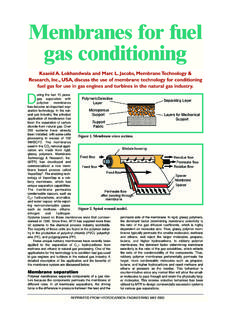
8 As a consequence, many engine users are forced either to live with the problem gas and the resulting low reliability and high maintenance costs, or to install costly-to-operate chemical scavenging systems. The above-described problems can be ameliorated by processing the gas using a special type of membrane that is more permeable to heavy hydrocarbons and acid gases than to methane. Early work in this area was performed at Phillips Petroleum almost thirty years Over the last few years, one company, Membrane Technology and Research, Inc. (MTR), of Menlo Park, CA, has developed commercial systems and processes incorporating specialized membrane technology to treat heavy or sour fuel gas streams3.
9 The process, known as FuelSep , is in use at a number of sites and for a variety of upstream fuel gas streams. To date, these membranes have been installed at more than sixty sites for heavy hydrocarbons separation from natural gas. Skid mounted compact membrane units make the FuelSep process particularly suitable for remote wellheads and compression stations where high levels of heavy hydrocarbons present in the fuel gas are reduced significantly to remain within the emissions threshold limits. This paper describes and compares two case studies and process configurations.
10 3 MEMBRANE BACKGROUND In the mid-1980s, membrane systems to remove carbon dioxide were introduced to the natural gas processing industry. These membranes separate gases primarily by molecular size. They permeate the small carbon dioxide molecules faster than the relatively larger methane molecules, but retain the even larger heavy hydrocarbon molecules in the gas stream. In contrast, recent advances in membrane technology have allowed development of membranes that utilize differences in gas solubility to permeate heavy hydrocarbons, carbon dioxide and water vapor simultaneously though the membrane.