Transcription of PRODUCT DATA SHEET Sikaflex®-1A
1 PRODUCT data SheetSikaflex -1 AAugust 2019, Version data SHEETS ikaflex -1 AElastomeric joint sealant / adhesivePRODUCT DESCRIPTIONS ikaflex -1A is a premium-grade, high-performance, moisture-cured, 1-component, polyurethane-based, non-sag elastomeric sealant. sikaflex -1a can be used in green and damp concrete applications. Meets Federal Specification TT-S-00230C, Type II, Class A. Meets ASTM C-920, Type S, Grade NS, Class 35, use T, NT, O, M, G, I, A. Canadian standard CAN/CGSB for all types of joints where maximum depth of sealant will not exceed 1/2 in. Excellent for small joints and fillets, windows, door frames, reglets, flashing, common roofing detail applictions, and many construction adhesive applications.
2 Suitable for vertical and horizontal joints; readily placeable at 40 F Has many applications as an elastic adhesive between materials with dissimilar coefficients of expansion. Submerged conditions, such as canal and reservoir joints. CHARACTERISTICS / ADVANTAGESE liminates time, effort, and equipment for mixing, filling cartridges, pre-heating or thawing, and cleaning of equipment. Fast tack-free and final cure times. High elasticity - cures to a tough, durable, flexible consistency with exceptional cut and tear -resistance. Stress relaxation. Excellent adhesion - bonds to most construction materials without a primer.
3 Excellent resistance to aging, weathering. Proven in tough climates around the world. Can be applied to green concrete 24 hours after pour Can be applied to damp concrete 1 hour after getting wet Odorless, non-staining. Jet fuel resistant. Certified to the NSF/ANSI Standard 61 for potable water. Urethane-based; suggested by EPA for radon reduction. Paintable with water-, oil- and rubber-based paints. Capable of 35% joint movement. APPROVALS / STANDARDSASTM C 920, Type S, Grade NS, Class 35, use NT, A, M Federal specification TT-S-00230 C Type II, Class A Canadian Standard CANICGSB Certified to NSF/ANSI standard 61 for portable water 1 / 5 PRODUCT fl.
4 Oz. (300 mL) Cartridge, 20 fl. oz. uni-pac Sausages, gal (17 L) in a 5 gal pail, 52 gal (197 L) in a 55 gal drumColorWhite, colonial white, aluminum gray, limestone, black, dark bronze, capitol tan, stone and medium bronze. Special architectural colors on LifeCartridge and Sausage: 12 months in original, unopened packaging. Pail and Drum: 6 months in original, unopened ConditionsStore at 40 -95 F (4 -35 C).TECHNICAL INFORMATIONS hore A Hardness(21 day) 45 5(ASTM C 661)Tensile Stress at Specified Elongation21 day Tensile Stress175 psi ( MPa)Stress @ 100%85 psi (0,59 N/mm2)(ASTM D 412)Elongation at Break550 %(ASTM D-412)Adhesion in PeelSubstratePeel StrengthAdhesion lossConcrete20 lbs0 %Aluminium20 lbs0 %Glass20 lbs0 %(ASTM C-794)(TT-S-00230C)Tear Strength55 (ASTM D-624)Movement Capability 35 %(ASTM C-719)Chemical ResistanceGood resistance to water, diluted acids, and diluted alkalines.
5 Consult Technical Service for specific to WeatheringExcellentService Temperature 40 F to +170 FAPPLICATION oz Cartridge: Yield in Linear FeetWidth/Depth1/4"3/8"1/2"1/4" " " " " " " 20 oz Sausage: Yield in Linear FeetCoverageProduct data SheetSikaflex -1 AAugust 2019, Version / 5 Width/Depth1/4"3/8"1/2"1/4" " " " " " " 1 gallon: Yield in Linear FeetWidth/Depth1/4"3/8"1/2"1/4" " " " " " " TimeFinal cure: 4 to 7 daysCuring RateTack-free time 3 to 6 hours Tack-free to touch 3 hoursAPPLICATION INSTRUCTIONSSUBSTRATE PREPARATION PRODUCT Conditioning: Condition material to 65 -75 F before using. Clean all surfaces.
6 Joint walls must be sound, clean, frost-free, and free of oil and grease. Curing compound residues and any other foreign matter must be thoroughly removed. A roughened surface will also enhance bond. Install bond breaker tape or backer rod to prevent bond at base of joint. Priming is not usually necessary. Most substrates only require priming if testing indicates a need or where sealant will be subjected to water immersion after cure. For green concrete applications control joints must be cut 8 hours prior to sealant installation and in expansion joint forms must be removed 4 hours prior to sealant installation.
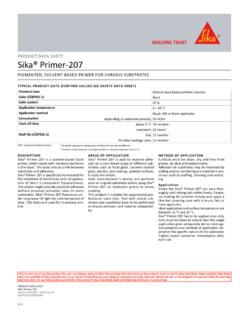
7 For wet concrete applications all excess or standing water must be displaced and concrete must then dry for a minimum of 60 min prior to sealant installation. Consult sikaflex Primer Technical data SHEET or Technical Service for additional information on METHOD / TOOLSR ecommended application temperatures: 40 -100 F. For cold weather application, condition units at approximately 70 F; remove prior to using. For best performance, sikaflex -1a should be gunned into joint when joint slot is at mid-point of its designed expansion and contraction. Place nozzle of gun into bottom of the joint and fill entire joint. Keep the nozzle in the sealant, continue on with a steady flow of sealant preceding the nozzle to avoid air entrapment.
8 Avoid overlapping of sealant to eliminate entrapment of air. sikaflex -1a can be applied on green concrete after the concrete has cured for a minimum of 24 hours at 75 joints must be cut and open for min of 8 hours prior to application. Expansion joints must have forms removed a minimum of 4 hours prior to application. For damp concrete applications sikaflex -1a can be applied 60 minutes after any and all water has been displaced. Tooling & FinishingTool sealant to ensure full contact with joint walls and remove air entrapment. Joint dimension should allow for 1/4 inch minimum and 1/2 inch maximum thickness for sealant.
9 Proper design is 2:1 width to depth ratio, For use in horizontal joints in traffic areas, the absolute minimum depth of the sealant is 1/2 in. and closed cell backer rod is recommended. RemovalUse personal protective equipment (chemical resistant gloves/goggles/clothing). Without direct contact, remove spilled or excess PRODUCT and placed in suitable sealed container. Dispose of excess PRODUCT and container in accordance with applicable environmental regulations. Over PaintingProduct data SheetSikaflex -1 AAugust 2019, Version / 5 Allow 1-week cure at standard conditions when using sikaflex -1a in total water immersion situations and prior to OF TOOLSC lean all tools and application equipment with sika Remover-208 immediately after use.
10 Hardened material can only be removed cleaning skin use sika Cleaning Sealing and Bonding Chart Method Statement: Joint Sealing Method Statement: Joint Maintenance, Cleaning and Renovation Technical Manual: Facade Sealing LIMITATIONSA llow 1 week cure at standard conditions when using sikaflex -1a in total water immersion situations. When overcoating with water, oil and rubber based paints, compatibility and adhesion testing is essential. Sealant should be allowed to cure for 7 days prior to overcoating Avoid exposure to high levels of chlorine. (Maximum continuous level is 5 ppm of chlorine.) Maximum depth of sealant must not exceed 1/2 in.