Transcription of PROGRAM ADMINISTRATOR DEFINITION AND …
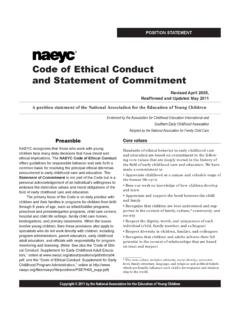
1 PROGRAM ADMINISTRATOR DEFINITION AND competencies I. PROGRAM ADMINISTRATOR DEFINITION The PROGRAM ADMINISTRATOR is the individual responsible for planning, implementing, and evaluating an early care and education PROGRAM . The role of the ADMINISTRATOR covers both leadership and management functions. Leadership functions relate to the broad view of helping an organization clarify and affirm values, set goals, articulate a vision, and chart a course of action to achieve that vision. Managerial functions relate to the actual orchestration of tasks and setting up systems to carry out the organization's mission.
2 Functions of the PROGRAM ADMINISTRATOR include: Pedagogical. Creating a learning community of children and adults that promotes optimal child development and healthy families. Organizational and Systems. Establishing systems for smooth PROGRAM functioning and managing staff to carry out the mission of the PROGRAM . Planning and budgeting the PROGRAM 's fiscal resources. Managing organizational change and establishing systems to monitor and evaluate organizational performance. Human Resources. Recruiting, selecting, and orienting personnel. Overseeing systems for the supervision, retention, and professional development of staff that affirm PROGRAM values and promote a shared vision.
3 Collaborative. Establishing partnerships with PROGRAM staff, family members, board members, community representatives, civic leaders, and other stakeholders to design and improve services for children and their families. Political. Advocating on behalf of high-quality services to meet the needs of children and their families. The ADMINISTRATOR may have different role titles depending on the PROGRAM type or sponsorship of the PROGRAM . Common titles include: director, site manager, ADMINISTRATOR , PROGRAM manager, early childhood coordinator, and principal. II. Core competencies An Informant to Selection of Annual Professional Development Options Adapted from Illinois Director Credential The core competencies needed for effective early childhood PROGRAM administration fall into two broad categories: management knowledge and skills and early childhood knowledge and skills.
4 These are not discrete categories; there is conceptual as well as practical overlap between and within each category. Management Knowledge and Skills Administrators need a solid foundation in the principles of organizational management including how to establish systems for smooth PROGRAM functioning and managing staff to carry out the mission of the PROGRAM . 1. Personal and Professional Self-Awareness Knowledge and application of adult and career development, personality typologies, dispositions, and learning styles. Knowledge of one's own beliefs, values, and philosophical stance. The ability to evaluate ethical and moral dilemmas based on a professional code of ethics.
5 The ability to be a reflective practitioner and apply a repertoire of techniques to improve the level of personal fulfillment and professional job satisfaction. 2. Legal and Fiscal Management Knowledge and application of the advantages and disadvantages of different legal structures. Knowledge of different codes and regulations as they relate to the delivery of early childhood PROGRAM services. Knowledge of child custody, child abuse, special education, confidentiality, anti-discrimination, insurance liability, contract, and labor laws pertaining to PROGRAM management. Knowledge of various federal, state, and local revenue sources.
6 Knowledge of bookkeeping methods and accounting terminology. Skill in budgeting, cash flow management, grantwriting, and fundraising. 3. Staff Management and Human Relations Knowledge and application of group dynamics, communication styles, and techniques for conflict resolution. Knowledge of different supervisory and group facilitation styles. The ability to relate to staff and board members of diverse racial, cultural, and ethnic backgrounds. The ability to hire, supervise, and motivate staff to high levels of performance. Skill in consensus building, team development, and staff performance appraisal.
7 4. Educational Programming Knowledge and application of different curriculum models, standards for high-quality programming, and child assessment practices. The ability to develop and implement a PROGRAM to meet the needs of young children at different ages and developmental levels (infant/toddler, preschool, kindergarten). Knowledge of administrative practices that promote the inclusion of children with special needs. 5. PROGRAM Operations and Facilities Management Knowledge and application of policies and procedures that meet state/local regulations and professional standards pertaining to the health and safety of young children.
8 Knowledge of nutritional and health requirements for food service. The ability to design and plan the effective use of space based on principles of environmental psychology and child development. Knowledge of playground safety design and practice. 6. Family Support Knowledge and application of family systems and different parenting styles. Knowledge of community resources to support family wellness. The ability to implement PROGRAM practices that support families of diverse cultural, ethnic, linguistic, and socio-economic backgrounds. The ability to support families as valued partners in the educational process.
9 7. Marketing and Public Relations Knowledge of the fundamentals of effective marketing, public relations, and community outreach. The ability to evaluate the cost-benefit of different marketing and promotional strategies. The ability to communicate the PROGRAM 's philosophy and promote a positive public image to families, business leaders, public officials, and prospective funders. The ability to promote linkages with local schools. Skill in developing a business plan and effective promotional literature, handbooks, newsletters, and press releases. 8. Leadership and Advocacy Knowledge of organizational theory and leadership styles as they relate to early childhood work environments.
10 Knowledge of the legislative process, social issues, and public policy affecting young children and their families. The ability to articulate a vision, clarify and affirm values, and create a culture built on norms of continuous improvement and ethical conduct. The ability to evaluate PROGRAM effectiveness. The ability to define organizational problems, gather data to generate alternative solutions, and effectively apply analytical skills in its solution. The ability to advocate on behalf of young children, their families and the profession. 9. Oral and Written Communication Knowledge of the mechanics of writing including organizing ideas, grammar, punctuation, and spelling.