Transcription of PROJECT MANAGEMENT - campussuite …
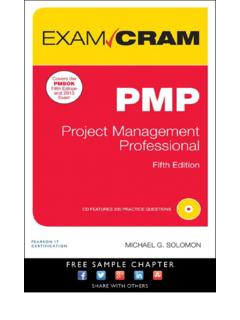
1 Copyright 2018 by Thomas Edison State University. All rights reserved. Syllabus for PMP-100 PROJECT MANAGEMENT COURSE DESCRIPTION The PROJECT MANAGEMENT Institute (PMI) is the preeminent, internationally recognized professional association in the field of PROJECT MANAGEMENT . PMI serves practitioners and organizations with standards that describe best practices, globally recognized credentials that certify PROJECT MANAGEMENT expertise, and resources for professional development. The PROJECT MANAGEMENT Certificate Program at Thomas Edison State University is fully aligned with the publication A Guide to PROJECT MANAGEMENT Body of Knowledge, Sixth Edition (PMBOK Guide), developed by the PROJECT MANAGEMENT Institute (PMI).
2 The PMBOK Guide is aligned using knowledge areas as its basis, this course follows suit. A process group includes the constituent PROJECT MANAGEMENT processes that are linked by the respective inputs and outputs where the outcome resulting from one process becomes the input for another. This course and the accompanying course materials facilitate preparation for PROJECT MANAGEMENT professional (PMP) or PMI s Certified Associate in PROJECT MANAGEMENT (CAPM) certification. The curriculum follows what PMI describes as the knowledge areas, but through the eyes of the PROJECT process groups. These PROJECT process groups include the following: initiating, planning, executing, monitoring and controlling and closing PROJECT MANAGEMENT processes.
3 Focusing on both the process groups the knowledge areas facilitates easier understanding of the PROJECT MANAGEMENT processes while aligning with the PROJECT life cycle processes followed by the industry. Students will earn 40 professional Development Units (PDUs) upon successful completion of this course. These 40 PDUs satisfy the PMP and CAPM Exam educational requirements. COURSE AUDIENCE This course is intended for students who are interested in working as PROJECT managers, IT PROJECT managers, PROJECT coordinators, PROJECT analysts, PROJECT leaders, senior PROJECT managers, team leaders, product managers, program managers, PROJECT team members, operation managers, stakeholders, and senior managers who want to be effective in PROJECT MANAGEMENT .
4 PREREQUISITES FOR TAKING THE CERTIFYING EXAM PMP Requirements: In order to sit for the exam, an individual must demonstrate either of the following in order to apply for the PMP credential: Copyright 2018 by Thomas Edison State University. All rights reserved. A four-year degree (bachelor s or the global equivalent); and at least three years of PROJECT MANAGEMENT experience (4,500 hours) within the last 8 years leading and directing projects; and 35 hours of PROJECT MANAGEMENT education OR A secondary diploma (high school or the global equivalent); with at least five years of PROJECT MANAGEMENT experience (7,500 hours) within the last 8 years leading and directing projects.
5 And 35 hours of PROJECT MANAGEMENT education CAPM Requirements Individuals, who are interested in taking the Certified Associate in PROJECT MANAGEMENT (CAPM) certification Exam from PROJECT MANAGEMENT Institute (PMI) , must have: A secondary diploma (high school or the global equivalent) AND At least 1,500 hours experience OR 23 hours of PROJECT MANAGEMENT education by the time they sit for the exam COURSE TOPICS Module 1: PROJECT MANAGEMENT Framework Module 2: PROJECT Integration and PROJECT Scope MANAGEMENT Module 3: PROJECT Schedule and PROJECT Cost MANAGEMENT Module 4: PROJECT Quality and PROJECT Resource MANAGEMENT Module 5: PROJECT Communications and PROJECT Risk MANAGEMENT Module 6: PROJECT Procurement and PROJECT Stakeholder MANAGEMENT Module 7: professional Responsibility, Test Preparation, and Wrap Up Copyright 2018 by Thomas Edison State University.
6 All rights reserved. COURSE OBJECTIVES After completing this course, you will be able to: 1. Explain what a PROJECT is and differentiate between PROJECT , program, and portfolio MANAGEMENT 2. Define the PROJECT life cycle and the difference between projects and operational work 3. Identify types of stakeholders and their importance to a PROJECT 4. Describe methods to manage stakeholders 5. Identify the PROJECT MANAGEMENT knowledge areas and process groups 6. Define PROJECT initiation and key components of a PROJECT charter and stakeholder register 7. Describe the key components of a PROJECT plan and all subsidiary plans 8.
7 Discuss processes related to PROJECT execution; directing and managing PROJECT execution; manage quality; acquiring, developing, and managing a PROJECT team; and distributing information and managing stakeholder expectations 9. Explain methods for monitoring and controlling PROJECT work, performing integrated change control, verifying scope, controlling PROJECT scope, schedule, and costs as well as ways to accomplish quality control and reporting on PROJECT performance 10. Discuss methods for monitoring and controlling risks and administering procurements 11. Define PROJECT close out 12. Explain PMI s Code of professional and Ethical Conduct COURSE MATERIALS You will need the following materials to do the work of the course.
8 The required textbooks are available from the University s textbook supplier, MBS Direct. (Note: Q&A s for the PMBOK Guide Sixth Edition is not available at the bookstore) Required Textbook A Guide to the PROJECT MANAGEMENT Body of Knowledge (PMBOK Guide), Sixth Edition ISBN-13: 978-1-62825-184-5 Q&A's for the PMBOK Guide Sixth Edition ISBN-13: 978-1-62825-461-7 Crosswinds Success Series: PMP Exam Bootcamp Manual ISBN-13: 978-1-61908-138-3 Copyright 2018 by Thomas Edison State University. All rights reserved. COURSE STRUCTURE The PROJECT MANAGEMENT certificate program is an online course consisting of seven modules.
9 Modules include an overview, topics, learning objectives, study materials, and assignments. Module titles are listed below. Module 1: PROJECT MANAGEMENT Framework Course objectives covered in this module: #1, #2, #3, #5 Module 2: Integration and Scope MANAGEMENT Course objectives covered in this module: #6, #7, #8, #9, #11 Module 3: Schedule and Cost MANAGEMENT Course objectives covered in this module: #7, #8, #9 Module 4: Quality and Resource MANAGEMENT Course objectives covered in this module: #7, #8, #9 Module 5: Communications and Risk MANAGEMENT Course objectives covered in this module: #7, #8, #9, #10 Module 6: Procurement and Stakeholder MANAGEMENT Course objectives covered in this module.
10 #4, #6, #7, #8, #9, #10, #11 Module 7: professional Responsibility, Test Preparation, and Wrap Up Course objectives covered in this module: #12 ASSESSMENT METHODS For your formal work in the course, you are required to participate in online discussion forums, attend synchronous events, complete module level quizzes, and take proctored midterm and final examinations. See below for details. Consult the Course Calendar for assignment due dates. Discussion Forums In addition to posting an introduction to the class in Module 1, you are required to participate in seven graded online discussions. In order to facilitate interaction and knowledge sharing, students are required to participate in discussions according to the course calendar.