Transcription of Prop 47 Summary - California
1 1 PROPOSITION 47 By Kathryn B. Storton Santa Clara County District Attorney s Office 11/5/2014 I. EFFECTIVE DATE A proposition is typically effective the day after the election, unless otherwise specified in the measure. Since the election took place on November 4, 2014, Proposition 47 is effective on November 5, 2014. (See Section 10(a) of Article II of the California Constitution.) II. RETROACTIVITY Because it lessens punishment, Proposition 47 applies to all pending cases regardless of when the crime was committed, and all convictions not yet final as of 11/5/2014 ( , cases in which defendants were sentenced during the 60-day period preceding 11/5/2014 or cases with appeals pending).
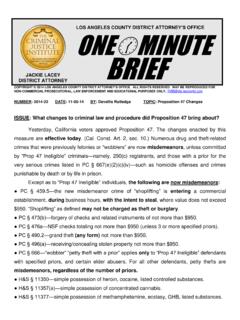
2 (See In re Estrada (1965) 63 740.) Proposition 47 also creates, in new , a procedure for any defendant currently serving a sentence for a felony that would be a misdemeanor under Prop. 47, to petition for recall of the sentence and request resentencing in accordance with Sections 11350, 11357, or 11377 of the Health & Safety Code, or Section , 473, 476a, , 496, or 666 of the Penal Code, as those sections have been amended or added by this act. also provides a procedure for a defendant who has completed his or her sentence to file an application to have a felony conviction designated a misdemeanor. [See Section XII in this publication for more about resentencing.] III. OVERVIEW A. Misdemeanor Offenses Proposition 47 provides that a number of forgery, theft, grand theft, and drug crimes 2 that were chargeable as misdemeanors or felonies (commonly known as wobblers ), can now be charged only as misdemeanors, unless the defendant has a specified prior conviction or the value of the property (in theft cases) is over $950.
3 The list of specified prior convictions that take a defendant out of Proposition 47 is very narrow ( 667(e)(2)(C)(iv) and 290(c)). Many people in the legal community refer to these priors as superstrikes. (See Storton s List of Proposition 47 Prior Convictions, a separate document.) B. Serious &/Or Violent Offenders Many repeat offenders and serious/violent offenders can no longer be charged with a felony when they commit forgery, theft, or drug crimes. For example, a defendant who has a prior misdemeanor conviction for indecent exposure ( ) from thirty years ago and no other criminal history, can be charged with a felony for stealing $950 worth of merchandise, or less, from a small business. However, a career criminal or violent offender who was released from state prison last week after serving a lengthy sentence for multiple armed robberies, multiple residential burglaries, arson or gang crimes, human trafficking, assault with a deadly weapon, witness intimidation, or even voluntary manslaughter can only be charged with a misdemeanor crime.
4 Theft of a gun has been a long-time non-alternative felony and a strike, but Prop. 47 provides that unless the value of the gun is over $950, or the defendant has a specified prior conviction from Prop. 47 s very narrow list, the theft of a gun is only a misdemeanor. Possession of dangerous and illegal drugs, such as cocaine, heroin, PCP, and methamphetamine is only a misdemeanor under Prop. 47, unless the defendant has a specified prior conviction from Prop. 47 s very narrow list. C. Punishment Pursuant to 1170(h) ( realignment ) Throughout Prop. 47, it is provided that a defendant who has a prior conviction specified in 667(e)(2)(C)(iv) or 290(c) may be punished pursuant to 1170(h) ( realignment ) even if the value of the property involved is $950 or less. In other words, the defendant may be charged with a felony crime regardless of the value of the item involved in the crime.
5 However, punishment pursuant to 1170(h) is limited by paragraph (3) of 1170(h), which provides a list of realignment disqualifiers (prior or current serious felony ( (c)), prior or current violent felony ( (c)), required to register as a 290 sex offender, or a aggravated white collar crime enhancement is imposed.) Therefore, a defendant charged with a felony who has a Prop. 47 prior will not qualify for realignment sentencing in most cases because all but two of the specified Prop. 47 priors are also realignment disqualifiers. All crimes that subject a defendant to 290 registration as a sex offender are realignment disqualifiers. 3 And, all of the crimes listed in 667(e)(2)(C)(iv) are serious and/or violent felonies, and thus strikes and realignment disqualifiers, except 653f solicitation to commit murder and 11418(a)(1) possession of a weapon of mass destruction.
6 A felon who is disqualified from 1170(h) realignment sentencing is eligible for a state prison sentence. Hundreds of felonies were specifically redesignated in October 2011 by AB 109 as felonies that are punishable pursuant to 1170(h), and the disqualification provisions of 1170(h)(3) apply to all of these felonies. It is no different for Proposition 47. IV. THEFT Proposition 47 creates new , which provides, in its entirety: (a) Notwithstanding Section 487 or any other provision of law defining grand theft, obtaining any property by theft where the value of the money, labor, real or personal property taken does not exceed nine hundred fifty dollars ($950) shall be considered petty theft and shall be punished as a misdemeanor, except that such person may instead be punished pursuant to subdivision (h) of Section 1170 if that person has one or more prior convictions for an offense specified in clause (iv) of subparagraph (C) of paragraph (2) of subdivision (e) of Section 667 or for an offense requiring registration pursuant to subdivision (c) of Section 290.
7 (b) This section shall not be applicable to any theft that may be charged as an infraction pursuant to any other provision of law. New does several things: (1) It provides that any theft that is not over $950 is considered petty theft and only a misdemeanor (unless the defendant has a specified prior). (2) It creates an over- $950 threshold for grand theft crimes that currently have a lesser threshold or no threshold; without the threshold being met, the crime is considered petty theft. Examples of crimes that had a lesser threshold: 487(b)(1) & (b)(2) farm crop or animal/fish thefts had a $250 threshold; 487b conversion by severance of real property had a $250 threshold; 487i defrauding a housing program had a $400 threshold. Examples of crimes that had no threshold: 487(c) grand theft person; 487(d)(1) grand theft automobile; 487(d)(2) grand theft firearm; 487a grand theft of a specified animal; 484e grand theft involving access cards.
8 Therefore, 4 the theft of a gun that is worth $950 or less is a misdemeanor. A grand theft person where the property s value does not exceed $950 is a misdemeanor. (3) It authorizes charging any theft misdemeanor as a felony if the defendant has a prior conviction for a crime specified in 667(e)(2)(C)(iv) or 290(c). For example, the theft of a $300 bicycle by a defendant who has a Prop. 47 prior, can be charged as a felony rather than misdemeanor petty theft. provides that it does not apply to any theft that may be charged as an infraction. (theft of $50 value or less) is an example of this type of infraction. Because merely says shall be considered petty theft and shall be punished as a misdemeanor and does not provide for a particular range of jail sentence, such as county jail not exceeding one year , existing 19 and 490 limit misdemeanor petty theft crime punishment to six months in jail.
9 19 provides that except in cases where a different punishment is prescribed, every offense declared to be a misdemeanor is punishable by up to six months in jail and/or by a fine of up to $1,000. 490 provides that petty theft is punishable by up to six months in jail and/or by a fine of up to $1,000. A Note About Charging: It is preferable to charge the most specific theft section possible, so that the charging document, at a glance, and the defendant s rap sheet, indicate what type of property or conduct the theft involves. The language of supports this: Notwithstanding Section 487 or any other provision of law defining grand theft.. For example, in a 487(c) (theft from the person) or 487(d)(2) (theft of a firearm) case involving property worth $950 or less, charge 487(c) or 487(d)(2) as a misdemeanor, rather than generic petty theft ( 484-488).
10 An allegation within the meaning of could be considered, or the property value could be specified as $950 or less. In a 487j case (theft of copper exceeding $950 value) involving $300 worth of property where the defendant has a Prop. 47 prior and thus is chargeable with a felony , charge 487j copper theft as a felony and allege the Prop. 47 prior. Based on the language of , it also appears that 484-488 could be charged as a felony with the Prop. 47 prior alleged, but the code section itself would not provide any information as to the type of theft. 5 Theft Chart Value of Property is $950 or Less & Defendant Has No Specified Prior: A misdemeanor theft violation is chargeable. Value of Property is $950 or Less & Defendant Has a Specified Prior: A felony theft violation is chargeable.