Transcription of PROPANE EMERGENCY SHUTOFF VALVES - …
1 PROPANE EMERGENCY SHUTOFF VALVESNFPA 58 (2014 edition) : EMERGENCY SHUTOFF VALVES required by the code shall be tested annually for the functions required by (2) and (3). Backflow check VALVES installed in lieu of EMERGENCY SHUTOFF VALVES shall checked annually for proper operation. The PROPANE Education and Research Council (PERC) has developed an Operations and Maintenance Manual that is available for free download at Select Safety & Training and then go to the Codes and Compliance category. Following is the section from the Operations and Maintenance Manual regarding EMERGENCY SHUTOFF ENGINEERINGV ersion ESV s Risk Management1 Since 1822, Crum & Forster has successfully anticipated what s next. Our insurance policy is our promise to help you the policyholder in the event of a loss.
2 It gives you a future benefit that you can count on. But C&F offers something more. Our Risk Engineers can help your operation right now. Before you ever encounter a claim, our Risk Engineers can meet you and identify actual and potential loss sources. We ll conduct a thorough study of your company that includes exposures, hazards and accident trends. Together we ll review your current loss prevention efforts, physical location, loss information and other business records to pinpoint fundamental loss causes. Then we ll create an action plan with practical recommendations to strengthen existing safety programs. We can maintain an ongoing review of it to evaluate progress and effectiveness. We can even conduct a legal exposure review of your company s agreements.
3 Everything we do is aimed at putting into place an effective loss control strategy that works consistently over time to lower your operation s risk of loss. Our highly specialized Risk Engineers are strategically located throughout the country and have the experience, training and professionalism to provide risk management solutions to meet your business needs and contribute to your success. They have on average more than 20 years industry experience, many with roles dedicated to safety and training. And we invest not only in our insureds, but in the industry. We are members of and participate in many state associations and regularly present at industry conventions and events. These connections and experience are invaluable, and are key in assisting you in developing and deploying a modern, up-to-date safety and training solutions are both innovative and established.
4 Whether it s Accident Event Recorders (AERs) to help identify vehicle accident causes and tailor safety training, digital tracking systems, or online video training to assure OSHA compliance, we bring you the latest technology. Matched with the experience of our Risk Engineers, your operation benefits from the engineering awareness built over a lifetime and cutting edge safety science. C&F RISK ENGINEERS UNDERSTAND YOUR BUSINESSE mergency Shut Off VALVES EMERGENCY VALVES must actuate when a hose pull away occurs that causes a break in fixed piping system EMERGENCY SHUTOFF VALVES (ESV s) and backflow check VALVES that are required by the Code must be tested annually for their functionality. ESV s must be specifically tested for: Manual SHUTOFF from a remote location.
5 Manual SHUTOFF at the installed location. The results of these tests must be documented (see sample inspection log at the end). The NFPA 58 does not set requirements for the retention and maintenance of these test results. You should check with established company policy for the manner in which and the length of time that these records should be kept. Temperature-sensitive elements ( , thermal links) cannot be painted nor have any ornamental finishes applied after they are manufactured. The primary reason is any paint or finish could affect the melting capabilities of the thermal link at the desired operating cables working correctly? 1. The cable should be free to move through its entire range without binding.
6 2. The cable should fully open and completely close the the pneumatic control system in good working order? 1. Check the operators to ensure proper functioning (typically, through release of air or nitrogen pressure and then re-pressurizing). 2. The system should be checked for leaks by pressurizing it and checking all connections with an ammonia-free leak testing (soap) solution. For the leak test, no bubbles should form. Listen and smell for possible leaks. 3. The operator should fully open and completely close the hydraulic operators in good working condition? 1. Check the operators to ensure proper functioning (typically, through release of pressure and then re-pressurizing). 2. The operator should fully open and completely close the ENGINEERINGC ontact Information Reporting Claims or Loss24-hour toll free number: ESV s Risk ManagementIs the thermal link intact and free of paint?
7 1. Self-explanatory. Additionally, the thermal link should be free of any coating (including foreign matter) that could interfere with the proper functioning of the ESVs in good working condition and leak-free? 1. Check for leakage at all body seams, plus the connections to the piping and hose. Check each fitting using a gas detector calibrated for LP-Gas or an ammonia-free leak testing (soap) solution. No gas should be detected. For the leak test solution, no bubbles should form. Listen and smell for possible leaks. 2. Test (operate) the closing feature to ensure that it will close and open the an annual test been performed and documented as required by NFPA58? 1. The VALVES must be tested for the following functions: a.
8 Manual SHUTOFF from a remote location. b. Manual SHUTOFF at the installed location. Note: Check for the presence of the thermal operating cables working correctly? 1. Check operating cables to make sure they can move through their entire range without binding. 2. Make sure the cable tension is not too tight since that might prevent the valve from latching properly, or vibration or jarring could cause inadvertent closure during normal transfer the pneumatic control system in good working condition? 1. Check the operators to ensure proper functioning (typically, through release of air or nitrogen pressure, then re-pressurization). 2. The system should be checked for leaks by pressurizing the system and checking all connections with an ammonia-free leak testing solution.
9 For the leak test solution, no bubbles should form. Listen and smell for possible leaks. 3. The operator should fully open and completely close the remote EMERGENCY SHUTOFF devices between 25 and 100 feet from the ESV and within the path of egress?Is the remote EMERGENCY shutdown station identified with a sign? 1. Signs should be visible from the point of transfer and have the words PROPANE -Container Liquid Valve EMERGENCY SHUTOFF in block letters at least 2 inches high in contrasting colors. Note: Faded or broken signs should be replaced with signs that are easily legible. Is the thermal link intact and free of paint? 1. Self-explanatory. Additionally, the thermal link should be free of any coating (including foreign matter) that could interfere with the proper functioning of the in mind that NFPA 58 s annual testing recommendation is a minimum safe standard.
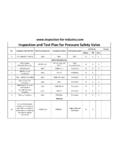
10 Your company may employ more frequent testing. Whichever testing schedule is set, it is recommended that it be followed, and that corrective action be taken should there be a need for repairs. Document the results. Properly train your personnel to inspect and test ESV s. Whenever an employee is filling at a bulk plant he should report any ESV deficiencies to ENGINEERINGP ropane ESV s Risk Management3 RISK ENGINEERINGE xamples of deficiencies:ESV manual shut-off VALVES are held open with bungee manual shut-off VALVES are held open by a 2 x 6 piece of ESV s Risk Management4 RISK ENGINEERINGESV and Back Check Valve Testing LogCompany:Plant LocationBobtail #1 Bobtail #2 Bobtail #3 Transport UnloadingTransport UnloadingRailcar UnloadingRailcar UnloadingBulk Storage #1 Bulk Storage #2 Bulk Storage #3 Liquid ServiceVapor ServiceCorrective Action(If No in previous column)AcceptableYe sNoLocation:Year.