Transcription of Protect yourself from electrical shocks - …
1 Protect yourself from electrical shocks You all know the stories about musicians who died from electrical shocks while playing electric guitar. The reason for this is that the strings are normally connected to ground for hum-cancelling reasons, especially on single coil guitars and a damage or malfuntcion of your amp can send a lethal electrical shock that will hit you while touching the strings. Here is how you can Protect yourself from being grilled while playing. The most simple solution is to disconnect your strings from ground by cutting the cable, eg.
2 From underneath the bridge on a Tele. If your guitar is well shielded this can work. I suggest to try this first, if your guitar is silent, producing no noises or hum leave it the way it is and you are save. If this will not work and your guitar is humming, there is another cheap trick to make your guitar save while the strings are still connected to ground. All you need is a (=1nF) cap with a minimum rating of 500 volts or higher and a 220k resistor. Wire both parts in parallel, solder a piece of wire at both ends (1mm diameter or higher recommended) and wrap the hole thing with insulating tape to make it save from being shorted.
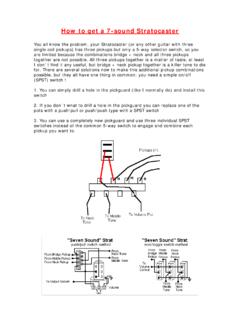
3 Cut the wire that grounds the strings and insert the wrapped "fuse" between the both open ends like shown in the drawing. If now a damage accures our new "fuse" will limit the shock to approx. 40. volts which is not dangerous for humans. You will feel the electrical shock, but it will not hurt you and it is a good indicator that there is something wrong with your amp. Unplug your amp immediately by pulling the power cord. Don t touch any parts of your amp and don t try to turn it off by using the on/off switch !
4 !!!! Your amp needs professional maintenance now. Available at the singlecoil-webshop ( ). Technical backgrounds (from ). The most important thing for musicians, and especially guitarists, to understand is that "ground" isn't always ground! While the negative side of the input jack on your amplifier is often called "ground" it actually may be at a lethal voltage when referenced to "earth" ground or to "ground" on another piece of equipment. Furthermore, even when your equipment is operating perfectly it can still carry a lethal charge when you are plugged into an improperly wired mains power source.
5 Finally, even when your equipment is working perfecty and is plugged into a properly grounded mains outlet, you may be using other equipment that is not properly grounded "ground" on that equipment may be at a lethal voltage referenced to ground on your equipment. In all three of the above scenarios your body may be the path of least resistance between one voltage level and another significantly different voltage level whenever that happens you are an electrocution looking for a place to happen. There are three shock scenarios the guitarist faces.
6 These scenarios are not "theoretical," musicians have died! 1. Failure of the guitarist's own amplifier places a lethal voltage on the "ground" side of the jack and thus on the strings. This scenario is usually only encountered on early vintage equipment. Even then such failures are extremely rare but when they occur they can place hundreds of volts DC on the "ground" side of the jack and the failure may be difficult to detect until the shock knocks you on your backside. This failure is basically impossible with modern three-prong equipment plugged into a properly grounded three-prong mains outlet.
7 Never use ground lift adaptors on power cords! The shock path is from the amplifer, through the guitar chord to the guitar bridge and strings, to the guitarist's fingers. From there the shock path either goes through the guitarist to the floor through his feet or through the guitarist to a grounded piece of equipment such as a microphone. Even the first path through the resistance of shoes and floor covering may sometimes be lethal because the voltage potential is so high. The second path is easily lethal because the path from the guitarist to earth ground has very little resistance to the flow of current.
8 2. The guitarist's equipment is okay, but improper mains wiring places a lethal voltage (referenced to earth ground) on the "ground" side of the jack. This voltage could be either AC or DC, depending on the design of the equipment. This occurs most often when the earth ground of the mains wiring is not connected and the "neutral" and "hot" sides of the outlet are reversed. This scenario is much more common than it should be it seems far too many club owners have all their wiring and remodeling done by half-wit inlaws.
9 Fortunately, this is also the easiest scenario to detect and prevent. Every gigging musician should have one of the simple three-prong testers that are sold for a few bucks in hardware stores and should use it every time they set up for a gig even if they've played the venue a thousand times. The shock path is similar to that of scenario one, above. In this case the path through the feet (and the resistance of shoes and floor covering) can be painful but is less likely to be fatal because the voltages are lower than those of scenario one.
10 However, the path through another piece of equipment can still easily be fatal. 3. The guitarist's equipment may or may not be okay and plugged into good mains wiring, but in either case other equipment in use is plugged into improper mains wiring. This results in a lethal potential on other equipment, such as microphones, when referenced to the guitarist's equipment. Again, this voltage could be either AC or DC, depending on the design of the equipment. This scenario is also much more common than it should be and for the same reasons given in scenario two, above.