Transcription of Provider Self - Evaluation Guide - Sasseta
1 Provider self - Evaluation GuideFor further information please contact us on: Call Centre 0861 102 477 SERVES THE FOLLOWING INDUSTRIES:Legal Investigation and Private Security Policing Correctional Services Justice National Intelligence Agency South African Secret Services Department of DefenceTable of ContentsAcknowledgements .. 21. What is self - Evaluation ? .. How does the self - Evaluation processfit into the accreditation process ? .. Step 1: Application phase .. Step 2: The site visit .. Step 3: Accreditation and provisional accreditation phase .. Step 4: Monitoring phase .. Step 5: Review .. Step 6: Application for extension of accreditation .. The role of the self - Evaluation form in terms of the accreditation process .. How to use this Guide .. What are the outputs of this process ? .. 52. Underlying approach .. 63. Steps in conducting the self - Evaluation .
2 Preparing for the self - Evaluation .. Designing the self - Evaluation .. Data collection .. Analysis and report writing .. Review and repeat .. 74. Organisational self - Evaluation .. Strategic leadership .. Governance and management .. Human resources .. Physical and learning resources .. Institutional linkages .. 105. Programme self - Evaluation .. Learner information, entry and support .. Learning programmes .. Assessment and moderation .. Education, training and development practitioners .. 136. self - Evaluation and developmental plan reporting format and conclusions .. Organisational Programmes self - Evaluation .. 157. Annexure A .. Key to self -rating .. 168. Annexure B: self -rating summary results .. 22 AcknowledgementsThis self - Evaluation Guide is based on the Local Government, Water and Related Services SETA s self -evaluationprocess. The Sasseta would like to acknowledge the LGWSETA in this is a 4th edition June 20061 The Sector Education and Training Authority for.
3 Legal Investigation and Private Security Policing Correctional Services Justice National Intelligence Agency South African Secret Service Department of DefenceAcronymsABETA dult Basic Education and TrainingCAWUC onstruction and Allied Workers UnionCCFOC ritical Cross Field OutcomesCIDBC onstruction Industry Development BoardCOSATUC ongress of South African Trade UnionsCETAC onstruction Industry Sector Education & Training AuthorityDoEDepartment of EducationDoLDepartment of LabourDPWD epartment of Public WorksEEAE mployment Equity ActETDPE ducation and Training Development Practitioner/PracticesETDP SETAE ducation, Training and Development Practices SETAETQAE ducation and Training Quality Assurance BodyFETF urther Education and Training (NQF Levels 2 4)FETCF urther Education and Training CertificatesFETQAF urther Education and Training Quality Assurance BodyGETG eneral Education and Training (ABET, NQF, Level 1, Std 4)GETCG eneral Education and Training CertificateHEQCH igher Education Qualifications CouncilHETH igher Education and Training (NQF Levels 5 8)
4 M&EMonitoring and EvaluationMOUM emorandum of UnderstandingNLRDN ational Learner Record DatabaseNQFN ational Qualifications FrameworkNSAN ational Skills AuthorityNSBN ational Standard BodiesNSDSN ational Skills Development StrategyNSFN ational Skills FundNTCN ational Technical CertificateOBEO utcomes Based EducationOBETO utcomes Based Education and TrainingPDIP reviously Disadvantaged IndividualPOEP ortfolio of EvidenceSASSETAS afety and Security Sector Education and Training AuthorityQALAQ uality Assurance of Learner AchievementsQMSQ uality Management SystemRPLR ecognition of Prior LearningSADTUS outh African Democratic Teachers UnionSAQAS outh African Qualifications AuthoritySAQAAS outh African Qualifications Authority ActSARSS outh African Revenue ServiceSDAS kills Development ActSDCS kills Development CommitteeSDFS kills Development FacilitatorSDLS kills Development LevySDLAS kills Development Levies ActSDPUS kills Development Planning UnitSDSS kills Development StrategySETAS ector Education and Training AuthoritySGBS tandard Generating BodySIRAP rivate Security Industry Regulatory AuthoritySMES ubject Matter ExpertSMMES mall Medium and Micro EnterprisesSSPS ector Skills PlanWPAW orkplace AssessmentWSPW orkplace Skills Plan2 The Sector Education and Training Authority for: Legal Investigation and Private Security Policing Correctional Services Justice National Intelligence Agency South African Secret Service Department of Defence1.
5 IntroductionThis Guide has been developed by the Sasseta to assist constituent education and training providers with theprocess of self - Evaluation . The Guide is part of a series of documents, all of which complement each other andshould be used as a whole package . The package contains the following: Accreditation Application Form Sasseta Provider Accreditation Manual Accreditation Programme Evaluation Form Assessor/Moderator Guide and Application What is self - Evaluation ?In the context of education and training and accreditation processes, self - Evaluation is the process wherebyproviders reflect on their own practices in order to ascertain more broadly the extent to which they are ensuring thehighest standards of quality in the provision of education and training. A self - Evaluation process is a reflectiveprocess it is your opportunity as a Provider to reflect on your organisation and its outputs, with a view toimproving your own systems and is important to note that the Sasseta does not view the self - Evaluation as a quick checklist process .
6 Theprovider accreditation manual and the application form explain to providers what the criteria for accreditation areand what documentary evidence needs to be available in order to fulfil the basic requirements for self - Evaluation process , on the other hand, is more about the process of reflection and about achieving qualityin the short-, medium- and long-term. Providers are urged to conduct the self - Evaluation process not only to obtainaccreditation, but as a mechanism for constantly improving quality and setting and obtaining higher and highergoals in this will notice that the items against which you complete the self - Evaluation process are not exactly thesame as the criteria for accreditation. This is because the self - Evaluation process is inclusive of both whatyou need to have in place in order to be accredited, as well as what you need to continually ensure qualityprovision in the long-term.
7 The processes of self - Evaluation and accreditation are complementary to oneanother, but are not the same with a QMS processSelf- Evaluation is a key component of a Quality Management System. In order to reflect on whether the organ-isation is achieving its objectives in an effective and efficient manner it is critical that the organisation has amechanism for continual review and quality How does the self - Evaluation process fit into the accreditation process ?The accreditation process comprises six major phases that follow a sequence that forms a process cycle. Thephases in the process cycle are progressive and each phase needs to be completed for the next to besuccessfully achieved. The phases are briefly outlined Step 1: Application Sasseta provides various documents to providers applying for accreditation; these include:a) Provider Accreditation Manualb) Provider self - Evaluation Guidec)Accreditation Application Formd)Assessor/Moderator Guide and Registration FormNote that the self - Evaluation should be completed by the Provider and submitted together with the application self - Evaluation should be submitted to the ETQA as it gives the evaluator a sense of the state of readiness ofthe Provider , although the emphasis of the self - Evaluation form is to encourage providers to undertake the self - Evaluation as part of a culture of Sector Education and Training Authority for.
8 Legal Investigation and Private Security Policing Correctional Services Justice National Intelligence Agency South African Secret Service Department of the application form with the evidence required both documents to the should acknowledge receipt of application and self -assessment forms within 10 reviews whether or not evidence requirements for the application phase have been met,and follows up on missing documentary evidence within 10 days. Providers are urged to submitany outstanding evidence as soon as possible, so as to not hold up the process of initial evidence requirements have been met, Sasseta submits programme Evaluation formsto the Provider for programme Evaluation forms, which Sasseta reviews for completeness and ensures thatsubject-matter experts review in terms of the programme approval criteria. The ETQA will thenfollow up with the Provider , where Step 2: The site programme Evaluation forms have been submitted, Sasseta will initiate processes to puttogether a verification team (including an official as well as one or two subject-matter experts(although this may only be one person as the bulk of the programme Evaluation activities will takeplace before the visit based on the forms).)
9 This subject-matter expert will review a sample of theprogrammes and related materials during the site visit. This site visit should take placeapproximately 30 days after submission of the programme Evaluation ETQA will inform you as a Provider about the site visits so that a date can be verification team are briefed and provided with the necessary documentary site visit is team reports theirfindings to the Sasseta who will take this recommendation through therequisite processes in the SETA (such as the ETQA committee and EXCO). possible courses of action ensure:a)The process of full accreditation commencesb)The process of provisional accreditation commencesc)Approved Provider Status Awardedd)The Provider is informed of denial of accreditation status and a decision is taken onwhether or not to charge the Provider for expenses Step 3: Accreditation and provisional accreditation phaseThe outcome of the Evaluation of the documentation and the site visit will be one of the Accreditation:This will be granted if the applicant complies fully with the Accreditation:Provisional Accreditation will be granted to a Provider who does not fullymeet the requirements, subject to the implementation of the necessary corrective actions based ona mutually agreed development plan in line with the time-frames set by the.
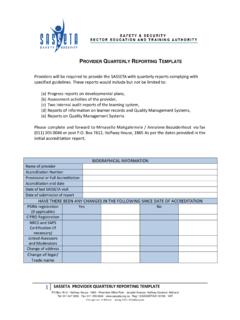
10 A status which confirms that the Provider can provide a sound learning environment forshort course(s) it intends to offer, not tied to any Unit Standards at of Accreditation:The Sasseta has the right to reject any application for accreditation withcosts if the Provider applying for accreditation does not meet the requirements for accreditation andhas no intention to implement the required corrective approved for either provisional or full accreditation will be notified in writing and issuedwith an Accreditation Certificate as per the SASSETAC ertification Sector Education and Training Authority for: Legal Investigation and Private Security Policing Correctional Services Justice National Intelligence Agency South African Secret Service Department of by a Provider against the non-accreditation of the Provider may be lodged in writing withthe Sasseta in terms of theAppeals Procedure for Providers,and the necessary arrangementsfor the appeal will be Step 4: Monitoring Sasseta conducts site audits at providers as an ongoing monitoring and Evaluation will be required to provide the Sasseta with quarterly reports complying with specifiedguidelines.