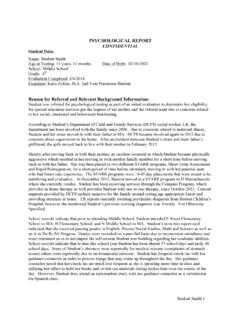
Transcription of PSYCHOLOGICAL REPORT CONFIDENTIAL
1 Student Holland 1 PSYCHOLOGICAL REPORT CONFIDENTIAL Student Data: Name: Student Holland Age at Testing: 12 years, 3 months Date of Birth: 11/26/2001 School: Middle School Grade: 6th Evaluation Completed: 3/31/14 Examiners: Katie Zofcin, , School Psychology Intern Reason for Referral and Relevant Background Information: Student was referred for PSYCHOLOGICAL testing as part of an initial evaluation to determine her eligibility for special education services per the request of her parents and teachers. Mr. and Mrs. Holland noted concerns surrounding Student s difficulty in math. Her teachers indicated concerns regarding memory, specifically rote memory and remembering previously learned information both academic and otherwise. Her parents reported that she has had difficulty in math since the second grade. Over the course of her schooling, she has had a number of tutors for math.
2 Mr. and Mrs. Holland indicated that tutoring appeared to help Student and improved her grades towards the end of the school year. Currently, her parent s reported that she does not have a tutor, however, she stays after school for homework club and occasionally for extra help with teachers. Her parents mentioned that Student typically does well in school and on homework assignments, however she has been failing her math tests. School records indicate that prior to attending Middle School, Student attended Elementary School in Massachusetts from Pre-School to first grade; Partnership School in Massachusetts for second and third grade; and Sunshine Elementary School fourth and fifth grade. Student s term three REPORT card indicated that she received an A in Physical Education and Health and Wellness; an A- in English and Engineering Technology; a B+ in History/Social Studies; a B in Science; a C+ in French; and a C in Math.
3 On the most recent state-wide testing (MCAS), which was conducted in the 5th grade, Student scored within the Proficient range on ELA (score of 252), the Needs Improvement range in Math (score of 220), and the Proficient range on Science and Technology/Engineering (score of 240). Student reported living with her father, mother, and 13-year-old sister. She described generally being in a calm mood. When asked what she does for fun outside of school, Student mentioned that she enjoys playing with her cousins and friends, reading the Dork Diaries, and playing games on her phone. Student indicated that she aspires to one day be a zoologist or marine biologist because she likes animals and science. Student reported that her favorite subject in school is English because she is good at reading and writing. Her least favorite and hardest subject in school is Math.
4 Student mentioned that Math has always been hard for her. She stated sometimes worrying about school in regards to her performance in her classes and getting her homework in on time. One thing she wishes she could change about school would be to even out her abilities in order to become less strong at English and better in Math. Student also indicated that she wished she were better in Math. Student Holland 2 According to Mr. and Mrs. Holland, Student met all developmental milestones within normal limits. Her parents did not indicate any significant medical history or any family history of learning disabilities. Mr. and Mrs. Holland also did not REPORT any record of previous testing. Tests Administered: Wechsler Intelligence Scale for Children, Fourth Edition (WISC-IV) Standard Battery & Selected Supplemental Subtests Wide Range Assessment of Memory and Learning, Second Edition (WRAML-2) Selected Subtests Behavior Assessment System for Adolescents (BASC-2) Self- REPORT of Personality Behavior Assessment System for Adolescents (BASC-2) Parent Rating Scales Behavior Assessment System for Adolescents (BASC-2) - Teacher Rating Scales Conners 3 Parent Conners 3 Teacher Parent Interview Student Interview Record review Behavioral Observations: Overall Presentation: Student completed the administered battery during four testing sessions.
5 The sessions ranged in duration from approximately thirty to fifty minutes. Student was friendly and cooperative throughout the sessions, engaging in spontaneous conversation between tasks as well as answering conversational questions posed. Attention: Student was able to sit without fidgeting and did not demonstrate any difficulty sustaining her attention toward the tasks at hand. Attitude towards testing: Student exhibited appropriate effort, maintained good eye contact and focus throughout testing. She was engaged in each task, made an attempt to answer every question, and appeared extremely motivated to put forth her best effort and do well. Additionally, when her verbal responses required elaboration in order to be awarded credit, she attempted to provide additional information. Cognitive Functioning Ability levels were assessed using the WISC-IV as a basis for intellectual evaluation along with the administration of additional assessments to evaluate specific areas in greater depth.
6 The WISC-IV is one of the most widely used scales of individual intellectual development for children and adolescents. It not only measures general intelligence but, through subtest interpretation and the development of area composite scores, generates a diagnostic profile of a student's learning style. PSYCHOLOGICAL testing resulted in the following WISC-IV cognitive ability scores (Table 1). Interpretations from this testing suggest that Student s verbal reasoning abilities are stronger than those of other students her age. Her non-verbal reasoning abilities, as well as her ability to hold information in mind, manipulate it and produce a result (Working Memory) fall within the range of age expectations. Student s rate of work production (Processing Speed) falls below the range of age expectations. Due to significant discrepancies among some of Student s index scores, her Full Scale IQ score is not considered to be a valid measure of her global cognitive functioning, and is therefore not reported.
7 Her performance on the individual WISC-IV indices will be of greater diagnostic significance. It is also important to note that there is significant inter-subtest scatter on certain indices. Student Holland 3 Table 1. WISC-IV Composite Scale Index Score Confidence Interval (95%) Percentile Range Descriptor Verbal Comprehension (VCI) 112 105-118 79th High Average Perceptual Reasoning (PRI) 92 85-100 30th Average Working Memory (WMI) 102 94-109 55th Average Processing Speed (PSI) 83 76-94 13th Low Average Verbal Comprehension: Verbal comprehension is the ability to understand and manipulate verbal concepts on both a concrete and abstract level. On those WISC-IV subtests measuring this ability (Table 2) Similarities, Vocabulary, and Comprehension Student's composite score of 112, (79th percentile), is above the range expected for a student her age.
8 When asked to apply knowledge learned from her environment, to orally define vocabulary words and to orally express her answers to a variety of social judgment questions, Student s abilities are better developed than those of her same-aged peers. Her performance on the supplemental Information subtest was within the range of age expectations, suggesting that Student is as able as her same-aged peers to retain, effectively retrieve and express previously learned information Table 2. WISC-IV Verbal Comprehension Subtest Scores Well Below Above Well Below Average Average Average Above Similarities Verbal concept formation: Abstract and logical reasoning with objects and ideas placed in meaningful categories.. 12 .. Vocabulary Tests ability to describe the meaning of words.
9 Related to educational environment and language development.. 12 .. Comprehension Requires understanding of what is involved in social situations and the ability to provide answers to social problems. Common-sense.. 13 .. Information (Supplemental) Tests formally and informally learned general knowledge. Reflects long-term memory of facts.. 10 .. Perceptual Reasoning and Organization: Perceptual reasoning involves visual integration/organizational skills, including the ability to recognize or conceptualize shapes and to construct abstract designs. Assessments administered in this area are also designed to measure abstract, categorical reasoning ability. On the WISC-IV subtests pertinent to this area (Table 3) Picture Concepts, Block Design, and Matrix Reasoning Student's composite score of 92, (30th percentile), is within the range of age expectations.
10 Although she demonstrated age-appropriate abilities to categorize visual information and to detect patterns in visual information, she had difficulty when asked to use colored blocks to construct abstract designs. On this task Student indicated she was done working without first checking her work and as a result made small and careless errors. Student Holland 4 Table 3. Memory & Learning Working Memory Learning and working memory skills were assessed through the administration of several tasks designed to measure recall of orally and visually presented material. Working memory is the ability to hold information in mind for the purpose of completing a task and it is essential to carry out multi-step activities and follow complex instructions. On the WISC-IV subtests assessing auditory memory (Table 4) Letter-Number Sequencing and Digit Span Student s composite score of 102 (55th percentile), is within the range of age level expectations, suggesting that Student s ability to hold and manipulate orally presented information in her short-term memory is comparable to that of her same-aged peers.