Transcription of Psychomotor Domain Objectives
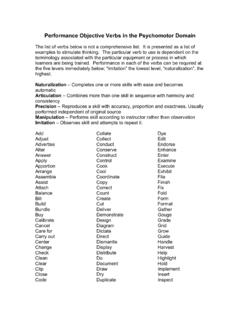
1 Psychomotor Domain Objectives Imitation - Manipulation - Precision - Articulation - Naturalization 1. Imitation - early stages in learning a complex skill, overtly, after the individual has indicated a readiness to take a particular type of action. Imitation includes repeating an act that has been demonstrated or explained, and it includes trial and error until an appropriate response is achieved. Action Verbs - begin, assemble, attempt, carry out, copy, calibrate, construct, dissect, duplicate, follow, mimic, move, practice, proceed, repeat, reproduce, respond, organize, sketch, start, try, volunteer 2.
2 Manipulation - individual continues to practice a particular skill or sequence until it becomes habitual and the action can be performed with some confidence and proficiency. The response is more complex than at the previous level, but the learner still isn't "sure of him/herself." Action Verbs - (same as imitation), acquire, assemble, complete, conduct, do, execute, improve, maintain, make, manipulate, operate, pace, perform, produce, progress, use 3. Precision - skill has been attained. Proficiency is indicated by a quick, smooth, accurate performance, requiring a minimum of energy. The overt response is complex and performed without hesitation.
3 Action Verbs - (same as imitation and manipulation), achieve, accomplish, advance, automatize, exceed, excel, master, reach, refine, succeed, surpass, transcend 4. Articulation - involved an even higher level of precision. The skills are so well developed that the individual can modify movement patterns to fit special requirements or to meet a problem situation. Action Verbs - adapt, alter, change, excel, rearrange, reorganize, revise, surpass, transcend 5. Naturalization - response is automatic. The individual begins to experiment, creating new motor acts or ways of manipulating materials out of understandings, abilities, and skills developed.
4 One acts "without thinking." Action Verbs - arrange, combine, compose, construct, create, design, refine, originate, transcend Dave, R. (1967). Psychomotor Domain . Berlin: International Conference of Educational Testing. 2 Psychomotor Domain Taxonomy Classification Examples of Infinitives Examples of Direct Objects Example Objective REFLEX MOVEMENTS To flex, to stretch, to straighten, to extend, to inhibit, to lengthen, to shorten, to tense, to stiffen, to relax Reflexes The child will turn his or her head toward a loud sound. FUNDAMENTAL MOVEMENTS To crawl, to creep, to slide, to walk, to run, to jump, to grasp, to reach, to tighten, to support, to handle Changes location, moves in space while remaining in one place, moves extremities in coordinated fashion The child will crawl on hands and knees.
5 PERCEPTUAL ABILITIES To catch, to bounce, to eat, to write, to balance, to bend, to draw from memory, to distinguish by touching, to explore Discriminates visually, discriminates auditory, discriminates kinesthetically discriminates tactually, coordinates two or more perceptual abilities The child will walk a balance beam. PHYSICAL ABILITIES To endure, to improve, to increase, to stop, to start, to move precisely, to touch, to bend Exerts tension, moves quickly, stops immediately, endures fatigue The learner will catch a volleyball that is thrown. SKILLED MOVEMENTS To waltz, to type, to play the piano, to plane, to file, to skate, to juggle, to paint, to dive, to fence, to golf, to change Changes or modifies basic body movement patterns, uses a tool or implement in adaptive or skilled manner The learner will dance a demonstrated routine.
6 NONDISCURSIVE COMMUNICATION To gesture, to stand, to sit, to express facially, to dance skillfully, to perform skillfully, to paint skillfully, to play skillfully Moves expressively, moves interpretatively, communicates, emotions, communicates esthetically, expresses joy The learner will pantomime a work given to him or her by the teacher. Harrow, A. (1972). Taxonomy of the Psychomotor Domain . 3 A guide for developing behavioral Objectives . New York: McKay. Psychomotor Domain Psychomotor learning is demonstrated by physical skills; coordination, dexterity, manipulation, grace, strength, speed; actions which demonstrate the fine motor skills such as use of precision instruments or tools, or actions which evidence gross motor skills such as the use of the body in dance or athletic performance.
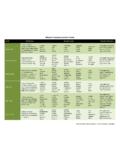
7 Major Categories in the Psychomotor Domain (Simpson's Taxonomy) Description of Category Instructional Objectives Behavioral Terms For Specific Learning Outcomes Perception recognizes detects chooses, describes, detects, distinguishes, identifies, isolates, selects Set Knows sequence Demonstrates proper stance Correct hand placement begins, displays, moves, proceeds, responds, shows, starts Guided Response Performs as demonstrated Applies as shown Demonstrates sequence assembles, builds, constructs, dismantles, displays, fastens, fixes, mends, organizes, works Mechanism Writes smoothly and legibly Sets up equipment Demonstrates a simple skill Same list as guided response Complex Overt Response Operates equipment skillfully Demonstrates correct form Performs skillfully Repairs a machine same list as guided response Adaptation Adjusts to opponent's style Modifies to soloist adapts, alters, changes, rearranges, revises Origination Creates a dance step Composes music arranges, composes, constructs, designs, creates Simpson, E.
8 (1972). The classification of educational Objectives in the Psychomotor Domain : The Psychomotor Domain . Vol. 3. Washington, DC: Gryphon House. 4 Set of Action Verbs for Psychomotor Domain Objectives Activate Correct Loosen Transfer Adjust Create Make Troubleshoot Align Demonstrate Manipulate Tune Apply Design Mend Turn on/off Arrange Dismantle Mix Type Assemble Drill Nail Saw Balance Fasten Operate Sharpen Break down Fix Paint Set Build Follow Press Sew Calibrate Grind Produce Sketch Change Grip Pull Start Clean Hammer
9 Push Stir Close Heat Remove Use Combine Hook Repair Weigh Compose Identify Replace Wrap Connect Load Rotate Construct Locate Resources: Psychomotor Domain Taxonomy Bloom's taxonomy - learning domains The Psychomotor Domain