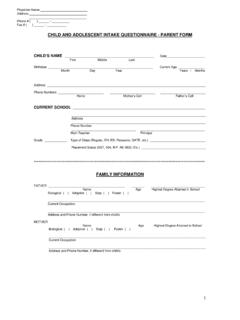
Transcription of Psychotherapy and ounseling Intake Forms
1 Psychotherapy and Counseling Intake Forms 50 Ready-To-Use Forms By Angela M. Doel, MS and Lawrence E. Shapiro, PhD Between Sessions Resources, Inc. Coral Gables, FL Psychotherapy and Counseling Intake Forms by Angela M. Doel, MS and Lawrence E. Shapiro, PhD Cover by Mike Canavan 2022 Between Sessions Resources Permission is granted for the purchaser to copy these worksheets for personal or professional use, but not for resale. All other rights are reserved. Disclaimer: This book is intended to be used as an adjunct to Psychotherapy . If you are experiencing serious symptoms or problems in your life, seek the help of an experienced mental health professional.
2 ISBN Published by Between Sessions Resources Suite 467 1825 Ponce De Leon Blvd. Coral Gables, FL 33134-4418 About the Authors Angela M. Doel, , is a writer and director of operations at Between Sessions Resources. She has served in various clinical supervisory positions and worked as a family therapist. Ms. Doel earned her in Counseling Psychology at the University of Pennsylvania. She holds an advanced certificate in nutritional counseling, and her areas of specialization are health education and eating disorders. Lawrence E. Shapiro, PhD, is a prolific author of self-help books and the inventor of more than 100 therapeutic games. Dr.
3 Shapiro is known for his practical approach to helping others. He has written workbooks, storybooks, card games, board games, and smartphone apps. His work has been translated into twenty-seven languages. Section 1. Intake FormsPAGEC lient Intake Form1 Life History Questionnaire6 Psychosocial History16 child Intake Form27 Developmental History Form32 Couples Therapy Intake Form43 Family Therapy Intake Form50 Opioid Use Intake Form57 New Client Basic Information67 Emergency Contact Form68 Initial Session Solution-Focused Questions69 Initial Session Checklist75 Section 2. Permissions, Policies, and Agreements76 Authorization for Appointment Reminders77 Informed Consent form for Outpatient Services79 Informed Consent for Group Therapy Sessions83 Permission to Obtain or Release Confidential Information87 Parental Consent for Treatment of Minors88 child and Adolescent Counseling Agreement91 Permission to Send Mail92 Treatment by Intern Informed Consent and Release94 Dialectic Behavior Therapy Client Agreement95 Couples Therapy Agreement98 Drug Testing Consent Form99 Consent for Treatment Using Exposure Therapy100 Authorization to Release Confidential Information to Family Members102 Authorization to Release Confidential Information
4 To Professionals103 Authorization to Use Unencrypted Email and Text104 Authorization for Recurring Credit Card Charges105 Request for Restriction on Use/Disclosure of Protected Health Information107 Sliding Scale Fee Agreement109 General Office Policies111 Appointment Policy113 Financial Policy114 Good Faith Estimate for Mental Health Services115 Client Rights119 Client Rights and Expectations (substance use)120 Acknowledgment of Receipt of Notice of Privacy Practices122 Electronic Communication Policy124 HIPAA Compliance Checklist126 HIPAA Compliance Privacy Notice129 Consent to Use Touch in Therapy134 Table of Contents Consent to Record Therapy Session135 Guest Therapy Consent136 Policy for Treating a child of Divorced, Separated, or Unmarried Parents137 Section 3.
5 Telehealth139 Telehealth Session Checklist140 Informed Consent for Telehealth Services141 Telehealth Safety Risks and Planning143 Telehealth Emergency Plan144 Telehealth Group Counseling Agreement146 Security Checklist for Electronic Devices148 Introduction Perhaps you are just starting out as a therapist, and you are interested in establishing an effective Intake process. Maybe you re a seasoned counselor and you want to ensure your Intake paperwork is up to date. The Intake process is one of the most important parts of the therapeutic process, as it lays the foundation for successful working relationships with your clients. You must ensure you get all the information you need to make informed decisions about how to assess and treat clients.
6 In addition, your clients must be provided with all the necessary information, so they have a clear understanding of confidentiality, your services, and their rights. The purpose of the Intake session is for you to create an accurate picture of a client s therapeutic needs. In other words, this session allows you to review all there is to know as if that s possible in one session! about a new client. One way in which you do that is through the use of Forms which include informed consent, release of information, questionnaires, intakes, and so on. During the Intake session, you might ask questions about current problems, therapy and treatment history, personal relationships, and therapy goals.
7 Along with basic client information, you must address: topics such as payment, ethical concerns, and the therapeutic relationship informed consent and release of information confidentiality and client rights and responsibilities any documents they filled out before the session the potential need for a crisis plan Because so much happens during the initial Intake session, it is often longer than the typical 50-minute session. Being clear and concise is particularly important. Having all the paperwork ready is essential. Before you sit down with your client or turn on your webcam for the Intake session, make sure you: have all the necessary paperwork ready review the pre-session questionnaire so you have a sense of your client s background and presenting problems write down questions you need to ask during the Intake session Once you are conducting the Intake session with your client, the most important skill you can practice is good listening.
8 This workbook makes it easier for you to focus on establishing the therapeutic relationship with your new client instead of scrambling for the necessary paperwork. This workbook includes every form you need to conduct the most effective Intake sessions with new clients. Visit for 100+ additional practice management Forms . Section 1. Intake Forms 1 CLIENT Intake form Please answer the following questions to the best of your abilities. This information is held to the same standards of confidentiality as our therapy sessions. This questionnaire will take approximately 30 minutes to complete. Name: _____ (Last) (First) (Middle initial) Name of parent or guardian (if minor): _____ Birth date: _____/_____/_____ Age: _____ Gender: ____Male ____Female ____Other: _____ Marital status: ___Single ___Partnered ___Married ___Separated ___Divorced ___Widowed Number of children: _____ Ages: _____ Home address: _____ City: _____ State: _____ Zip code: _____ Home phone: _____ May we leave a message?
9 Yes / No Cell/other: _____ May we leave a message? Yes / No Email: _____ May we email you?* Yes / No *NOTE: Emails may not be confidential. Referred by: _____ Are you currently receiving psychological services, professional counseling, psychiatric services, or any other mental health services? Yes / No Reason for change: _____ Have you had any mental health services in the past? Yes / No Reason for change: _____ Are you currently taking any psychiatric prescription medication? Yes / No 2 If yes, please list: _____ Have you been prescribed psychiatric prescription medication in the past? Yes / No If yes, please list: _____ General Health Information How would you describe your physical health at the present time?
10 ____Poor ____Unsatisfactory ____Satisfactory ____ Good ____ Very good Please list any persistent physical symptoms or health concerns ( , chronic pain, headaches, hypertension, diabetes, thyroid dysfunction, etc.): _____ Are you on any medication for physical/medical issues? Yes / No If yes, please list: _____ Are you having any problems with your quality of sleep? Yes / No If yes, check those that apply: ____ Sleep too much ____ Sleep too little ____ Poor quality ____ Disturbing dreams ____ Other: _____ How many times per week do you exercise? _____ days _____ minutes / hours Are there any changes or difficulties with your eating habits?