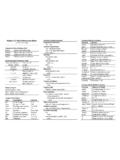
Transcription of Python 3 Cheat Sheet - Pages individuelles
1 Sequence Containers IndexingBase TypesPython 3 Cheat Sheet 2012-2015 - Laurent PointalLicense Creative Commons Attribution 4 Latest version on : "One\nTwo"'I\'m'str"""X\tY\tZ1\t2\t3""" 10-6escaped tabescaped new lineMultiline string:Container Typeslist[1,5,9]["x",11, ]["mot"][]tuple(1,5,9)11,"y", ("mot",)()dict{1:"one",3:"three",2:"two" , :" "}{"key":"value"}set{}{1,9,3,0} ordered sequences, fast index access, repeatable valuesset() key containers, no a priori order, fast key access, each key is unique{"key1","key2"}Non modifiable values (immutables)Variables assignmentx= +8+sin(y)
2 Y,z,r= , ,0 followed by diacritics allowed but should be avoided language keywords forbidden lower/UPPER case discrimination expression with only comas tupledictionarycollectioninteger, float, boolean, string, bytesIdentifiers a toto x7 y_max BigOne 8y and forx+=3x-=2increment x=x+3 decrement x=x-2 Conversionsfor lists, tuples, strings, int("15") 15int("3f",16) 63can specify integer number base in 2nd parameterint( ) 15truncate decimal partfloat(" ") ( ,1) to 1 decimal (0 decimal integer number)bool(x)False for null x, empty container x , None or False x ; True for other x str(x) ".
3 "representation string of x for display (cf. formatting on the back)chr(64) '@'ord('@') 64code charrepr(x) ".."literal representation string of xbytes([72,9,64]) b'H\t@'list("abc") ['a','b','c']dict([(3,"three"),(1,"one") ]) {1:'one',3:'three'}set(["one","two"]) {'one','two'}separator str and sequence of str assembled str':'.join(['toto','12','pswd']) 'toto:12:pswd'str splitted on whitespaces list of str"words with spaces".split() ['words','with','spaces']str splitted on separator str list of str"1,4,8,2".split(",") ['1','4','8','2']sequence of one type list of another type (via list comprehension)[int(x) for x in ('1','29','-3')] [1,29,-3]type(expression)lst=[10, 20, 30, 40, 50]lst[1] 20lst[-2] 4001234-5-4-3-1-2 Individual access to items via lst[index]positive indexnegative index012354-5-4-3-1-2negative slicepositive sliceAccess to sub-sequences via lst[start slice:end slice:step]len(lst) 5lst[1:3] [20,30]lst[::2] [10,30,50]lst[-3:-1] [30,40]lst[:3] [10,20,30]lst[:-1] [10,20,30,40]lst[3:] [40,50]lst[1:-1] [20,30,40]lst[.]
4 ] [10,20,30,40,50]Missing slice indication from start / up to mutable sequences (list), remove with del lst[3:5] and modify with assignment lst[1:4]=[15,25]Conditional Statementif age<=18: state="Kid"elif age>65: state="Retired"else: state="Active"Boolean LogicStatements Blocksparent statement: statement block parent statement: statement next statement after block 1indentation !Comparisons : < > <= >= == != = a and ba or bnot alogical andlogical orlogical notone or other or bothboth simulta--neouslyif logical condition: statements blockstatement block executed onlyif a condition is trueCan go with several elif, and only one final else.
5 Only the block of first true condition is [-1] 50lst[0] 10 last one first onex=None undefined constant valueMathsOperators: + - * / // % ** integer remainderabfrom math import sin, (pi/4) (2*pi/3) (81) log(e**2) ( ) 13floor( ) 12escaped ' floating approximated valuesangles in radians(1+ )*2 ( ) ( ,1) (4,3) variables, functions,modules, namesM mento (ordered sequences of chars / bytes)(key/value associations) pitfall : and and or return value of a or of b (under shortcut evaluation). ensure that a and b are booleans.
6 (boolean results)a=b=c=0assignment to same valuemultiple assignmentsa,b=b,avalues swapa,*b=seq*a,b=sequnpacking of sequence initem and listbytesbytesb"toto\xfe\775"hexadecimal octal0b0100xF30o642binaryoctalhexa""empt ydict(a=3,b=4,k="v")Items count keys=hashable values (base types, )TrueFalseTrue and False constants configure editor to insert 4 spaces in place of an indentation [::-1] [50,40,30,20,10]lst[::-2] [50,30,10]1) evaluation of right side expression value2) assignment in order with left side names= assignment binding of a name with a value immutablesOn mutable sequences (list), remove with del lst[3] and modify with assignment lst[4]=25del xremove name xb""@ matrix +numpy index from 0(here from 0 to 4)frozenset immutable setPriority (.
7 Usual order of operationsmodules math, statistics, random, decimal, fractions, numpy, etc. (cf. doc)Modules/Names Importsfrom monmod import nom1,nom2 as fctmodule truc file direct access to names, renaming with asimport monmod access via .. modules and packages searched in Python path (cf )?yesnoshallow copy of sequence?yesnoand*=/=%=.. with a var x:if bool(x)==True: if x:if bool(x)==False: if not x:raise ExcClass(..)Signaling an error:Errors processing:try: normal procesising block except Exception as e: error processing blocknormalprocessingerrorprocessingerro rprocessingraiseraise X()zero finally block for final processing in all on Errors"modele{} {} {}".
8 Format(x,y,r)"{selection:formatting!conv ersion}" Selection : 2 nom 4[key] 0[2]strDisplayprint("v=",3,"cm :",x,",",y+4)print options: sep=" "items separator, default space end="\n"end of print, default new line file= to file, default standard outputitems to display : literal values, variables, expressionsloop on dict/set loop on keys sequencesuse slices to loop on a subset of a sequenceConditional Loop Statementstatements block executed as long ascondition is truewhile logical condition: statements blocks = 0i = 1while i <= 100: s = s + i**2 i = i + 1print("sum.)
9 ",s)initializations before the loopcondition with a least one variable value (here i)s= i=1i=100i2 make condition variable change !statements block executed for each item of a container or iteratorfor var in sequence: statements blocks = "Some text"cnt = 0for c in s: if c == "e": cnt = cnt + 1print("found",cnt,"'e'")Go over sequence's valuesAlgo: count number of e in the over sequence's index modify item at index access items around index (before / after)lst = [11,18,9,12,23,4,17]lost = []for idx in range(len(lst)): val = lst[idx] if val > 15: (val) lst[idx] = 15print("modif:",lst,"-lost:",lost)Algo.
10 Limit values greaterthan 15, memorizingof lost values. beware of infinite loops!initializations before the looploop variable, assignment managed by for statementvalues to formatformating directivesInteger SequencesFiless = input("Instructions:") input always returns a string, convert it to required type(cf. boxed Conversions on the other side).range(5) 0 1 2 3 4range(2,12,3) 2 5 8 11range(3,8) 3 4 5 6 7range(20,5,-5) 20 15 10range(len(seq)) sequence of index of values in seq range provides an immutable sequence of int constructed as neededrange([start,] end [,step])f = open(" ","w",encoding="utf8")storing data on disk, and reading it backopening mode 'r' read 'w' write 'a' append.