Transcription of Quality standards for dermatology - British …
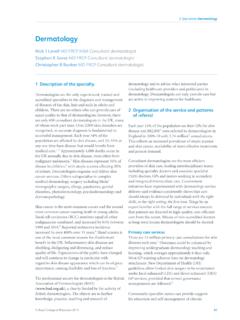
1 Quality standards for dermatologyproviding the right care for people with skin conditionsthis standards document was initiated by the British association of dermatologists (B ad) and has been made possible by the invaluable support of the many stakeholder groups who have offered their endorsement and whose representatives joined the project advisory group and working group. the standards could not have been developed without the support and commitment of the project advisory group and working group and, in particular, the unstinting hard work of the standard leads: Janet mclelland (project lead), Helen frow, andrew langford, rebecca Penzer and Julia schofield.
2 We are also extremely grateful to all those who offered expert advice and feedback in response to the would like to thank the British association for sexual Health and HiV (BasHH), on the format of whose standards for the management of sexually transmitted infections (stis) we based ours, and in particular dr i mmy ahmed for his advice about the process they support has come from the Bad, the British dermatological nursing group (Bdng), the Primary Care dermatology society (PCds) and the skin Care Campaign (sCC).We would like to acknowledge input from the department of are particularly grateful to our writer, diane stafford, whose ability.
3 Commitment to Quality and persistence were essential in producing this department of health has provided a supporting role in the development of these standardsacknowledgementsAcknowledgement s Foreword by Baroness Masham 01 Executive summary 02 Introduction 05 standard 1 Principles of dermatology care 07 standard 2 Patient and public involvement 13 standard 3 Appropriately trained staff 17 standard 4 Clinical assessment and management 22 standard 5 Models of care and links to other services 28 standard 6 Diagnostic investigations 33 standard 7 Clinical governance 37 standard 8 Information governance 41 appendices appendix a Membership of the project groups 47 appendix B Levels of care for skin conditions in the UK 48 appendix c The commissioning cycle 50 appendix d dermatology education and training 51 appendix e Links to other services 56 appendix f Clinical guidance, audit and risk management 58 appendix g Key performance indicators 59 Glossary of abbreviations 61 Contentscontents skin disease in the Uk is.
4 The most prevalent disease in under 16s (1 in 5 babies have eczema) the second most common disease in adults Each year 24% of the population present to their GP with a skin problem. Skin cancer is the most common form of cancer in the UK and malignant melanoma incidence rates in Britain have more than quadrupled since the 1970s. Millions of people in the UK are affected by skin conditions and the best possible care is vital so that they remain as healthy as they can and are able to lead fulfilling lives. To deliver care of this order, commissioners, clinicians and patients must know what constitutes an acceptable level of service and be enabled to develop services that meet the needs of everyone with a skin condition.
5 Because these standards are based on research-backed evidence, they can be used to highlight services that offer real value for money and, crucially, to challenge inadequate service provision and request diseases not only cause great discomfort and disfigurement, they also affect people psychologically and socially, each in different ways. I am delighted that these standards not only cover the essential services needed to treat the skin disease itself, but also highlight the vitally important holistic services that ensure the whole person is treated as effectively as is vital to remember that each skin disease can have a wide range of symptoms and effects beyond the purely clinical.
6 For example: the mother exhausted from constantly wet-wrapping her persistently crying baby who has eczema the 15-year-old boy who hanged himself with his school tie because he was being bullied about his acne the woman with vitiligo who no longer leaves the house because she has been subjected to ridicule the woman who no longer has sex because of her lichen sclerosus These are just a few of the millions of people whose lives are affected by skin conditions and could be improved by implementing these standards across the healthcare economy, so that services really do meet the needs of the individual. I offer my congratulations to all involved in developing these excellent and very useful standards and add my fervent hope that they will be widely Masham of iltonforeword by Baroness masham of ilton01 Quality standards for dermatologyi am delighted to write the foreword for this very important guidance.
7 Having been the president of the psoriasis association for over 20 years and as a long-term member of the all party parliamentary group on skin, i wholeheartedly support these standards and will take a very keen interest in the way they are received and implemented. f orewordexecutive summary02 Quality standards for dermatologyAnyone commissioning services is well aware of the need to commission for Quality , innovation, productivity and prevention and to use resources in the most cost-efficient manner. As the way that services are commissioned continues to evolve, the twin challenges of assessing the Quality of care offered by various service providers and ensuring that patients can access care of a high standard remain.
8 These standards are intended as a reference guide to what constitutes a good- Quality service for both commissioners and providers of care for patients with skin are eight standards and each comprises a series of recommendations, with rationales and references to support these, a list of implications for commissioners and at least one key performance indicator. This executive summary highlights only the key points from each standard. standard 1: principles of dermatology careThis covers the overarching principles that should underpin the provision of care for people with skin conditions. These principles are absolutely crucial to the delivery of good- Quality care and should be viewed as non-negotiable.
9 Every local health economy must provide for full and fair patient access to the full range of high- Quality dermatology services at all levels of care - to this end, models of care should be developed using stakeholder commissioning groups. Consistent, nationwide high- Quality care that meets independent Quality standards , such as those developed by NICE, is a cornerstone of the NHS for the 21st century it can only be achieved if there is clear local support for independent Quality standards . People with skin conditions should have their care managed at a level appropriate to the severity and complexity of their condition, acknowledging that this may vary over time.
10 All services should have access to a range of supportive services that can help meet the holistic needs of people with skin conditions - these could include psychological support, access to medical social workers, camouflage services and occupational therapy. Because it is so fundamental to the delivery of good- Quality care, we urge all readers to read Standard 1 in full on pages 2: patient and public involvement The best way to design and develop user-centred dermatology services that meet the needs of people with skin conditions is to involve potential and current service users in their design, development and ongoing governance.