Transcription of Quantitative, Qualitative and Mixed Methods What is the ...
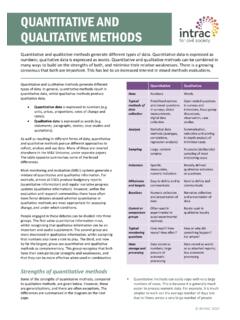
1 Page 1 of 4 quantitative , Qualitative and Mixed Methods What is the difference between quantitative and Qualitative data, and what s Mixed Methods ? Which is better? This guide introduces the difference between quantitative and Qualitative data, and explains what they are each suitable for. It is intended to help you interpret what you read in journal articles in order to make critical evaluation easier. It will also be useful if you are thinking about collecting your own data for a dissertation or other research-based project to make sure that you design your project well from the beginning. quantitative data is numbers and statistics. The advantage here is that you can collect and analyse much more information. With good design, that means you can make general statements about what is likely to be true overall.
2 A drawback can be a lack of depth ( reasons why, context, emotions or feelings). Also, it requires mathematical and/or statistical knowledge to be able to analyse the data effectively. Descriptive statistics (bar graphs, pie charts, etc.) are useful to present the data and inform the reader, but are not usually adequate analytical Methods . These only describe your sample. Inferential statistics are used to explain or demonstrate hypotheses in the overall population. Your research design needs to consider what statistical analyses will be performed from the beginning. You need to know at the outset what type of data you will be collecting. For example, if you are collecting data on sickness at work, you could collect this as a yes/no type question ( have you been off sick in the last month) or as a scale ( how many days have you been off sick).
3 So the data that you need affects the questions that you ask. When reading articles which use quantitative data, examine the methodology section to see how they have identified their population and sample. Also examine this section to see whether or not their approach supports their conclusion. For example, studies may identify a similarity between two variables ( ice cream sales and murders committed) and conclude that there is a link (although it may be coincidental) or it could be due to a third variable ( heat - murders go up in summer and so do ice cream sales). So always look for alternative explanations for the link or explanation the author is proposing. Qualitative data includes words, opinions, thoughts, feelings and behaviours. The advantage is that you get lots of detail about specific cases, people or group.
4 The disadvantages are that you can t make general statements, and that analysis is time-consuming. Some would argue that the analysis is also very subjective, but this depends on your approach. When reading a piece of Qualitative research, look for the level of detail and clarity in the methodology and particularly how they analysed the data. For example, you will often see thematic analysis referred to, but the author should give details about how the themes were identified and on what basis where certain themes kept and others ignored. Also, be alert to what generalisations are made on the basis of very small samples or case studies. A good Qualitative research article will have a solid basis in previous research and will compare their results to other studies. It will also include lots of rich detail, usually in the form of quotes or examples, to illustrate their interpretations.
5 So read the results sections carefully, and see whether or not you agree with how they have analysed the data. Page 2 of 4 Which one you should use typically depends on your research questions and topics, as well as your purpose. If your purpose is to explain, measure, and/or prove a link between two different things ( diet and obesity), quantitative data would probably be more appropriate. For example, quantitative data topics might be: A company s profitability A comparison of primary school children s reading marks and family background How rates of secondary infection in a hospital ward change in winter How many newspaper articles mention immigration in a given period The frequency of particular personality types introversion If your purpose is to explore, illustrate, and/or give rich and detailed information about particular instances, you are probably going to prefer Qualitative data.
6 Qualitative data topics might be: Consumer perceptions of a company or brand Parents feelings and habits about reading to their children Nurses knowledge and opinions of infection prevention protocols How newspaper articles describe and represent immigrants How introverts think of themselves Note that all of these topics are much too vague to be really good dissertation or research article titles; they need to be more focused in reality. And purpose depends on previous literature. If previous research shows you that rates of secondary infection in hospital wards usually go up in the winter, you don t need to repeat that research. But perhaps you might have a new idea about why, which you could test. Consider this when reading articles: was their research really necessary?
7 What new knowledge is the article adding? This is one of the best places to start with a critical evaluation of a research article: were they right in their choice of Qualitative or quantitative data? But it s worth noting that certain subjects have a very strong preference for a certain type of data - for example, Qualitative research is very common in education, and quantitative research is common in business and management studies. Question whether this may have influenced the author's choice. So the first question is what type of information will answer the research question ? If your question is how do parents feel about reading to their children , collecting statistics on reading test results will not answer the question. Interviewing parents, on the other hand, could give you some answers.
8 The second question you need to ask yourself is: how objective is the topic? Is it actually possible or appropriate to measure it quantitatively? If you know want to measure rates of secondary infection, collecting quantitative data is appropriate. People either do or do not get a secondary infection in hospital, so you can count the rates and get a useful answer. If, on the other hand, you want to know how a Page 3 of 4 particular work of art is perceived by viewers, this will be entirely subjective each individual will be different in their perception. So you could make a questionnaire and ask them to tick boxes about their perceptions, to get quantitative results. But would this be appropriate? Would you be forcing individual views into pre-defined categories and losing interesting information?
9 It could be much better to interview or collect Qualitative questionnaire responses. Don t assume, then, that quantitative data is better. For some topics, Qualitative is the best option. Look out for this in journal articles: have they attempted to deal with a fundamentally objective topic in a highly subjective way? Or vice versa, have they tried to measure something in a standardised way which is very personal and individual? Some researchers do this in ways you may think are inappropriate, and it s a good question to ask in a critical evaluation or literature review whether a different approach would have been more appropriate. Generally speaking, if you want to know about: Frequency Rates Amounts Scores Measurable differences Or anything objective Whereas if you want to know about: Feelings Thoughts Opinions Beliefs Perceptions Representations Language Or anything subjective *Unless you can define particular categories ( positive or negative opinions) and want to collect a large set of data.
10 What about Mixed Methods ? Is that better? Mixed Methods means that you collect both quantitative and Qualitative data and analyse both together to answer your question. For instance, say you wanted to know whether parents feelings about reading with their children affected children s reading scores. You could interview parents, sort them into groups ( confident, Mixed feelings, and anxious) and compare the test scores of children whose parents fall into different groups. That would be a good Mixed Methods design, because you are using the Qualitative data to inform the analysis of the quantitative data (known as multi-stage research design). Alternatively you can triangulate , or collect different types of data to check your findings or illustrate your interpretations. For instance, you could compare the reading test scores of children, and also interview them and their parents to find out how they feel about reading.