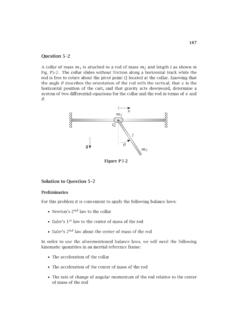
Transcription of Question 3–12 - Anil V. Rao
1 105 Question 3 12A particle of massmis attached to a linear spring with spring constantKandunstretched lengthr0as shown in Fig. P3-12. The spring is attached at its otherend at pointPto the free end of a rigid massless arm of lengthl. The armis hinged at its other end and rotates in a circular path at a constant angularrate . Knowing that the angle is measured from the downward directionand assuming no friction, determine a system of two differential equations ofmotion for the particle in terms ofrand . tlmrKOP Figure P3-12 Solution to Question 3 12 KinematicsFirst, letFbe a fixed reference frame.
2 Then, choose the following coordinatesystem fixed in reference frameF:Origin atOEx=AlongOPWhent=0Ez=Out of PageEy=Ez ExNext, letAbe a reference frame fixed to the arm. Then, choose the followingcoordinate system fixed in reference frameA:Origin atOex=AlongOPez=Out of Page(=Ez)ey=ez exFinally, letBbe a reference frame fixed to the direction along which the springlies ( , the directionPm). Then, choose the following coordinate system fixed106 chapter 3. Kinetics of Particlesin reference frameB:Origin atOur=AlongPmuz=Out of Page(=Ez=ez)u =uz urThe geometry of the bases{Ex,Ey,Ez},{ex,ey,ez}, and{ur,u ,uz}is shown inFig.
3 3-10. Using Fig. 3-10, we have the following relationship between the basise t turu eyuz,ez,EzExEyx Figure 3-10 Geometry of Bases{Ex,Ey,Ez},{ex,ey,ez}, and{ur,u ,uz}forQuestion 3 12 .{ex,ey,ez}and the basis{ur,u ,uz}:ex=cos( t)ur sin( t)u ey=sin( t)ur+cos( t)u ( )Next, observing that the basis{ex,ey,ez}rotates with angular rate relativeto the basis{Ex,Ey,Ez}, the angular velocity of reference frameAin referenceframeFis given asF A= Ez= ez( )Next, using Eq. ( ), we observe that the angle formed betweenthe basisvectorsurandex(and similarly betweenu andey) is t.
4 Consequently,the angular velocity of reference frameBin reference frameAis given asA B=( )ez=( )uz( )Finally, observing that the basis{ur,u ,uz}rotates with angular rate relativeto the basis{Ex,Ey,Ez}, we obtain the angular velocity of reference frameBin107reference frameFasF B= uz( )The position of the particle can be written asr=rP+rm/P( )whererPis the position of pointPandrm/Pis the postion of the particle relativeto pointP. In terms of the bases defined above, we have thatrP=Rexrm/P=rur( )Substituting the expressions from Eq. ( ) into Eq.
5 ( ), we obtainr=Rex+rur( )Differentiating the expression for the position as given in Eq.( ) in referenceframeF, we have thatFv=Fdrdt=Fddt(rP)+Fddt rm/P =FvP+Fvm/P( )Now sincerPis expressed in the basis{ex,ey,ez}and{ex,ey,ez}is fixed inreference frameA, we can apply the rate of change transport theorem torPbetween reference framesAandFto giveFvP=Fddt(rP)=Addt(rP)+F A rP( )Now we have thatAddt(rP)=0F A rP= ez Rex=R ey( )Adding the two expressions in Eq. ( ), we obtainFvP=R ey( )Next, sincerm/Pis expressed in the basis{ur,u ,uz}and{ur,u ,uz}is fixed inreference frameB, we can apply the rate of change transport theorem torm/Pbetween reference framesBandFto giveFvm/P=Fddt rm/P =Bddt rm/P +F B rm/P( )108 chapter 3.
6 Kinetics of ParticlesNow we have thatBddt rm/P = rurF B rm/P= uz rur=r u ( )Adding the two expressions in Eq. ( ), we have thatFvm/P= rur+r u ( )Then, adding Eq. ( ) and Eq. ( ), we obtain the velocity of the particle inreference frameFasFv=FvP+Fvm/P=R ey+ rur+r u ( )Now the acceleration of the particle in reference frameFis given asFa=Fddt Fv =Fddt FvP +Fddt Fvm/P =FaP+Fam/P( )Observing that the expression forFvPas given in Eq. ( ) is expressed in thebasis{ex,ey,ez}and{ex,ey,ez}is fixed in reference frameA, we can applythe rate of change transport theorem toFvPbetween reference framesAandFto giveFaP=Fddt FvP =Addt FvP +A F FvP( )Now sinceRand are constant, we have thatAddt FvP =0F A FvP= ez R ex= R 2ey( )Adding the two expressions in Eq.
7 ( ), we obtain the acceleration of pointPin reference frameFasFaP= R 2ex( )Next, sinceFvm/Pis expressed in the basis{ur,u ,uz}and{ur,u ,uz}is fixedin reference frameB, the acceleration of the particle relative to pointPin refer-ence frameFcan be obtained by applying the rate of change transport theoremtoFvm/Pbetween reference framesBandFasFam/P=Fddt Fvm/P =Bddt Fvm/P +F B Fvm/P( )Now we have thatBddt Fvm/P = rur+( r +r )u F B Fvm/P= uz ( rur+r u )= r 2ur+ r u ( )109 Adding the two expressions in Eq. ( ), we obtain the acceleration of theparticle relative to pointPin reference frameFasFam/P=( r r 2)ur+(2 r +r )u ( )Then, adding Eq.
8 ( ) and Eq. ( ), we obtain the accelerationof the parti-cle in reference frameFasFa= R 2ex+( r r 2)ur+(2 r +r )u ( )Finally, using the expression forexin terms of{ur,u }from Eq. ( ), theacceleration of the particle in reference frameFcan be written in terms of thebasis{ur,u ,uz}asFa= R 2[cos( t)ur sin( t)u ]+( r r 2)ur+(2 r +r )u ( )Simplifying Eq. ( ), we obtainFa=[ r r 2 R 2cos( t)]ur+[2 r +r +R 2sin( t)]u ( )Kinetics and Differential Equations of MotionIn order to obtain the two differential equation of motion for the particle, weneed to apply Newton s 2ndlaw, ,F=mFa.
9 The free body diagram of theparticle is shown in Fig. 3-11. It can be seen that the only force acting on theFsFigure 3-11 Free Body Diagram of Particle for Question 3 12 .particle is due to the linear spring,Fs. Consequently, we have thatFs= K 0 us( )Now we are given that the unstretched length of the spring isrOwhich impliesthat 0=r0. Furthermore, the attachment point of the spring isrA=rP. Conse-quently, the stretched length of the spring is given as = kr rAk = kr rPk( )Using the expression forrfrom Eq. ( ) and the expression forrPfromEq. ( ), we obtain = krur+Rex Rexk = krurk =r( )110 chapter 3.
10 Kinetics of ParticlesFinally, we have thatus=r rAkr rAk=r rPkr rPk=rurr=ur( )The spring force is then given asFs= K(r r0)ur( )The resultant force acting on the particle is then given asF=Fs= K(r r0)ur( )Then, settingFin Eq. ( ) equal tomFawhereFais obtained from Eq. ( ),we obtain K(r r0)ur=m[ r r 2 R 2cos( t)]ur+m[2 r +r +R 2sin( t)]u ( )Equating components in Eq. ( ), we obtain the following two scalar equa-tions:m[ r r 2 R 2cos( t)]= K(r r0)( )m[2 r +r +R 2sin( t)]=0( )It can be seen that neither Eq. ( ) nor Eq. ( ) contains any unknown re-actions forces.