Transcription of QUICK GUIDE TO DETERMINING EYE WASH …
1 Page 1 of 2. QUICK GUIDE TO DETERMINING EYE wash REQUIREMENTS. Ministries of Labour enforce the compliance to MSDS (Material Safety Data Sheet) requirements Introduction Under what circumstances are Eye wash units required? Most common hazards include painting, chemical storage/usage, battery charging areas, etc. If you already are using chemical resistant gloves, respirators, or chemical resistant goggles, chances are the MSDS will require a 15-Minute Primary Eye wash Device. As I am sure you are aware, legislation requires you have current MSDS on file for all chemicals used in your facility ( cleaning compounds, battery charging areas, solvents, photocopy toner, whiteout, etc.)
2 Your MSDS Provides Crucial Information A copy of the MSDS should be readily available for review by all employees. Backup copies of the MSDS. should be available in your Safety and Medical Department and/or front office. Review the MSDS First Aid Measure Section to ensure the proper Eye wash Equipment is implemented. In the event of an emergency, the MSDS for that particular hazardous substance should be identified and brought with the injured party when further medical help is sought. This will aid medical personnel in the proper treatment of the injury.
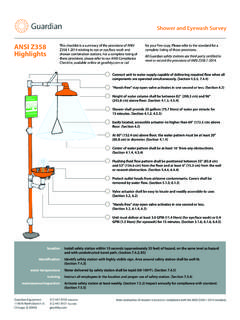
3 For additional information on WHMIS stations, click here. Definition of Primary Eye wash Device A Primary Eye wash Device may be a self-contained, portable, or plumbed unit that: I. Activates within 1 second or less, II. Flushes both eyes simultaneously, III. Provides hands free operation, IV. ANSI requires the delivered flushing fluid temperature shall be tepid (moderately warm, lukewarm). This is to encourage the full 15-Minutes of flushing. In other No ice cream headaches! V. ANSI requires eye wash units to deliver adequate amounts of water (15 minutes) for rinsing.
4 However, the water flow has to be softened so the force does not drive the contaminants into the optic system. This is one of many reasons why the garden hose idea is not acceptable. VI. Delivers not less than gpm ( Lpm) for a minimum of 15 minutes (copious amounts), VII. For further information, click here. Additional ANSI Standards Requirements Emergency Eye wash equipment is no more than 10 seconds to reach. Path of travel should be free of obstructions that may inhibit the immediate use of the emergency eye wash unit.
5 For strong acids or strong caustics, the Eye wash should be immediately adjacent to hazard. All employees who may be exposed to hazardous material shall receive the appropriate training as per ANSI Standards. For more information, click here (WPCC 15 minute Primary Eye wash Products now available). Definition of Secondary/Personal Eye wash Device Secondary/Personal Eye wash Devices do not meet the standard for 15-minute primary devices and are, therefore, intended for support use, not as a replacement for self-contained, or plumbed units.
6 These devices are located in the immediate vicinity of employees working in a potentially hazardous area and are used to deliver initial first aid while getting the person to a 15-minute primary unit, or as extended aid when transporting a person from the 15- minute primary eye wash unit to a medical facility. Secondary / Personal Eye wash devices provide less than 15. minutes (copious amounts) of the flushing required. Brought to you by Talott First Aid & Safety, innovators and creators of functional products.
7 Tel: 613 225-9517 Fax: 613 727-8445. 4-46 Antares Dr., Box 5119, Station F , Ottawa, Ontario, Canada K2C 3H4 Created on 1/28/15 11:30 AM. Page 2 of 2. Evaluate Your Current Eye wash Situation Ministries of Labour enforce the compliance to MSDS (Material Safety Data Sheet) requirements Do you currently have Eye wash units? If YES (see A). If NO (see B). A What type? Plumbed o Are the units being flushed weekly and documented as required by ANSI o Do they provide water at a flushing temperature that is tepid - moderately warm, lukewarm as required by ANSI o Are they in the correct location?
8 15-Minute Primary Self Contained flushing units. o Are they being maintained according to the manufacturer's requirements? o Are they in the correct location? Secondary (personal) Eye wash units that deliver less than 15-Minutes of flush. o Are the Secondary Eye wash units sufficient? See B. B Check your MSDS under first aid requirements section. The MSDS will indicate whether a 15-Minute Primary Eye wash device is required. Words like 15-Minutes of flushing, or copious amounts of water ..are used. Once Eye wash needs have been determined from the MSDS requirements, you then have the following options: Plumbed Eye wash Stations Device must comply with definition of 15-Minute Primary Eye wash Unit as required by ANSI o NOTE: faucet mounted eye wash devices are defined as Secondary, not 15-Minute Primary Units.
9 Consider the following: Expense associated with installation and/or relocation to hazards. Adequate drainage should be available to prevent slip hazards. Tap water, which may contain rust, scale, and contaminants that could further damage delicate eye tissue. Water temperature shall be tepid, (moderately warm, lukewarm), as required by ANSI To achieve this, an Emergency Eye wash Tempered Water Blending System is required. Additional expense. Maintenance - Plumbed systems must be flushed weekly and documented as required by ANSI 2004.
10 To request additional information on available equipment click here. Pure Flow 1000 15-Minute Primary Self Contained Eye wash Station: Is SEI Certified and fully comply as required by ANSI Standard. Consider the following: Mounts virtually anywhere Delivers ambient temperature flushing solution. Delivers a buffered saline solution as recommended by ANSI Solution replacement up to 24 months (2 years). For more information, click here (Available WPCC 15-Minute Primary Eye wash Products Information). Brought to you by Talott First Aid & Safety, innovators and creators of functional products.