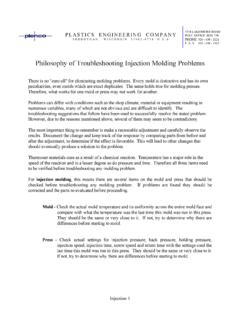
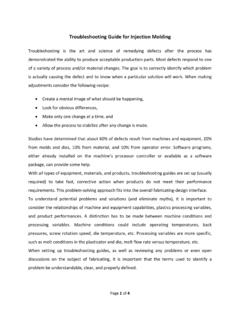
Transcription of Quick Guide to Injection Molding - Solvay
1 Technical Bulletin Specialty polymerSQuick Guide to Injection MoldingTo r lo n PAIT orlon polyamide-imide (PAI) resins process under a unique set of conditions and certain aspects of the Injection Molding equipment are specific to this material. Because Torlon PAI is a reactive polymer, the polymer will increase in molecular weight via chain extension, branching and cross-linking when heated. To avoid this during Injection Molding and to produce high-quality components, specific equipment considerations and processing procedures must be followed.
2 EquipmentInjection Molding Machine Modern reciprocating screw Injection Molding machines with microprocessor controls capable of closed loop control are recommended for Molding Torlon PAI resin. Barrel size should be such that 50 % to 80 % of the barrel is used for each shot to minimize residence time. Clamp tonnage should allow for at least 4 tons of clamp pressure per square inch (620 kg/sq cm) of projected part area. A reverse taper nozzle is Design Low compression ratio screw with no check device is necessary.
3 Compression ratio between 1 : 1 and : 1 is recommended. L/D (length to diameter) ratio of the screw should be between 18 : 1 and 24 : contact Solvay for assistance with specifying screw designs and locating suitable screw manufacturers. Figure 1: Screw designCompression ratio 1:1 :1 Length-to-diameter ratio 18:1 24:1 Smooth, constant taperRudimentary ights on screw tipDrying Torlon PAI resins are hydroscopic and require drying before Injection Molding . Drying equipment must be capable of achieving temperatures of at least 121 C (250 F) and maintaining a dew point of 40 C ( 40 F).
4 Capacity of the drying system should be adequate to allow the recommended drying time in a continuous operation, which is typically 12 hours at the above conditions. Shorter drying times can be achieved at higher temperatures (see Figure 2). Moisture analysis equipment is recommended to insure that the maximum recommended moisture content of 500 ppm ( %) is achieved. Resin must be kept dry throughout the entire Molding 2: Drying time at various temperatures using dessicant drying systemMoisture content [ppm]Drying time [Hours]5,0002,00010,0001,000500200100004 812162024121 C (250 F) 149 C (300 F)177 C (350 F) 2 \ Quick Guide to Injection Molding Torlon PAItable 1.
5 Starting point Molding conditionsDrying Instructions (1)Drying temperature 149 C (300 F)Drying time8 hoursMolding ConditionsTarget melt temperature360 C 382 C (680 F 720 F)Barrel temperaturesRear zone304 C (580 F)Middle zone327 C (620 F)Front zone343 C (650 F)Nozzle temperature371 C (700 F)Mold temperature177 C 232 C (350 F 450 F) Injection speedHighHold pressureApproximately 50 % of pressure needed to achieve Injection speedBack pressureModerate, 7 bar 14 bar (100 psi 200 psi)Screw speed50 rpm 100 rpm(1) Optional drying temperatures and times are shown in Figure 2process control and monitoringThe Molding process should be controlled by screw velocity and position, not by pressure and time.
6 This will insure a controlled Injection rate and fill time. The following three parameters can be monitored to insure that the process is in control once acceptable parts are molded: Injection time: This is the time it takes the screw to move forward from full shot position to the transfer position. It is a critical parameter and should be monitored continuously. Final cushion position: This is the final position of the screw after the part has been injected and fully packed. It is a volumetric indication of the amount of polymer injected into the mold and should be monitored continuously.
7 Pressure required to achieve Injection velocity: This is an indication of the relative viscosity of the polymer and should be monitored as well. Injection time and final cushion position parameters should be equipped with alarms and tightly controlled, as even small changes can have significant effect on the quality of molded parts. Pressure can be allowed to fluctuate slightly, but within an established processing band. Typically, this parameter will change significantly before either of the other two change, and it can be used to detect a processing problem before unacceptable parts are and purgingTorlon PAI resins must not be left in the barrel of the Molding machine during process interruptions or at the completion of a Molding run.
8 Suitable purge compounds with thermal capabilities in excess of 371 C (700 F) are commercially available and should be used to completely purge the Torlon PAI resin from the machine. Please contact Solvay for recommended materials and their to follow proper purging procedures can result in contamination in subsequent Molding runs and even damage the cureParts Injection molded from Torlon PAI must undergo a thermal process known as post cure. This step is necessary to achieve properties detailed in the Torlon PAI Design Guide .
9 Uncured or inadequately cured parts will not perform at the expected post cure process involves placing molded parts in a forced air oven and thermally treating them using a series of increasing temperatures for varying times. The standard cure cycle shown in Table 2 is suitable for parts with maximum cross-sectional thickness of mm ( inch). Solvay can help you determine the best cure schedule for your application and test that molded parts are fully cured. table 2: Standard 17-day cure cycletimecure temperature1 Day149 C (300 F)1 Day191 C (375 F)1 Day204 C (400 F)1 Day218 C (425 F)1 Day232 C (450 F) 1 Day243 C (470 F)1 Day252 C (485 F)10 Days260 C (500 F)Maximum cross-sectional thickness of mm ( inch) | Europe, Middle East and Africa | Americas | Asia Safety Data Sheets (MSDS) are available by emailing us or contacting your sales representative.
10 Always consult the appropriate MSDS before using any of our products. Neither Solvay Specialty Polymers nor any of its affiliates makes any warranty, express or implied, including merchantability or fitness for use, or accepts any liability in connection with this product, related information or its use. Some applications of which Solvay s products may be proposed to be used are regulated or restricted by applicable laws and regulations or by national or international standards and in some cases by Solvay s recommendation, including applications of food/feed, water treatment, medical, pharmaceuticals, and personal care.