Transcription of Quick Look at Vaccines Needed for Sickle Cell Disease
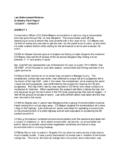
1 A Quick look at Vaccines Needed for Persons with Sickle Cell Disease Michigan Department of Health and Human Services Division of Immunization Page 1 of 2 May 17, 2019 Sickle cell Disease is a group of inherited red blood cell disorders. Because people with Sickle cell Disease are at an increased risk of infection and other health problems, vaccination is especially important. Common illnesses such as influenza can quickly become dangerous for a person with Sickle cell Disease . Persons with Sickle cell Disease should receive all age-appropriate vaccinations following the Centers for Disease Control (CDC) and Advisory Committee on Immunization Practices (ACIP) routine recommended In addition, people with Sickle cell Disease are at an increased risk for infection by encapsulated bacteria such as pneumococcus, meningococcus, and Haemophilus influenzae type b (Hib).
2 Because of this, people with Sickle cell Disease will need additional vaccine doses. This Quick look provides guidance for additional vaccine doses Needed for persons with Sickle cell Disease . HIB VACCINATION RECOMMENDATIONS FOR Sickle CELL Disease : PERSONS AGED 0-18 YEARS: Vaccinate according to the routine recommendation, 2- or 3-dose primary series (depending on vaccine used) at 2 and 4 months, or at 2, 4, and 6 months, and a booster dose at 12-15 months. This is a complete Hib vaccine series. For children aged 12-59 months: If 0 doses or 1 dose of Hib vaccine was given before age 12 months, give 2 doses of Hib, 8 weeks apart. If 2 or more Hib doses were given before age 12 months, give 1 dose of Hib at least 8 weeks after previous dose. For children aged 5-18 years, if the child has not received a complete Hib series before age 14 months OR at least 1 dose of Hib vaccine at or after 14 months of age, give 1 dose Hib.
3 PERSONS AGED 19 YEARS AND OLDER: If no previous dose of Hib vaccine received, give 1 dose of Hib. PCV13 AND PPSV23 VACCINATION RECOMMENDATIONS FOR Sickle CELL Disease : PERSONS AGED 0-18 YEARS: Note: All recommended PCV13 doses should be administered prior to PPSV23 vaccination if possible. PCV13 and PPSV23 should NOT be administered during the same visit. For PCV13, vaccinate according to the routine recommendation, a 4-dose series at 2, 4, and 6 months, and at 12-15 months. Persons aged 2 years should receive 2 doses of PPSV23 separated by 5 years, beginning at least 8 weeks after completing all recommended doses of For children aged 2-5 years: If a 3-dose PCV13 schedule was received previously, give 1 dose PCV13 at least 8 weeks after last PCV13 dose. If fewer than 3 PCV13 doses were received previously, give 2 doses of PCV13.
4 Give the first PCV13 8 weeks after the most recent dose, then give the last dose 8 weeks later. If no history of PPSV23, give 1st dose of PPSV23 at least 8 weeks after last PCV13 dose, give 2nd PPSV23 5 years after the 1st. For children aged 6-18 years: If no history of either PCV13 or PPSV23, give 1 dose of PCV13, 8 weeks later give 1st dose of PPSV23. Give 2nd PPSV23 dose 5 years after the 1st PPSV23 dose. If child has received PCV13 but not PPSV23, give 2 doses of PPSV23 (1st dose at least 8 weeks after most recent PCV13 dose, 2nd dose at least 5 years after 1st PPSV23) If child has received PPSV23 but not PCV13, give 1 dose PCV13 at least 8 weeks after most recent PPSV23. Ensure 2nd dose of PPSV23 is given 5 years after the 1st PPSV23 dose and at least 8 weeks after PCV13. PERSONS AGED 19 YEARS AND OLDER: Note: All recommended PCV13 doses should be administered prior to PPSV23 vaccination if possible.
5 PCV13 and PPSV23 should NOT be administered during the same visit. For adults aged 19 years and older with no previous dose of PCV13 received, give 1 dose PCV13. For adults aged 19 years and older with no previous dose of PPSV23 received, give 2 doses PPSV23, 5 years apart. For adults aged 65 years and older, give 1 dose PPSV23 this will be the final dose. Ensure 5-year interval from last PPSV23 dose. Minimum intervals between PCV13 and PPSV23 for adults aged 19 years and older are: If PCV13 given first (preferred), wait at least 8 weeks before giving PPSV23. If PPSV23 given first, wait at least 1 year before giving PCV13. Michigan Department of Health and Human Services Division of Immunization Page 2 of 2 May 17, 2019 MENACWY AND MENB VACCINATION RECOMMENDATIONS FOR Sickle CELL Disease : PERSONS AGED 0-18 YEARS: If using Menveo : For children initiating at age 8 weeks, give a 4-dose series at 2, 4, 6, and 12 months.
6 For children initiating at age 7-23 months, give 2 doses. The 2nd dose should be at least 12 weeks after the 1st dose and after the 1st birthday. For children initiating at age 24 months and older, give 2 doses, 8 weeks apart. If using Menactra : For children aged 24 months and older, give 2 doses, 8 weeks apart. Do NOT administer Menactra until 2 years of age3 and at least 4 weeks after completion of all PCV13 doses. It is recommended to give Menactra either before or at the same time as DTaP (if given after, wait 6 months after DTaP dose). MenACWY boosters: Regardless of which vaccine was used for primary series, boost with Menveo or Menactra . If most recent meningococcal vaccine was given before age 7 years, give 1st booster 3 years after most recent dose, with additional boosters every 5 years. If most recent meningococcal vaccine was given at/after age 7 years, give 1st booster 5 years after most recent dose and boost every 5 years thereafter.
7 Meningococcal B: For children aged 10 years and older without a complete MenB series, give either 2 doses Bexsero (1 month apart), or 3 doses Trumenba (0, 1-2, 6 months). Use the same product for ALL doses. PERSONS AGED 19 YEARS AND OLDER: If no previous doses of MenACWY received, give 2 doses of MenACWY, 8 weeks apart. Boost with MenACWY every 5 years. If using Menactra : Do NOT administer Menactra and PCV13 at the same time. It is recommended to give PCV13 first and wait 4 weeks before giving Menactra. MenB: If no complete MenB series received, give either 2 doses Bexsero (1 month apart), or 3 doses Trumenba (0, 1-2, 6 months). Use the same product for ALL doses. CONTRAINDICATIONS Sickle cell Disease is NOT a contraindication to vaccination with any vaccine . ANTIBODY-CONTAINING PRODUCTS AND Vaccines For guidance on vaccine administration timing and receipt of antibody-containing products ( , blood transfusions), refer to ACIP s General Best Practice Guidelines section on Timing and Spacing of Immunobiologics at (Table 3-4 and Table 3-5).
8 ADDITIONAL INFORMATION FOR CHILDREN WITH Sickle CELL Disease : transcranial doppler ULTRASOUND (TCD) SCREENING: In children with Sickle cell anemia (HbSS), screen annually with transcranial doppler ultrasound (TCD) beginning at age 2 years and continuing until at least age 16 years to determine risk of stroke. PENICILLIN PROPHYLAXIS: Children with Sickle cell anemia (HbSS) should receive oral penicillin prophylaxis from birth through age 5 years. Dosing recommendations are 125 mg for age <3 years and 250 mg for age 3 years twice daily to prevent invasive pneumococcal infection. When discontinuing penicillin prophylaxis at age 5 years, it is important to assure that the child has completed the recommended pneumococcal vaccination series. If not, complete the series immediately. Erythromycin prophylaxis may be used as an alternative for children with suspected or proven penicillin allergy.
9 1 Refer to the ACIP vaccination schedules for children, adolescents, and adults at 2 There is a discrepancy between ACIP and the National Heart, Lung, and Blood Institute s (NHLBI) recommendation for interval between PPSV23 doses for children. The Michigan Department of Health and Human Services Division of Immunization follows ACIP recommendations. For more information, refer to the NHLBI Evidence-Based Management of Sickle Cell Disease guidelines at 3 Because of high risk for invasive pneumococcal Disease , children with functional or anatomic asplenia (including Sickle cell Disease ) should not be immunized with Menactra before age 2 years to avoid interference with the immune response to the pneumococcal conjugate vaccine series. For more resources on immunization recommendations and persons with Sickle cell Disease , refer to , , , , , and