Transcription of Quick Reference Guide for healthcare …
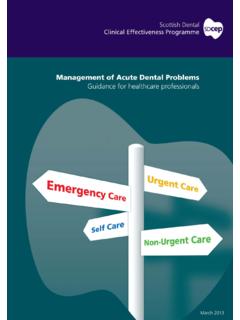
1 management of acute dental ProblemsQuick Reference Guide for healthcare professionalsScottish DentalClinical Effectiveness ProgrammeSDcepMarch 2013 Emergency CareUrgent CareSelf CareNon-Urgent CareScottish DentalClinical Effectiveness ProgrammeSDcepThe Scottish dental Clinical Effectiveness Programme ( sdcep ) is an initiative of the National dental Advisory Committee (NDAC) and is supported by the Scottish Government and NHS Education for Scotland. The programme aims to provide user-friendly, evidence-based guidance on topics identified as priorities for oral health care in guidance is designed to support improvements in patient care by bringing together, in a structured manner, the best available information that is relevant to the topic and presenting this information in a form that can be interpreted easily and implemented. Supporting the provision of quality care Scottish dental Clinical Effectiveness ProgrammeSDCEP operates within NHS Education for Scotland.
2 You may copy or reproduce the information in this document for use within NHS Scotland and for non-commercial educational of this document for commercial purpose is permitted only with written 978 1 905829 16 3 First published 2013 Scottish dental Clinical Effectiveness ProgrammeDundee dental Education Centre, Frankland Building, Small s Wynd, Dundee DD1 4 HNEmail 01382 425751 / 425771 Website Quick Reference Guide is intended for use by staff in any healthcare setting who may have to manage patients with acute dental problems. Most patients with an acute dental problem will have one or more of the following symptoms: Pain Swelling Bleeding Trauma Ulceration Altered Sensation or Abnormal Appearance Based on each of these symptoms, the decision support flowcharts in this Guide can be used to identify any immediate attention or advice to give to the patient and to determine the appropriate provider of subsequent care.
3 If a patient reports more than one symptom, use the first reported symptom as the start point. In all cases of trauma, healthcare providers need to be conscious of the possibility of non-accidental injury and consider appropriate local referral if this is : If the dental problem is secondary to a more significant problem ( a significant facial injury) or is resulting in severe symptoms ( difficulty breathing, severe dehydration), initial contact should be with appropriate emergency medical services via NHS 24 (Tel: 08454 24 24 24). Endpoints are defined as: Emergency Care arrange for the patient to have contact with a clinical advisor within 60 minutes and subsequent treatment within a timescale that is appropriate to the severity of the condition Urgent Care advise the patient to seek dental or medical care as indicated within 24 hours unless the condition worsens Non-urgent Care advise the patient to see a dentist within 7 days if required unless the condition worsens Self Care the patient should be able to manage the problem without the need for further involvement of a healthcare professional .
4 However, advise the patient that if the symptoms persist or worsen, they should contact a dentist or general medical categories should apply at any time in the 24 hour period. When there is a preferred provider of care, this is indicated in the normal working hours, all dental practices have arrangements to provide emergency care for their registered patients. Health Boards also have local emergency dental arrangements in place for non-registered patients and NHS 24 can advise on how to contact these. Out-of-hours ( to hours during the week and throughout the weekend), some dental practices have their own emergency arrangements. In addition, a full triage and patient booking service is available through NHS 24. It should be noted that some allowance on treatment times may need to be made for remoteness, rurality, patient travel and degrees of urgency within each category.
5 Similarly, providers of care may vary depending on location. Users of this Quick Reference Guide might find it useful to note the contact details of local providers of care in the space provided on page electronic decision support tool based on the information contained within these flowcharts is also provided. This can be accessed on the internet via a personal computer, tablet or smart phone. Note that, as guidance, the information in this document does not override the individual responsibility of the healthcare professional to make decisions appropriate to the individual patient. The full version of the management of acute dental Problems guidance is available at of acute dental Problems12 Patient with PainAssess whether the patient has: 1) atypical jaw pain and any other signs of myocardial infarction (MI), breathlessness, chest pain 2) exceeded the recommended dose of pain relief medication ( an adult has taken more than eight 500 mg paracetamol tablets within 24 hours).
6 Note if the patient is a child, elderly or has not eaten normally, the concern about overdose is there signs ofMI or overdose?NOYESE mergency Care: NHS24 or dial 999Is the pain due to trauma? NOYESIs there swelling?NOYESIs the pain in a tooth?YESNOIs the pain in an erupting tooth?*Start from Swelling pathwayNOYESIs this an adult or newly erupted tooth in a child? CHILDADULTA dvise optimal analgesia, soft brushing and rinsing after food Self Care unless problem persists or worsensHas analgesicbeen taken?YESNOA dvise optimal analgesia. Avoid stimuliNon-urgent Care: DentalHas analgesic controlled the pain?NOYESU rgent Care:DentalGo to Trauma pathway Go to Swelling pathway StartManagement of acute dental ProblemsHas the patient recently had a tooth extracted? Is the pain associated with an orthodontic appliance, sharp tooth or denture? Is the pain in the face or mouth?
7 Urgent Care: dental Non-urgent Care: DentalEmergency Care: NHS24 Advise optimal analgesia, patient to avoid smoking and to maintain good oral hygieneAdvise optimal analgesia (including topical), use of chlorhexidine mouthwash and, as appropriate: Application of malleable wax to sharp teeth or non-removable parts of appliance causing trauma Patient to keep dentures out, where possibleAre there signs of visual disturbance suggestive of temporal arteritis?NOYESNOMOUTHYESYESFACEA dvise optimal analgesia. Avoid stimuliNon-urgent Care: DentalAdvise chlorhexidine mouthwash, optimal analgesia. If signs of spreading infection, consider prescribing metronidazole or amoxicillinUrgent Care: DentalUrgent Care: DentalIs the pain from an ulcer?YESNONO Chlorhexidine mouthwash is not suitable for children under 7 years old because of its taste and their limited ability to rinse without swallowing3 PainGo to Ulceration pathway 4 Patient with SwellingAssess the degree of swelling: Is the patient having difficulty breathing?
8 Does the patient find it difficult to stick out or move their tongue? Is the swelling closing the eye? Has the swelling worsened in the last hour? Is the swelling sudden and unexplained (possible angioedema)?Is the patient systemically unwell ( rigors, increasing temperature, dehydrated, lethargic)? Note that a child or immunocompromised patient may deteriorate more rapidlyAssess whether the patient has: 1) atypical jaw pain and any other signs of myocardial infarction (MI), breathlessness, chest painOR2) exceeded the recommended dose of pain relief medication ( an adult has taken more than eight 500 mg paracetamol tablets within 24 hours). Note if the patient is a child, elderly or has not eaten normally, the concern about overdose is Care: NHS24 Emergency Care: NHS24 Emergency Care: NHS24 or dial 999 Non-urgent Care: DentalIs the swelling rapidly increasing or likely to obstruct the airway or close the eye?
9 Is the swelling slowly increasing in size, hot or firm to touch?The patient may require antibiotics. If in non- dental setting or dental care is unavailable, consider prescribing antibiotics before the patient also in pain?NONOYESNONOAre there signs of MI or overdose?Urgent Care:DentalStartGo to * on Pain pathwayPatient with BleedingManagement of acute dental Problems5 Swelling I BleedingAdvise patient to: rinse the mouth once only with warm (not hot) water bite on moistened cotton handkerchief or gauze maintain constant pressure while sitting upright quietly for 20 minutes. Be aware that bleeding may be more persistent if the patient is taking blood thinners .Several conditions can cause low level bleeding. Assessment by a dentist is Care: NHS24 Emergency Care: NHS24 Emergency Care: dental or NHS24 Non-urgent Care: DentalHas the patient had a recent dental extraction or other dental treatmentHas the patient had recenttrauma?
10 Is the bleeding brisk and persistent?Is the patient systemically unwell?Has the bleedingstopped?Is the patient on bloodthinners ?Repeat pressure adviceAdvise no smoking, alcohol or exercise for 24 hoursHas the bleedingstopped?Is the bleeding brisk and persistent?YESYESYESYESNOU rgent Care:DentalStartGo to Trauma pathwayNONONOYESYESSelf Care unless problem persists or worsensNO Blood thinners include warfarin, aspirin, clopidogrel6 Patient with Trauma (including chipped, cracked or broken teeth) Emergency Care: NHS24 Emergency Care: NHS24 Emergency Care: NHS24 Emergency Care: dental or NHS24 Has there been a head injury, loss of consciousness, significant facial trauma, is there uncontrollable bleeding or is the airway compromised?Assess and control any residual bleeding by applying pressureDoes the patient have any intraoral or soft tissue trauma?Does the patient have a degloving injury, large lacerations, lacerations across the tongue?