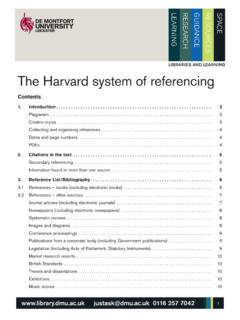
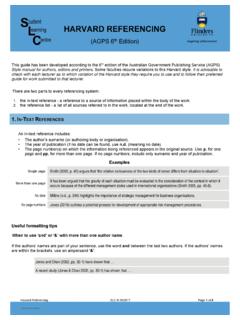
Transcription of Quote, Unquote: A guide to Harvard referencing
1 A guide to Harvard referencingQuote,Unquote 36337 Quote Unquote Booklet-POB:Layout 1 21/5/09 09:44 Page A Skills for Learning, Leeds Metropolitan University, as permitted under the Copyright Designs and Patents Act1988, this publication cannot be reproduced, stored or transmittedin any form or by any means, without the prior permission of Skillsfor Quote Unquote Booklet-POB:Layout 1 21/5/09 09:44 Page referencing : the to cite sources in your work..7 How to create your list of references or of Quote Unquote Booklet-POB:Layout 1 21/5/09 09:44 Page 1 Getting good marks for your assignments depends on many things,one of them is accurate referencing of sources you have sure you get all of the marks allocated for referencing ; thiscould be as much as ten per cent of the total.
2 It is not hard all youneed to do is keep accurate notes of your sources and follow anaccepted academic referencing system . The author-date or Harvard method of referencing is the standardat Leeds Metropolitan the Harvard system was originally developed in the USA, ithas become the most common system in use internationally and isfrequently the standard house style for academic journals. Harvardhas the advantages of flexibility, simplicity, clarity and ease of use,both for author and reader. Sources are cited in the body of the textand listed alphabetically in the bibliography or list of references.
3 Quote, Unquote is an authoritative source on author-datereferencing practice which makes using Harvard easy as the detailsof how to reference different types of sources are all here for you toconsult, as and when you need to. Quote, Unquote is produced atLeeds Metropolitan University by the Skills for Learning team whosupport and develop all aspects of academic writing, including goodreferencing practice. Introduction Quote Unquote Booklet-POB:Layout 1 21/5/09 09:44 Page 2 The advice in this booklet conforms to:British Standards Institution (1983) BS6371:1983.
4 Recommendationsfor citation of unpublished , Standards Institution (1989) BS1629:1989. Recommendationfor references to published , Standards Institution (1990) BS5605:1990. Recommendationsfor citing and referencing published material. Milton Keynes, Standards Institution (2000) BS5261-1:2000. Copypreparation and proof correction. Design and layout of , are variations in referencing practice across different subjects andcourses, particularly around the list or lists which appear at the end of apiece of work usually called the bibliography or list of references.
5 Check course documentation or any other guidance you are given. Harvard is NOT necessarily the same as a publisher s house style. When writing an article for inclusion in a professional journal, you mustconsult the editor s notes on the style used in the specific Quote Unquote Booklet-POB:Layout 1 21/5/09 09:44 Page 3 Why should I reference?Good referencing makes it easy for the reader to see where the ideasbehind your writing have come from. Referring to the work ofestablished experts in your subject area gives your writing authorityand demonstrates to tutors that you have researched the topicproperly.
6 They should get enough information from your referencesto allow them to check any of the sources themselves, if they needto. Most importantly, good referencing should protect you from anypossibility of committing plagiarism. Plagiarism is a term used in academia for passing off other people swork as your own. This includes material or ideas from any sources,whether written, internet or audiovisual media, even ideas fromother students or academic Metropolitan University defines plagiarism as "thesubstantial unacknowledged incorporation in a student's work ofmaterial derived from the work (published or unpublished) ofanother.
7 Work includes internet sources." (Leeds Metropolitan University, 2002, C9. ). Harvard referencing : the Quote Unquote Booklet-POB:Layout 1 21/5/09 09:44 Page 4 How should I reference?There are twostages to referencing sources for a piece of academicwriting using the author-date or Harvard Refer to the source in your text (the citation).2. Give full details of the source in your bibliography or list of references at the end of your work (the reference). you are searching the literature on your chosen subject, save ornote down all the required details of the sourcesthat you find at thattime.
8 If you don t do this, you might not be able to accurately describethe sources you have used and you will have additional work when youneed to list these in your bibliography or list of references. 36337 Quote Unquote Booklet-POB:Layout 1 21/5/09 09:44 Page 5 Quote Unquote Booklet-POB:Layout 1 21/5/09 09:44 Page 6 The first part of good referencing is what you put in the textof yourassignment each time you use someone else s work. When you use other people s work you might be: Paraphrasing rephrasing the original ideas or opinions in yourown words.
9 Summarising writing a short description of the ideas oropinions in your own words but giving your own interpretation ofwhat the source says, rather than a simple rephrasing. Referring to a source mentioning the work without giving muchinformation about the content. Quoting using the actual words from the source enclosed inquotation marks. Using statistics or data from a source, such as financialinformation or market the author s name and date of publicationUsing the author-date or Harvard system of referencing does notrequire any numbering or footnotes on each page.
10 In most caseswhere you are paraphrasing, summarising or referring to a source,simply insert the author s name and the date of publication inbracketsafter you summarise, paraphrase or mention theinformation you have taken from the to cite sources in your Workers in teams tend to adopt particular roles (Belbin 1996). 36337 Quote Unquote Booklet-POB:Layout 1 21/5/09 09:44 Page 7 Where the author s name appears naturally in your workIn many cases, you can simply insert the author s name, followed bythe date of publication in brackets, into your reader can easily locate the full description of the item you havecited by referring to the alphabetical list of references orbibliography at the end of your document.