Transcription of R-407C - Refrigerants
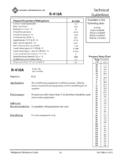
1 R-407 CAPPLICATIONS:u Residential Air Conditioning For New Equipment and Retrofittingu Commercial Air Conditioning For New Equipment and RetrofittingPERFORMANCE:u Lower discharge temperature than R-22u Closest capacity match to R-22u Similar P/T and mass flow properties u No component changesu Compatible with Polyolester (POE) oilNon-Ozone Depleting / Nonflammable / Non-toxic AVAILABLE SIZESTypeSizeCylinder25 ,550 lb. Physical Properties of Refrigerants R-407 CRefrigerant Classification HFC Molecular Weight Boiling Point (1atm, F) Critical Pressure (psia) Critical Temperature ( F) 187 Critical Density ( 3)
2 32 Liquid Density (70 F, 3) Vapor Density ( 3) Heat of Vaporization (bp, BTU/lb.) Specific Heat Liquid (70 F, BTU/lb. F) Specific Heat Vapor (1atm, 70 F, BTU/lb. F) Ozone Depletion Potential (CFC 11 = ) 0 Global Warming Potential (CO2 = ) 1770 ASHRAE Standard 34 Safety Rating A1 Temperature Glide ( F) 10 National Refrigerants , Roosevelt Boulevard Philadelphia, PA 19154 Tel: fax: web: e-mail.
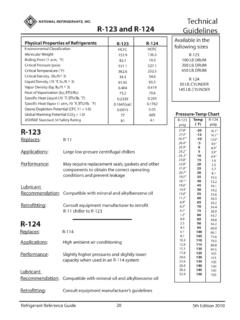
3 CHARTN ational R-407 CTEMP ( F)Liquid (psig)Vapor (psig) from NIST Refprop Red Figures (IN Hg) VacuumAC Product BulletinR- 407c Retrofit GuidelinesGeneral Considerations: Fixed Expansion Devices. Systems with orifice tubes may not perform exactly the same when retrofitted since high and low side pressures and other refrigerant properties are slightly different from R-22. Replacement of the orifice tube, however, is not usually required. TXVs. Existing R-22 TXVs will be sized correctly for R- 407c .
4 Superheat settings may be affected by the temperature glide. Filter Dryer. A filter drier should be added to a system as part of the retrofit process. If one already exists, the filter drier should be replaced with the same type currently in use. Lubricant. R- 407c requires polyolester (POE) lubricant. When retrofitting R-22 systems containing mineral oil, it will be necessary to change the oil at least once with POE to ensure proper oil return. Follow all manufacturer guidelines when changing from mineral oil to POE.
5 Performance. R- 407c has the closest capacity match to R-22 of any of the retrofit blends. System operation (low side pressure/ temperature, run time, energy use) should be very similar to R-22. High side pressures will run higher and there will be a temperature glide of about 8-10 F. Seals and O-Rings. For any retrofit job it is recommended to change Schrader valve cores, o-rings on caps, and any seals found to be leaking before the retrofit takes place. Retrofit Procedures: 1.
6 Collect baseline data for operation of the system with existing R-22 charge. Make note of any obvious performance problems with the system. Leak check the system as well, identifying any repairs to perform during the retrofit process. 2. Disconnect electrical power to system and properly recover the R-22 charge. Do not top off a system that contains R-22 with R- 407c . Record the weight of R-22 recovered. 3. Perform any required maintenance or repair operations previously identified, including replacement of Schrader cores and filter drier.
7 Add or change oil if required (follow equipment manufacturer s guidelines). 4. If desired, pressurize and leak check the system by preferred method. Evacuate the system down to 250 microns and confirm that it holds. 5. Remove liquid R- 407c from the cylinder and charge the system to about 90% to 95% of the original R-22 charge size. 6. Restart the system and allow it to come to normal operation conditions. Compare the new operation data to the R-22 baseline data. Adjust charge or system settings as needed.
8 7. Place a label on the system indicating that it contains R- 407c refrigerant and the oil Considerations: R- 407c can be added to a system during servicing, if required, without recovering the existing R- 407c charge. Verify system performance. If the system has a critical charge, however, it is recommended that any remaining refrigerant be removed prior to servicing. This refrigerant blend must be removed from the cylinder as a liquid. Follow industry approved best practices for recovery of refrigerant and achieve full vacuum on the system at the end of the recovery process.
9 Avoid mixing Refrigerants during recovery. Recovery of R-22 requires a cylinder with a service pressure of 260 psig minimum. Recovery of R- 407c requires a cylinder with a service pressure of 300 psig Refrigerants , Roosevelt Boulevard Philadelphia, PA 19154 Tel: fax: web: e-mail: information on retrofitting, please refer to NRI s Retrofit Handbook at