Transcription of R-407C - Refrigerants
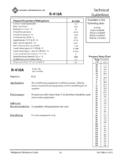
1 R-407 CAPPLICATIONS:u Residential Air Conditioning For New Equipment and Retrofittingu Commercial Air Conditioning For New Equipment and RetrofittingPERFORMANCE:u Lower discharge temperature than R-22u Closest capacity match to R-22u Similar P/T and mass flow properties u No component changesu Compatible with Polyolester (POE) oilNon-Ozone Depleting / Nonflammable / Non-toxic AVAILABLE SIZESTypeSizeCylinder25 ,550 lb. Physical Properties of Refrigerants R-407 CRefrigerant Classification HFC Molecular Weight Boiling Point (1atm, F) Critical Pressure (psia) Critical Temperature ( F) 187 Critical Density ( 3) 32 Liquid Density (70 F, 3) Vapor Density ( 3)
2 Heat of Vaporization (bp, BTU/lb.) Specific Heat Liquid (70 F, BTU/lb. F) Specific Heat Vapor (1atm, 70 F, BTU/lb. F) Ozone Depletion Potential (CFC 11 = ) 0 Global Warming Potential (CO2 = ) 1770 ASHRAE Standard 34 Safety Rating A1 Temperature Glide ( F) 10 National Refrigerants , Roosevelt Boulevard Philadelphia, PA 19154 Tel: fax: web: e-mail: CHARTN ational R-407 CTEMP ( F)Liquid (psig)Vapor (psig) from NIST Refprop Red Figures (IN Hg) VacuumAC Product BulletinR- 407c Retrofit GuidelinesGeneral Considerations: Fixed Expansion Devices.
3 Systems with orifice tubes may not perform exactly the same when retrofitted since high and low side pressures and other refrigerant properties are slightly different from R-22. Replacement of the orifice tube, however, is not usually required. TXVs. Existing R-22 TXVs will be sized correctly for R- 407c . Superheat settings may be affected by the temperature glide. Filter Dryer. A filter drier should be added to a system as part of the retrofit process. If one already exists, the filter drier should be replaced with the same type currently in use. Lubricant. R- 407c requires polyolester (POE) lubricant. When retrofitting R-22 systems containing mineral oil, it will be necessary to change the oil at least once with POE to ensure proper oil return.
4 Follow all manufacturer guidelines when changing from mineral oil to POE. Performance. R- 407c has the closest capacity match to R-22 of any of the retrofit blends. System operation (low side pressure/ temperature, run time, energy use) should be very similar to R-22. High side pressures will run higher and there will be a temperature glide of about 8-10 F. Seals and O-Rings. For any retrofit job it is recommended to change Schrader valve cores, o-rings on caps, and any seals found to be leaking before the retrofit takes place. Retrofit Procedures: 1. Collect baseline data for operation of the system with existing R-22 charge. Make note of any obvious performance problems with the system.
5 Leak check the system as well, identifying any repairs to perform during the retrofit process. 2. Disconnect electrical power to system and properly recover the R-22 charge. Do not top off a system that contains R-22 with R- 407c . Record the weight of R-22 recovered. 3. Perform any required maintenance or repair operations previously identified, including replacement of Schrader cores and filter drier. Add or change oil if required (follow equipment manufacturer s guidelines). 4. If desired, pressurize and leak check the system by preferred method. Evacuate the system down to 250 microns and confirm that it holds. 5. Remove liquid R- 407c from the cylinder and charge the system to about 90% to 95% of the original R-22 charge size.
6 6. Restart the system and allow it to come to normal operation conditions. Compare the new operation data to the R-22 baseline data. Adjust charge or system settings as needed. 7. Place a label on the system indicating that it contains R- 407c refrigerant and the oil Considerations: R- 407c can be added to a system during servicing, if required, without recovering the existing R- 407c charge. Verify system performance. If the system has a critical charge, however, it is recommended that any remaining refrigerant be removed prior to servicing. This refrigerant blend must be removed from the cylinder as a liquid. Follow industry approved best practices for recovery of refrigerant and achieve full vacuum on the system at the end of the recovery process.
7 Avoid mixing Refrigerants during recovery. Recovery of R-22 requires a cylinder with a service pressure of 260 psig minimum. Recovery of R- 407c requires a cylinder with a service pressure of 300 psig Refrigerants , Roosevelt Boulevard Philadelphia, PA 19154 Tel: fax: web: e-mail: information on retrofitting, please refer to NRI s Retrofit Handbook at

![Refrigerant Safety web[1] - Welcome to National ...](/cache/preview/b/d/f/6/9/8/f/f/thumb-bdf698ffde256b6e89e95209ac223ec3.jpg)