Transcription of Radiation Detection and Measurement
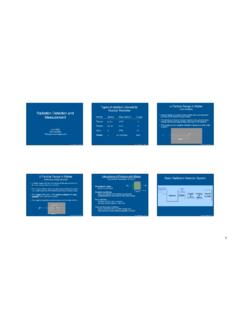
1 Rad. Detect & Measure, 2008 (TKL) Radiation Detection andMeasurementJune 2008 Tom Detect & Measure, 2008 (TKL)Types of Radiation relevant toNuclear MedicineParticleSymbolMass (MeV/c2) ChargeElectrone-, ! -1 Positrone+, !+ +1 Alpha" 3700 +2 Photon# no rest mass noneRad. Detect & Measure, 2008 (TKL) Loses energy in a more or less continuous slowing downprocess as it travels through matter. The distance it travels (range) depend only upon its initialenergy and its average energy loss rate in the medium.
2 The range for an " particle emitted in tissue is on the orderof m s." Particle Range in Mattermono-energetic- - - - - - - - - - - - - - - - - - -+ + + + + + + + + + + + + + + + + m s"Rad. Detect & Measure, 2008 (TKL) ! particle ranges vary from one electron to the next, even for !s ofthe same energy in the same material. This is due to different types of scattering events the ! encounters( , scattering events, bremsstrahlung-producing collisions, etc.). The ! range is often given as the maximum distance the mostenergetic !
3 Can travel in the medium. The range for ! particles emitted in tissue is on the order of mm s.! Particle Range in Mattercontinuous energy spectrummm s-! Rad. Detect & Measure, 2008 (TKL)Interactions of Photons with MatterExponential Penetration: N=N0e-$xPhotoelectric effectphoton is absorbedCompton scatteringpart of the energy of the photon is absorbedscattered photon continues on with lower energyPair productionpositron-electron pair is createdrequires photons above MeVCoherent (Rayleigh) scatteringphoton deflected with very little energy lossonly significant at low photon energies (<50 keV)$cm sNN0xRad.
4 Detect & Measure, 2008 (TKL)Basic Radiation Detector SystemPulseorCurrentstoredto diskincoming radiationAnalog-to-digitalAmplify&condit ionRad. Detect & Measure, 2008 (TKL)Basic Radiation Detector SystemsWhat do you want to know about the Radiation ?Energy?Position (where did it come from)?How many / how much?Important properties of Radiation detectors(depends on application)Energy resolutionSpatial resolutionSensitivityCounting SpeedRad. Detect & Measure, 2008 (TKL)Pulse Mode versus Current Mode Pulse mode Detect individual photons Required for NM imaging applications Current mode Measures average rates of photon flux Avoids dead-time lossesRad.
5 Detect & Measure, 2008 (TKL)Interaction Rate and Dead-timeparalyzablenon-paralyzableFrom: The Essential Physics of Medical Imaging (Bushberg, et al)True rateMeasured ratetimedeadtime= recorded eventsRad. Detect & Measure, 2008 (TKL)Types of Radiation Detectorsdetection modes / functionality Counters Number of interactions Pulse mode Spectrometers Number and energy of interactions Pulse mode Dosimeters Net amount of energy deposited Current mode Imaging Systems CT = current mode NM = pulse modeRad. Detect & Measure, 2008 (TKL)Types of Radiation Detectorsphysical composition Gas-filled detectors Solid-state (semiconductor) detectors Organic scintillators (liquid & plastic) Inorganic scintillatorsscintillators operate with aphoto-sensor( another detector)Rad.
6 Detect & Measure, 2008 (TKL)Gas-filled DetectorsIonizing event in airrequires about 34 eVFrom: Physics in Nuclear Medicine (Sorenson and Phelps)Rad. Detect & Measure, 2008 (TKL)Gas-filled detectors(operates in three ranges)Geiger-Muller countersProportional countersIonization chambers Radiation survey meters Dosimeters (dose calibrator)From: Radiation Detection and Measurement (Knoll, GF)Rad. Detect & Measure, 2008 (TKL)Ionization ChambersFrom: Physics in Nuclear Medicine (Sorenson and Phelps)ATOMLAB 200 Dose CalibratorNo amplificationNo dead-timeSignal = liberated chargeSettings for different isotopesCalibrationsIonizationchamber regionRad.
7 Detect & Measure, 2008 (TKL)Geiger-Muller countersFrom: Physics in Nuclear Medicine (Sorenson and Phelps)No energy infoLong dead-timeThin window probeRad. Detect & Measure, 2008 (TKL)Semiconductor Detectors Works on same principle as gas-filled detectors( , production of electron-hole pairs insemiconductor material) Only ~3 eV required for ionization (~34 eV, air) Usually needs to be cooled (thermal noise) Usually requires very high purity materials orintroduction of compensating impurities thatdonate electrons to fill electron traps caused byother impuritiesRad.
8 Detect & Measure, 2008 (TKL)Semiconductor Detectors CdZnTe detectors - can operate atroom temperatureRad. Detect & Measure, 2008 (TKL)Organic Liquid Scintillators(liquid scintillator cocktail) Organic solvent - must dissolve scintillator material andradioactive sample Primary scintillator (p-terphenyl and PPO) Secondary solute (wave-shifter) Additives ( , solubilizers) Effective for measuring beta particles ( , H-3, C-14).Rad. Detect & Measure, 2008 (TKL)Inorganic Scintillators(physical characteristics)Absorption of Radiation lifts electrons from valence toconduction bandImpurities (activators) create energy levels within theband gap permitting visible light scintillationsRad.
9 Detect & Measure, 2008 (TKL)Inorganic Scintillators(physical characteristics)NaI(Tl)BGOLSO(Ce)GSO(Ce) Density (gm/cm3) Number51756659 AttenuationCoefficient(@ 511 keV, cm-1) Output(photons/Mev)40K~8K~30K~20 KDecay Time230 ns300 ns12 ns60 ns40 nsWavelength410 nm480 nm420 nm430 nmIndex of e sn on on oRuggedn oy e sy e sn osensitivityenergy & spatial speedphoto-sensor matchingmanufacturing / costrelevant detectorpropertyRad. Detect & Measure, 2008 (TKL)Photomultiplier Tube (PMT)From: Physics in Nuclear Medicine (Sorenson and Phelps)photo-sensor needed with scintillatorsRad.
10 Detect & Measure, 2008 (TKL)Sample Spectroscopy SystemHardwareFrom: The Essential Physics of Medical Imaging (Bushberg, et al)incoming high-energy gammarayconverted to1000s of visiblephotons~20%converted toelectronselectron multiplicationbecomes electricsignallarger current orvoltage|more electrons|more scintillationphotons|higher gammaenergy(statisticaluncertainties!)Ra d. Detect & Measure, 2008 (TKL)Interactions of Photons with + with characteristicx-ray scattered photon fromlead x-ray from leadshieldFrom: The Essential Physics of Medical Imaging (Bushberg, et al)Rad.