Transcription of RAR FAQ Sheet - CivicWeb
1 What is a riparian area ? It is the stretch of land adjacent to a water body such as a lake, stream or wetland. riparian areas support critical ecosystem functions important to fish and fish habitat, including: vegetation & leaf litter shade & wind protection insects & amphibians large woody debris riverbank stability temperature regulation & moisture riparian areas vary in scope but the width for assessment purposes is 30 metres at each side and 60 metres for steeper banks ( ravines). What is the riparian Areas Protection Regulation (RAPR)? The RAPR is a BC regulation appended to the riparian Areas Protection Act that protects riparian areas from damage during the development process. RAR applies to all types of activities throughout the TNRD, including building construction, subdivision and rezoning.
2 Where and how is the RAPR applied in the TNRD? Pursuant to Zoning Bylaw 2400, RAPR applies to all provincially designated watercourses and water bodies. These are lakes, rivers, streams and wetlands that appear on the 1985 British Columbia Terrain Resource Inventory Mapping (TRIM) series. How do I know if RAPR applies to my property? You can check your property via myRegionView, the TNRD interactive web-based mapping system, accessible online. To get started with myRegionView refer to the Online Mapping FAQ Sheet . If you do not have access to the internet, please call TNRD staff at 250-377-8673, or email What happens if there is a riparian area on my property? If so, then you cannot remove vegetation, undertake development (such as construction, subdivision, rezoning etc.)
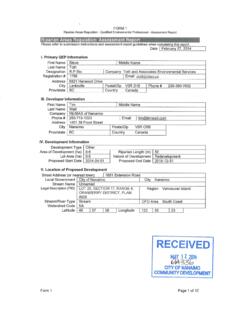
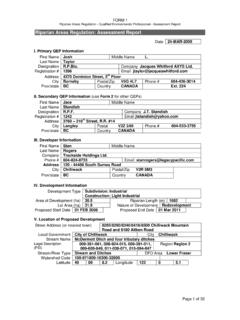
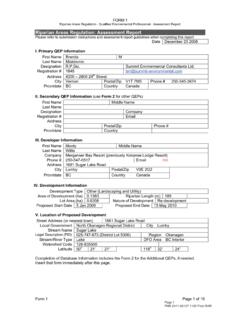
3 Within/near that area unless you retain a Qualified Environmental Professional to complete and file a riparian assessment Report. This Report will prescribe site-specific setback distances, conditions of development, planting, and so forth. How do I find a Qualified Environmental Professional (QEP)? QEPs are consultants ( biologists, geoscientists, foresters, agrologists, engineers) qualified by the Province to conduct and submit RAR Assessments. A list of QEPs who routinely conduct Assessments can be provided by the TNRD or the Province. This list is compiled for convenience only and is not a recommendation or endorsement. What if I believe that my development is not in a riparian area ? The TNRD is required to confirm that the RAPR does not apply.
4 If you feel that your land is not subject to RAPR or that the TRIM mapping is incorrect, your options include: 1. provide a site plan, certified by a BC Land Surveyor, that clearly shows that no development will be within a riparian area ; 2. provide a letter of opinion from a QEP, confirming that the RAPR does not apply; or 3. submit a sworn declaration, affirming that the development is not within a riparian assessment area . For further information on the BC riparian Areas Regulation, please visit To view the Province s riparian Areas Regulation brochure document, please visit riparian area Protection Regulation FAQ Sheet RAPR Process RAPR riparian Areas Protection Regulation QEP Qualified Environmental Professional SPEA Streamside Protection and Enhancement area RAPR & New Construction The site plan (right) illustrates an example of a property with a pre-existing home within the 30m riparian area and proposed new construction.
5 The dwelling may remain, as is, but all new building must be beyond the riparian area . If the owner wishes to develop within the riparian area , they must hire a qualified environmental professional to complete and file an assessment report. Then new const-ruction must meet recommendations and setbacks set out in the report. RAPR & Subdivision The site plan below illustrates an example of a proposed subdivision. If any portion of the parcel is or has a riparian area , then the owner must hire a qualified environmental professional to complete and file an assessment report. This is even if the new property lines are more than 30m from the water body. This also applies if all or any part of a parcel is subject to a rezoning or OCP amendment.
6 Development Application Proposed development within 30m of stream TNRD requires QEP Report QEP submits Report SPEA & Measures No HADD SPEA & Measures HADD DFO Ministry of Forests, Lands, and Natural Resource Operations Review, Approve & notify TNRD No Authorization Authorization Application Proceeds Approve with SPEA & Measures Reject