Transcription of Re-Envisioning the AACN Essentials
1 Re-Envisioning the AACN EssentialsNCSBN APRN Roundtable April 6, 2021 Joan Stanley, PhD, NP, FAAN, FAANPC hief Academic officerAmerican Association of Colleges of nursing Speaker has no conflict of interest to discloseESSENTIALS Task Force Leadership TeamJean GiddensVirginia Commonwealth UnivLinda CaldwellNancyDeBasio Jean BartelsAACN Board LiaisonCo-ChairsConsultantsAACN Staff LiaisonsJoan Stanley Rick Garc a Kathy McGuinn Cynthia McCurren University of Michigan -FlintJohn McFadden Barry UniversityLin ZhanUniversity of MemphisESSENTIALSTask Force MembersLori Escallier,SUNY Downstate Jacqueline Hill.
2 Bowie State UniversityKristin Lee, University of Missouri-Kansas CityKim Litwack, University of Wisconsin MilwaukeeJacklyn Barber,Morningside CollegeAngela Amar,University of NevadaLas VegasErica Hooper-Arana, University of San FranciscoCarol Buck-Rolland, University of VermontJill Case-Wirth, WellStar Health System (Practice) Eileen Fry-Bowers, University of San DiegoVincent Hall,Walden UniversityBeverly Foster, University of North Carolina Chapel HillMarcella Rutherford, Nova Southeastern UniversityAllison Squires, New York UniversitySusan Swider,Rush UniversityMarisa Wilson,University of Alabama-Birmingham Geraldine Young,Frontier nursing UniversityMartha Scheckel,University of St.
3 ThomasCasey Shillam,University of Portland Danuta Wojnar, Seattle University Marge Wiggins Maine Medical System (Practice)Jenny Schuessler,University of West GeorgiaMary Stachowiak,Rutgers UniversityRachel Start,Rush Oak Park Hospital (Practice)ESSENTIALSTask Force Members, of Presentation Overview & update on the re-envisioned Essentials New Model for nursing Education & APRN Education Transitioning to competency-based education Implementation & what s nextBACKGROUND The Essentials provides theeducationalframework for the preparation ofnurses.
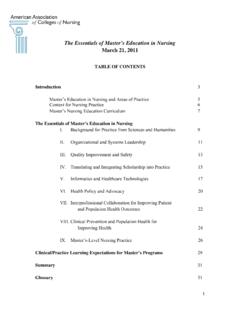
4 Essentials of Baccalaureate Education for Professional nursing Practice(2008) Essentials of Master s EducationinNursing(2011) Essentials of Doctoral Education for Advanced nursing Practice(2006) These documents provide specific guidance for the development and revision of nursing curricula at each degree TO THE ESSENTIALSP rovided foundation for the Essentials work: AACN Futures Task Force Report (2015) Common APRN Doctoral Level competencies (2017) AACN Vision for Academic nursing Education White Paper (2019) Published in Journal of Professional nursing in July-August WE LEARNED FROM OUR PRACTICE PARTNERS There is inconsistency among graduates (across all degree levels) in terms of knowledge, skills, is variability in length/expectations of programs.
5 We are not sure what your product is. If all programs are accredited, and that isthe measure of the quality of a program---how can there be variability in the product? How can we know a good program?How can we be assured of ROI for tuitioninvestment? Susan Mullaney, Senior Director Center for Clinician AdvancementUnitedHealth Group(Practice)CURRENT ISSUES IN nursing EDUCATION Multiple degree paths in nursing education which is messy and confusing! Variability in program length, scope, expectations Variability in quality of degree programs Inability to articulate that which is uniquely the discipline of nursing Differentiating between technical and professionallevels of nursing State of nursing Programs offered bySchoolsof NursingType of Programs byDegree#schoolsBACCALAUREATE Generic (Entry-Level)Baccalaureate672 Accelerated 2nd DegreeBaccalaureate(Entry-Level)
6 278 LPN-to-Baccalaureate111 RN-to-Baccalaureate558 MASTERS Baccalaureate toMaster s540 Accelerated Baccalaureate toMaster s51 RN-to-Master s183 Entry-LevelMaster s62 DOCTORAL Post-BaccalaureatePhD98 Post-Master sPhD143 Post-Baccalaureate toDNP239 Post Master s toDNP3422019-2020 Enrollment and Graduations in Baccalaureate and Graduate Programs in nursing . Washington, DC: American Association of Colleges Essentials FRAMEWORKThe revised Essentialsframework is based on 10domains andcompetencies within each are broad distinguishable areas of competence that in the aggregate constitute a general descriptiveframework for aprofession.
7 (Englander, et al., 2013).CompetencyCompetencyCompetencyDoma inDomainCompetencyCompetencyDomainCompet encyCompetencyCompetencyDomains for theEssentialsDomain 1: Knowledge for NursingPracticeDomain 2: Person-CenteredCareDomain 3: PopulationHealthDomain 4: Scholarship for NursingDisciplineDomain 5: Quality andSafetyDomain 6: InterprofessionalPartnershipsDomain 7: Systems-BasedPracticeDomain 8: Informatics and HealthcareTechnologiesDomain 9:ProfessionalismDomain 10: Personal, Professional, and LeadershipDevelopmentCONCEPTS ACROSS ANDWITHINDOMAINS Clinical Judgment Communication Compassionate Care Determinants of Health Diversity, Equity and Inclusion Ethics Evidence-Based Practice Health ,ascorevaluesofnursingpractice, ProfessionalPracticeAdvanced Identify Advocate for level of riskstoproviders within the workplace.
8 Recognize how to prevent workplace violence and injury. Promote policiesforsupport a culture ofworkenvironment safety (people, process and technology), including risks and strengths. Create a justcultureprevention of violence andriskreflecting civility Create a Manage own personalwell-transparent cultureforbeing Role model and leadwell-being and resiliency for self andSafetyClarification, New ModelUPDATE ON THE Essentials REVISION Stakeholder feedback: process and summary Major revisions, additions to the document Next stepsStakeholder Feedback Process2ndNational Faculty Meeting (NFM)
9 >260 schools submitted surveys >7621 faculty participated Many schools included practice partnersStakeholder Feedback ProcessInvitational Forums38 organizations participated 15 specialty nursing organizations 18 APRN organizations 5 accrediting and licensing organizationsStakeholder Feedback ProcessPresentations NCSBN Education consultants AONL regional groups CCNE Board of Directors Commission on Nurse Certification CRNA Organizational Leadership RepresentativesStakeholder Feedback ProcessLetters and Commentary Special Interest Groups Schools IndividualsNational Faculty Meeting (NFM) Feedback Common ThemesWhat did you like most?
10 One document easy to read and use Transition to CBE Continuity from entry to advanced level Clarity Includes practice input Inclusion of DEI and racism 4 spheres of care Goes beyond acute care to include entire healthcare continuum Future thinkingNFM Feedback Common ThemesWhat questions do you still have? Differentiating MSN from DNP Differentiating BSN from entry-level master s How does the ADN fit; How does the ADN differ from the BSN? Why not mandate the DNP? Where is nursing educator preparation and is this an advanced education track?