Transcription of Reading Fluency: Tasks, Texts, and Teaching
1 Reading Fluency: Tasks, Texts, and TeachingWhatWhat s All the Fuss About?s All the Fuss About?General Research FindingsFluent Reading , like the thread of life itself Fluent Reading , like the thread of life itself ((KendrewKendrew, 1966), is intrinsically elegant in , 1966), is intrinsically elegant in both form and cadenceboth form and certainly know We certainly know it when we see it, and we are quick to it when we see it, and we are quick to celebrate it, along with the trajectory of celebrate it, along with the trajectory of success it it portends.
2 Kame neui, , & Simmons, (2001). The DNA of Reading Fluency. Scientific Studies of Reading , 5(3), Research history of fluency research in the field of The history of fluency research in the field of Reading might be characterized as Reading might be characterized as intellectually spasmodic: There are periods of intellectually spasmodic: There are periods of great effort and creativity, followed by fallow great effort and creativity, followed by fallow periods of relative disinterest. In 1983 periods of relative disinterest.
3 In 1983 fluency was described as the fluency was described as the most neglectedmost neglected Reading skill (Allington,1983). Reading skill (Allington,1983).Wolf, M. and Katzir-Cohen, T. (2001). Reading fluency and its intervention. Scientific Studies of Reading , 5(3), Research Findingscont. Skilled readers can read words in context Skilled readers can read words in context threethreetimes times faster and read words in lists faster and read words in lists twotwotimes faster than times faster than can struggling readers. can struggling readers.
4 With this distribution of fluency in a classroom With this distribution of fluency in a classroom whole class instruction and singular approaches will whole class instruction and singular approaches will not be likely to meet the needs of all children. not be likely to meet the needs of all children. Struggling readers are slower because of problems in Struggling readers are slower because of problems in list list Reading as context doesnreading as context doesn t make any unique t make any unique contribution to fluency rates and to fluency rates and , , Fuchs, L.
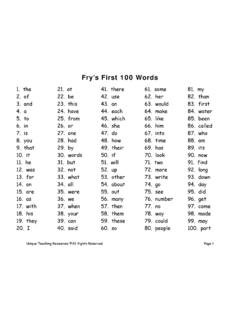
5 S., Van den Broek, P., Espin, C., & Deno. S. L. (2003) Accuracy and fluency in list and context Reading of skilled and RD groups: Absolute and relative performance levels. Learning Disabilities Research and Practice, 18 (4), Research words make up 33% of the words you read!25 words make up 33% of the words you read!ThorndikeThorndike--LorgeLorgemagaz ine count. Ed. Thorndike & I. magazine count. Ed. Thorndike & I. LorgeLorge. New York, 1944: Columbia [entries from "The teacher's w. New York, 1944: Columbia [entries from "The teacher's word book of 30,000 ord book of 30,000 words "; on RLIN] words "; on RLIN]General Research Findingscont.
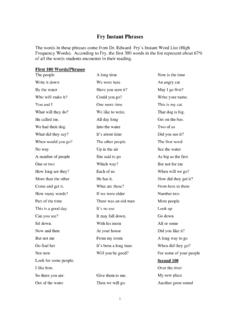
6 107 words make up over 50% of the words you read!107 words make up over 50% of the words you read! 930 words make up 65% of the words you read!930 words make up 65% of the words you read! 5,000 words make up 80% of the words you read?5,000 words make up 80% of the words you read? 13% of words occur only once in one million words13% of words occur only once in one million wordsZeno, S. M., Zeno, S. M., IvensIvens, S. H., Millard, , & , S. H., Millard, , & DuvvuriDuvvuri, R. (1995). The educator, R. (1995). The educator s word guide.
7 New s word guide. New York: Touchstone Applied Science Associates, : Touchstone Applied Science Associates, , E. H. (2004). Texts for Fluency and Vocabulary: Selecting Inst, E. H. (2004). Texts for Fluency and Vocabulary: Selecting Instructional Texts that ructional Texts that Support Reading Fluency Support Reading Fluency General Research Findingscont. 44% of American Fourth Graders 44% of American Fourth Graders cannot read fluently, even when they cannot read fluently, even when they read graderead grade--level stories aloud under level stories aloud under supportive testing testing conditions.
8 By Fourth Grade most children are By Fourth Grade most children are fairly accurate but also very accurate but also very , , Pinnell, , PikulskiPikulski, , , , WixsonWixson, , Campbell, , Gough, , & Beatty, (1995). List, , Campbell, , Gough, , & Beatty, (1995). Listening to ening to children read aloud: Oral fluency. Washington, DC: National Cenchildren read aloud: Oral fluency. Washington, DC: National Center for Educational Statistics, ter for Educational Statistics, Department of of Research Findingscont.
9 Context Reading fluency is highly dependent upon word-recognition skills as well as the context. Skilled readers do not rely upon context to predict or recognize words as do poorer readers. Context-free or word-recognition Reading skill helps poorer readers fluency while comprehension processes help skilled readers , , Fuchs, L. S., Van den Jenkins, , Fuchs, L. S., Van den BroekBroek, P., , P., EspinEspin, C., & , C., & DenoDeno. S. L. (2003). Sources of individual . S. L. (2003). Sources of individual differences in Reading comprehension and Reading fluency.
10 Journadifferences in Reading comprehension and Reading fluency. Journal of Educational Psychology, 95(4), l of Educational Psychology, 95(4), , K. (1980). Toward an interactive, K. (1980). Toward an interactive--compensatory model of individual differences in the development compensatory model of individual differences in the development of Reading fluency. Reading Research Quarterly, 16(1), 37of Reading fluency. Reading Research Quarterly, 16(1), Research Findingscont. Letter naming fluency uniquely predicts 1stgrade oral Reading fluency more so than does letter-sound , S.