Transcription of Real-life applications - Density and Volume
1 8/20/13 6:43 PMReal- life applications - Density and VolumePage 1 of 6 #bPhoto by: thieuryDensity and Volume - Real-life applicationsLike3 people like this. Sign Up to see what your friends EASURING V OLUMEWhat about the Volume of a solidthat is irregular in shape? Someirregularly shaped objects, such asa scooter, which consistsprimarily of one round wheel anda number of oblong shapes, canbe measured by separating theminto regular shapes. Calculus maybe employed with more complexproblems to obtain the Volume ofan irregular shape but the most basic method is simply to immerse the object in water. Thisprocedure involves measuring the Volume of the water before and after immersion, andcalculating the difference. Of course, the object being measured cannot be water-soluble; if it is,its Volume must be measured in a non-water-based liquid such as liquid volumes is easy, given the fact that liquids have no definite shape, and will SearchPowered by JRankScience Clarified Real-life Chemistry Vol 3 - Physics Vol 1 Density and VolumeeLearning Masters of Science from A&M Commerce Apply Now for October 2013 Start!
2 Science Clarified8/20/13 6:43 PMReal- life applications - Density and VolumePage 2 of 6 #bsimply take the shape of the container in which they are placed. Gasesare similar to liquids in the sense that they expand to fit theircontainer; however, measurement of gas Volume is a more involvedprocess than that used to measure either liquids or solids, becausegases are highly responsive to changes in temperature and the temperature of water is raised from its freezing point to itsboiling point (32 to 212 F or 0 to 100 C), its Volume will increase byonly 2%. If its pressure is doubled from 1 atm (defined as normal airpressure at sea level pounds-per-square-inch or 10 5 Pa)to 2 atm, Volume will decrease by only , if air were heated from 32 to 212 F, its Volume would increaseby 37%; and if its pressure were doubled from 1 atm to 2, its volumewould decrease by 50%. Not only do gases respond dramatically tochanges in temperature and pressure, but also, gas molecules tend tobe non-attractive toward one another that is, they do not tend tostick together.
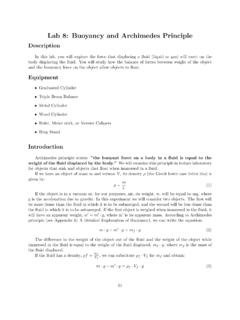
3 Hence, the concept of " Volume " involving gas isessentially meaningless, unless its temperature and pressure UOYANCY : V OLUME AND D ENSITYC onsider again the description above, of an object with irregularshape whose Volume is measured by immersion in water. This is notthe only interesting use of water and solids when dealing with Volume and Density . Particularlyintriguing is the concept of buoyancy expressed in archimedes 's than twenty-two centuries ago, the Greek mathematician, physicist, and inventorArchimedes (c. 287-212 ) received orders from the king of his hometown Syracuse, a Greekcolony in Sicily to weigh the gold in the royal crown. According to legend, it was while bathingthat archimedes discovered the principle that is today named after him. He was so excited,legend maintains, that he jumped out of his bath and ran naked through the streets of Syracuseshouting "Eureka!" (I have found it).What archimedes had discovered was, in short, the reason why ships float: because the buoyant,or lifting, force of an object immersed in fluid is equal to the weight of the fluid displaced by the8/20/13 6:43 PMReal- life applications - Density and VolumePage 3 of 6 # A STEEL SHIP FLOATS ON most ships are made of steel, and therefore, it is even harder to understand why an aircraftcarrier weighing many thousands of tons can float.
4 After all, steel has a weight Density (thepreferred method for measuring Density according to the British system of measures) of 480pounds per cubic foot, and a Density of 7,800 kilograms-per-cubic-meter. By contrast, sea waterhas a weight Density of 64 pounds per cubic foot, and a Density of 1,030 difference in Density should mean that the carrier would sink like a stone and indeed itwould, if all the steel in it were hammered flat. As it is, the hull of the carrier (or indeed of anysea-worthy ship) is designed to displace or move a quantity of water whose weight is greater thanthat of the vessel itself. The weight of the displaced water that is, its mass multiplied by thedownward acceleration due to gravity is equal to the buoyant force that the ocean exerts on theship. If the ship weighs less than the water it displaces, it will float; but if it weighs more, it another way, when the ship is placed in the water, it displaces a certain quantity of waterwhose weight can be expressed in terms of Vdg Volume multiplied by Density multiplied by thedownward acceleration due to gravity.
5 The Density of sea water is a known figure, as is g (32 ft m/sec 2 ); thus the only variable for the water displaced is its the buoyant force on the ship, g will of course be the same, and the value of V will be thesame as for the water. In order for the ship to float, then, its Density must be much less than thatof the water it has displaced. This can be achieved by designing the ship in order to maximizedisplacement. The steel is spread over as large an area as possible, and the curved hull, whenseen in cross section, contains a relatively large area of open space. Obviously, the Density of thisspace is much less than that of water; thus, the average Density of the ship is greatly reduced,which enables it to OMPARING D ENSITIESAs noted several times, the densities of numerous materials are known quantities, and can beeasily compared. Some examples of Density , all expressed in terms of kilograms per cubic meter,are:8/20/13 6:43 PMReal- life applications - Density and VolumePage 4 of 6 #bHydrogen: kg/m 3 Air: kg/m 3 Oak: 720 kg/m 3 Ethyl alcohol: 790 kg/m 3 Ice: 920 kg/m 3 Pure water: 1,000 kg/m 3 Concrete: 2,300 kg/m 3 Iron and steel: 7,800 kg/m 3 Lead: 11,000 kg/m 3 Gold: 19,000 kg/m 3 Note that pure water (as opposed to sea water, which is 3% denser) has a Density of 1,000kilograms per cubic meter, or 1 gram per cubic centimeter.
6 This value is approximate; however,at a temperature of F (4 C) and under normal atmospheric pressure, it is exact, and so,water is a useful standard for measuring the specific gravity of other GRAVITY AND THE DENSITIES OF gravity is the ratio between the densities of two objects or substances, and it is expressedas a number without units of measure. Due to the value of 1 g/cm 3 for water, it is easy todetermine the specific gravity of a given substance, which will have the same number value as itsdensity. For example, the specific gravity of concrete, which has a Density of g/cm 3 , is specific gravities of gases are usually determined in comparison to the specific gravity of rocks near the surface of Earth have a specific gravity of somewhere between 2 and 3, whilethe specific gravity of the planet itself is about 5. How do scientists know that the Density of Earthis around 5 g/cm 3 ? The computation is fairly simple, given the fact that the mass and Volume ofthe planet are known.
7 And given the fact that most of what lies close to Earth's surface seawater, soil, rocks has a specific gravity well below 5, it is clear that Earth's interior must containhigh- Density materials, such as nickel or iron. In the same way, calculations regarding the densityof other objects in the Solar System provide a clue as to their interior THAT 6:43 PMReal- life applications - Density and VolumePage 5 of 6 #bCloser to home, a comparison of Density makes it possible to determine whether a piece ofjewelry alleged to be solid gold is really genuine. To determine the answer, one must drop it in abeaker of water with graduated units of measure clearly marked. (Here, figures are given in cubiccentimeters, since these are easiest to use in this context.)Suppose the item has a mass of 10 grams. The Density of gold is 19 g/cm 3 , and since V = m / d =10/19, the Volume of water displaced by the gold should be cm 3 . Suppose that instead, theitem displaced cm 3 of water.
8 Clearly, it is not gold, but what is it?Given the figures for mass and Volume , its Density would be equal to m / V = 10 = 11 g/cm 3 which happens to be the Density of lead. If on the other hand the amount of water displacedwere somewhere between the values for pure gold and pure lead, one could calculate whatportion of the item was gold and which lead. It is possible, of course, that it could contain someother metal, but given the high specific gravity of lead, and the fact that its Density is relativelyclose to that of gold, lead is a favorite gold substitute among jewelry TO LEARN MOREB eiser, Arthur. Physics, 5th ed. Reading, MA: Addison-Wesley, , Janet. Flash! Bang! Pop! Fizz!: Exciting Science for Curious Minds. Illustrated by AnnHumphrey Williams. Hauppauge, : Barron's, 2000." Density and Specific Gravity" (Web site). < > (March 27,2001)." Density , Volume , and Cola" (Web site).< > (March 27, 2001)."The Mass Volume Density Challenge" (Web site). < (March 27, 2001).
9 "Metric Density and Specific Gravity" (Web site).< > (March 27, 2001)."Mineral Properties: Specific Gravity" The Mineral and Gemstone Kingdom (Web site).< > (March 27, 2001).8/20/13 6:43 PMReal- life applications - Density and VolumePage 6 of 6 #bRobson, Pam. Clocks, Scales and Measurements. New York: Gloucester Press, 1993." Volume , Mass, and Density " (Web site).< html> (March 27, 2001).Willis, Shirley. Tell Me How Ships Float. Illustrated by the author. New York: Franklin Watts,1999.