Transcription of Recommended format for the instrument rating …
1 1 Recommended format for the instrument rating ground evaluation (Initial skills test and revalidation check) 1. General A ground evaluation is conducted in order to ascertain whether the candidate possesses sufficient theoretical knowledge and whether he/she can apply this knowledge when planning to conduct a flight in accordance with instrument flight rules (IFR) and in instrument meteorological conditions (IMC). DFEs are encouraged to follow the ground evaluation format presented in this document in order to achieve and maintain a uniform standard.
2 The applicant should prepare himself or herself according to the ground evaluation format presented in this document while using the Recommended and any other applicable reference material. The ground evaluation for a revalidation check does not differ from the ground evaluation for a skills test except that navigation planning is not required for the revalidation check. For an initial instrument rating skills test a candidate is also required to prepare for an IFR navigation flight. The scenario for this flight (time of departure, number of passengers, route, destination, weather report, etc.)
3 Is supplied by the DFE prior to the ground evaluation. The DFE may allow the candidate to consult any of the reference material during the ground evaluation. Questions must be applicable to the type of operation which the candidate plans to conduct ( RVSM is not applicable to an initial COM/IR on a Piper Seneca). In order to fully and thoroughly evaluate the candidate, the SACAA recommends that the duration of a ground evaluation should not be less than: 1 hour for an initial skills test; and 40 minutes for a revalidation check.
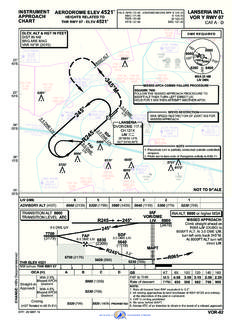
4 2. Relevant documentation and reference material The following documentation and material must be available during the examination: Up-to-date and relevant en-route and area charts (Jeppesen or Aerad) Up-to-date and relevant SID and STAR charts (Jeppesen, Aerad or AIP) Up-to-date and relevant approach charts (Jeppesen, Aerad or AIP) AIP volumes GEN & ENR AIP volume AD PARTS 61, 67, 91, 121 and 135 of the SACAR and associated SA-CATS AIP SUPP and AIC 2 NOTAMS relevant to the route intended to be flown TAFs and METARS for the day of the flight (Synoptic chart and SIGWC as required by DFE)
5 All documentation relevant to the navigation flight (initial skills test only or as required by DFE) Licence and up-to-date logbook Training portfolio (initial skills test only) Pilot Operating Handbook (POH). 3. Specific areas of knowledge The DFE must assess the knowledge and the practical application of the aspects listed in section 1 of form : Section 1: Ground evaluation Aspects CAR/CATS, AIP, SUPPLEMENTS, AICs, NOTAMs and completion of ATS flight plan Interpretation of weather reports, forecasts and charts Flight planning, aircraft performance and charts (SID,STAR, APP and en-route) All weather operations Technical knowledge of aircraft (POH, AFM as applicable) En-route navigation preparation and preparation of IFR navigation log The areas within an aspect from which practical questions may derive are listed and discussed below.
6 4. SACAR and SACATS The candidate must demonstrate general knowledge of the South African Civil Aviation Regulations and also the ability to navigate through the publications. The DFE may evaluate the candidate in any of the areas listed below: SACAR Part 61 instrument rating Revalidation check Logging of instrument flight time Skills test for an instrument rating Privileges and limitations of an instrument rating Period of validity of an instrument rating Revalidation of an instrument rating In case of CPL maintenance of competency Skills test for a commercial pilot licence Privileges and limitations of a commercial pilot licence Period of validity of a commercial pilot licence Maintenance of competency for a commercial pilot licence 3 In case of ATPL maintenance of
7 Competency Skills test for a airline transport pilot licence Privileges and limitations of an airline transport pilot licence Period of validity of an airline transport pilot licence Maintenance of competency for an airline transport pilot licence SACAR Part 91 Recency Duties of pilot-in-command regarding flight preparation Duties of pilot-in-command regarding flight operations Equipment for aircraft operated under IFR Additional equipment for single-pilot operation under IMC or at night Supplemental oxygen in the case of pressurised aircraft Supplemental oxygen in the case of non-pressurised aircraft Reduced Vertical Separation Minima (RVSM)
8 Operations Mandatory radio communication in controlled airspace Compliance with air traffic control clearance and instructions Compliance with IFR Aircraft equipment Change from IFR flight to VFR flight IFR procedures Minimum heights Semi-circular rule Standard instrument approach to and departure from aerodrome Aerodrome operating minima Pre-flight selection of aerodromes Planning minima for IFR flights Meteorological conditions Mass and balance Fuel and oil supply instrument approach and departure procedures Approach and landing conditions Approach ban Performance operating limitations 4 SA-CATS-OPS 91 Supplemental oxygen in the case of pressurised aircraft Supplemental oxygen in the case of non-pressurised aircraft Semi-circular rule Minimum flight altitude Aerodrome operating minima Planning minima for IFR flight Mass and balance Fuel and oil supply SACAR 135 Equipment for aeroplanes operated under IFR Aeroplane performance operating limitation SACAR 121 Equipment for aeroplanes operated under IFR Aeroplane performance operating limitation 5.
9 Aeronautical Information Publication (AIP) and Supplements The AIP contains useful information for the preparation of all-weather operations. The publication used for the evaluation must be up-to-date. The DFE must ascertain whether the candidate has consulted the relevant AIP supplements and NOTAMs. The candidate must demonstrate a thorough knowledge of the AIP sections listed below: Aeronautical information services ---------------------------------------- --------- GEN General rules ---------------------------------------- ---------------------------------- ENR Visual flight rules ---------------------------------------- ------------------------------ ENR instrument flight rules ---------------------------------------- ------------------------ ENR Approach and departure procedures ---------------------------------------- ----- ENR Radar services procedures
10 ---------------------------------------- ----------------- ENR Altimeter setting procedures ---------------------------------------- --------------- ENR All weather operations & low visibility procedures ---------------------------- ENR Flight planning ---------------------------------------- --------------------------------- ENR 5 6. ATS flight plan For an initial skills test the candidate must complete an ATS flight plan using the scenario given by the DFE. For a revalidation check, the DFE may evaluate the candidate in any aspect of an ATS flight plan with emphasis on: Field 10 (equipment) Field 15 (cruising speed, level and route) Field 18 (search & rescue) The DFE may allow the candidate to use AIC (Search and Rescue procedures), AIC (Filing of flight plans and wake turbulence separation data) and any other reliable reference publication if needed.