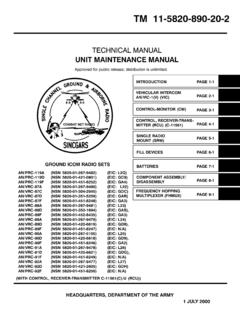
Transcription of Recommended Safe Working Practices
1 Recommended safe Working Practices Orica Avalanche Products Recommended safe Working Practices Orica Avalanche Products April 2011. Contents Contents 2 Procedures and Protocols 18. Recommendations within this document 4 Control team (recommendations) 18. Initiation system type recommendations 18. Acknowledgement & Contribution 5. In-house manufacturing fuse & cap assemblies 19. Introduction 6. Pull wire lighters 22. Industry Contacts 7 Hand charges 23. Definition of Authorities Having Jurisdiction (AHJ) 7 ANFO charges 24. Safety, Health & Environment 8 Avalauncher 25.
2 General Blasting Safety Guidelines 9 Avalauncher Projectiles 30. Unused charges 41. Orica avtrol Explosive Products 10. Fuse caps 10 Blasting log 42. Safety fuse 10 Misfires and no-light recommendations 43. Fuse assembly 11 Inventory control & documentation 45. Pull wire lighters 11 Transportation 46. Detonating cord 12 Disposal of explosive products 46. Cast boosters 13 Prevention of blasting accidents 47. Detonator sensitive emulsion cartridge 15 Terms & Definitions 50. 1 kg specific hand charges 15. Notes 53. ANFO 16. Disclaimer and Copyright 57. Avalauncher rounds 17.
3 2 Recommended safe Working Practices Orica Avalanche Products Contents 3. Recommendations within this Acknowledgement & Contribution document Orica wishes to acknowledge the contribution of materials from many members of the avalanche control community. Without their support the production of this document would not have been possible. This document contains recommendations for the use of explosives in avalanche mitigation applications. These recommendations were derived from industry Association contributions (material). organizations and industry professionals that strive to create the safest and most National Ski Area Association (NSAA).
4 Practical solutions to fit most situations. These recommendations were never intended to cover every situation or unique conditions, but rather to provide Association of Professional Patrollers (APP). guidance and insight to common avalanche mitigation protocol. WorkSafe British Columbia These recommendations should never be considered the final or only solution; Institute of Makers of Explosives (IME). it is up to each industry professional, organization or regulator to determine what technique or set of rules most appropriately meets their unique set of Industry Contributions (1st draft reviewer).
5 Circumstances. Jon Andrews, Stevens Pass Ski Area Gus (Piney) Gilman, Alta Ski Area Industry Contributions (photographic & forms). Mark Vesely, Fernie Alpine Resort Frank Waikart, Snow Basin Ski Area Curtis Norsen, Mt. Bachelor Ski Area Chad Hemphill & Troy Leahey, Revelstoke Mountain Resort John Brennan, Avalanche Mitigation Services Individual writing and editing Contributions Harry Hoover, Orica Mountain West Chris Hyle, Orica Mountain West Marc Vasily, Orica Canada Robert Onstott, Orica USA, Inc. 4 Recommended safe Working Practices Orica Avalanche Products Acknowledgements 5.
6 Introduction Industry Contacts The advice in this booklet is offered gratis with the main objective Canada (AHJ): of keeping Avalanche professionals free from harm as a result of WorkSafe BC. accidents caused by irregular or improper use of explosive materials. / Publications / OHSR egulation / The precautions are based on the collective experience of many individuals Canadian Avalanche Association (CAA). and organizations; the advice is given in good faith as representing the soundest safety advice in the use of Orica explosive products. Natural Resources Canada / mms-smm / expl-expl / It is your responsibility to understand and adhere to specific Federal, State, United States (AHJ): Provincial and local requirements.
7 Additionally, you should know that explosives procedures or policies may vary from one work site to another as a result of BATF. / explosives practical, operational, geographic, climatic or other differences. You are advised to refer to and be familiar with your individual worksite's avalanche procedures policy DOT, CFR Title 49. or applicable operating plans. / hazmat / regs / sp-a / approvals / explosives California OSHA, Article 121, Snow Avalanche Blasting None of the guidelines suggested in this booklet are intended to supersede or / oshsb / countermand any Federal, State, Provincial, Territorial, Municipal or individual company regulations in the use of explosive products or procedures.
8 Industry Organizations National Ski Area Association (NSAA). Why use explosives to mitigate avalanche danger? Avalanche experts can predict when avalanches are likely to occur. Experts then Association of Professional Patrollers (APP). can intentionally trigger the avalanche early, when they are certain that people are not in the area, or while roads are closed, to prevent potentially fatal accidents. Americana Avalanche Association (AAA). Frequent explosive control usually ensures that snow is brought down in several small avalanches, rather than a large destructive one.
9 Also, frequent avalanche International Society of Explosive Engineers releases prevent large, unpredictable natural avalanches later when the snowpack can become unstable. Institute Makers of Explosives Definition of Authorities Having Jurisdiction (AHJ). Authority having jurisdiction (AHJ): Any Federal, State, Provincial or local regulatory agency governing the storage, use and documentation of avalanche control explosives. 6 Recommended safe Working Practices Orica Avalanche Products Industry Contacts 7. Safety, Health & Environment General Blasting Safety Guidelines At Orica we believe that all work-related injuries, illnesses and The safety of a blasting operation depends on qualified, competent environmental incidents are preventable.
10 We will manage all our activities personnel using proper equipment and materials, observing correct blasting with concern for people and the environment and will conduct our procedures, Working in accordance with a well formulated plan. Failure business for the benefit of society without compromising the quality of life of any one of these elements can lead to injury or death, not only to the of future generations. blaster, but also to his co-workers and even the general public. People handling explosives must have intelligence, common sense and be trained In particular we will: in the use of explosives.