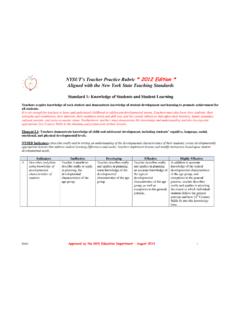
Transcription of Reeves Leadership Performance Matrix
1 Reeves ' Leadership Performance Matrix Resilience: Narrative: Leaders in education bounce back quickly from adversity and stay focused on the vision of the organization. They bring together people and resources with the common belief that the organization can grow stronger in tough times when it applies certain knowledge, skills, and attitudes in the face of adversity. Constructive Highly Effective Effective Needs Improvement Unsatisfactory Reactions (System-wide Impact) (Local Impact) ( Leadership Potential). In addition to Effective . The leader The leader offers frank The leader readily The leader acknowledges The leader is defensive constructively reacts acknowledgement of prior personal acknowledges personal personal and and resistant to the to disappointment and organizational failures and and organizational failures organizational failures acknowledgement of and barriers to clear suggestions for system-wide and offers clear when confronted with error.
2 Success learning resulting from those suggestions for personal evidence. lessons. learning. 2011 The Leadership and Learning Center 1. Willingness to Highly Effective Effective Needs Improvement Unsatisfactory Admit Error (System-wide Impact) (Local Impact) ( Leadership Potential). In addition to Effective . The leader The leader shares case studies of The leader admits failures The leader is able to The leader is unwilling demonstrates personal and organizational errors quickly, honestly, and accept evidence of to acknowledge errors. willingness to admit in a way that is used to guide, openly with direct mistakes when offered by error and learn from When confronted with inspire, and teach colleagues supervisor and immediate others. it evidence of mistakes, throughout the organization. colleagues. Some evidence of learning the leader is defensive The leader builds resilience in There is evidence of from mistakes is present.
3 And resistant to colleagues and throughout the learning from past errors. learning from mistakes. organization by habitually Non-defensive attitude highlighting and praising good exists in accepting mistakes where risks were taken, feedback and discussing mistakes were made, lessons were errors and failures. learned, and both the individual and the organization learned for the future. Disagreement The leader demonstrates The leader accepts and The leader sometimes The leader ignores or willingness to challenge executive implements Leadership and challenges executive and subverts executive and The leader authority and policy leaders policy with fidelity. policy Leadership without policy decisions that constructively appropriately with evidence and bringing those concerns to are unpopular or Initiatives are represented handles constructive criticism, but once the appropriate executive and difficult.
4 By the leader in a way that disagreement with decision is made, fully supports and policy authorities. advocates for policies as if Leadership and enthusiastically implements it is the leader's idea. The leader sometimes policy decisions organizational policy and Leadership implements unpopular decisions. The leader proactively policies unenthusiastically brings concerns to his or or in a perfunctory her immediate supervisor manner. by articulating disagreements and points of view in the interest of the organization. 2011 The Leadership and Learning Center 2. Dissent Highly Effective Effective Needs Improvement Unsatisfactory (System-wide Impact) (Local Impact) ( Leadership Potential). The leader In addition to Effective . constructively The leader creates constructive The leader uses dissent to The leader tolerates Dissent is absent due handles dissent from contention, assigning roles (if inform final decisions, dissent, but there is very to a climate of fear and subordinates necessary) to deliberately generate improve the quality of little of it in public.
5 Intimidation. multiple perspectives and consider decision making, and different sides of important issues. broaden support for his or her final decision. The leader recognizes and rewards thoughtful dissent. Defined structures and processes are in place for The leader uses dissenting voices eliciting input. to learn, grow and, where appropriate, acknowledge the leader's own error. The leader encourages constructive dissent in which multiple voices are encouraged and heard; the final decision is made better and more broadly supported as a result. Improvement The leader's previous evaluations The leader's previous The leader is aware of No evidence of of Specific are combined with personal evaluations are explicitly previous evaluations, but reference to previous Performance reflection and 360-degree feedback reflected in projects, tasks, has not translated them Leadership evaluations Areas to formulate an action plan that is and priorities.
6 Into an action plan. is present in the reflected in the leader's daily leader's choices of choices of priorities, as well as in Performance on each tasks and priorities. The leader evaluation reflects specific the organization's priorities. demonstrates and measureable explicit improvement The influence of previous improvements along the in specific evaluations has an impact not only Performance continuum Performance areas on the leader, but on the entire from unsatisfactory, to based on previous organization. needs improvement, to evaluations and effective, to highly effective. formative feedback 2011 The Leadership and Learning Center 3. Personal Behavior and Professional Ethics: Narrative: Leaders in education demonstrate personal behaviors consistent with community values and morals. They keep commitments, work with students, and act in service of the best interest of the students, staff, and community.
7 Integrity Highly Effective Effective Needs Improvement Unsatisfactory (System-wide Impact) (Local Impact) ( Leadership Potential). The leader In addition to Effective . demonstrates integrity The leader meets commitments The leader meets The leader meets explicit The phrases I'm working verbal, written, and implied commitments or negotiates written commitments. on it or I'm doing the without exception. exceptions where the best I can are regarded The need to get it in commitment cannot be as acceptable substitutes Commitments to individuals, writing does not allow met. for commitments. students, community members, subordinates or superiors and subordinates have the same Verbal commitments have to make assumptions that The leader does not weight as commitments to the same weight as written verbal statements have the follow through with tasks, superiors, board members, or commitments. weight of a commitment.
8 Budgets, and priorities other people with visibility and critical to the authority. Performance of his or her site or responsibilities. The leader's commitment to integrity is clear throughout the organization, as any commitment from anyone who reports to this leader is as good as a commitment from the leader. Emotional The leader possesses complete The leader deals with The leader occasionally The leader loses his or Self-Control self-control, even in the most sensitive subjects and exhibits aggressive, her temper and is difficult and confrontational personal attacks with dismissive, or demeaning emotionally unstable. The leader situations, but also provides dignity and self-control. behaviors leading to a Conversations on any demonstrates assistance to colleagues on the climate in which people The leader never meets sensitive topic are brief techniques of emotional are reluctant to raise emotional self- anger with anger, but or nonexistent.
9 Control intelligence. sensitive issues. defuses confrontational Not only is the leader an exemplar situations with emotional of emotional intelligence, but the intelligence, empathy, and entire organization reflects this respect. commitment to self-control, empathy, and respect. 2011 The Leadership and Learning Center 4. Ethical and Highly Effective Effective Needs Improvement Unsatisfactory Legal (System-wide Impact) (Local Impact) ( Leadership Potential). Compliance with In addition to Effective . Employees The leader meets the letter and There are no instances of The leader's conduct does The leader violates (even spirit of the law, avoiding both the illegal or unethical conduct not support a school just one time) the legal The leader fact and appearance of with employees or culture respectful of the and policy requirements demonstrates impropriety. prospective employees, legal and policy for the relationship compliance with and no other conduct that requirements for the between leaders and legal and ethical The leader inculcates the crosses the line of policy relationship between employees.
10 Requirements in foundations of mutual respect for or law. leaders and employees. relationship to colleagues and for the law employees throughout the organization. Tolerance The leader actively seeks The leader focuses There is no punishment of The leader suppresses differences in perspective, evaluation on the alternative points of view, other points of view and The leader encouraging different scenarios achievement of the but little or no development discourages demonstrates and curricula in the context of mission and adherence to or encouragement of those disagreement or tolerance of different academic standards. values without penalizing views exists. divergent thinking. points of view within differences in points of The leader explicitly differentiates the boundaries of view that are within the divergent thinking when it is the values and framework of constructive and facilitates a mission of the organizational transition to convergent thinking to organization requirements.