Transcription of Relationship between humanitarian and development aid
1 Helpdesk Research Report Relationship between humanitarian and development aid R is n Hinds Question What is the recent mainstream and influential literature on the Relationship between humanitarian and development aid, particularly on transition and bridging gaps? Provide an overview of the main conclusion and issues, suggested approaches, and knowledge gaps. Contents in the literature and evidence to linking humanitarian and development and rapid research report identifies literature on the Relationship between humanitarian and development aid.
2 The concept of linking relief, rehabilitation and development (LRRD) emerged in the 1990s when practitioners identified a funding gap between humanitarian assistance, relief, and development activities. Since then, agencies, academics and practitioners have attempted to find ways of reconciling the humanitarian - development nexus to provide both effective humanitarian relief, and sustainable medium- and long-term development action. The basic premise of LRRD is the need to link and create synergies between short-term relief measures, with longer term development programmes.
3 It reflects the belief that humanitarian need, poverty and state fragility are inter-related and often occur concurrently (Otto and Weing rtner 2013). 2 GSDRC Helpdesk Research Report State of the evidence There is a broad body of literature on the intersections and relationships between humanitarian and development aid. Much of the literature is in the form of secondary desk reviews, however there are some evaluations of donor and NGO attempts to better link humanitarian and development programmes. Some experts have raised concerns that the humanitarian - development Relationship falls between different topics and is therefore often dealt with obliquely and unsatisfactorily 1.
4 Others caution that while much has been written from a humanitarian perspective, there is a lot less from a development perspective2. Relationship between humanitarian and development aid There are various approaches to understanding the Relationship between humanitarian and development aid. Some literature points to a specific time period; envisaging the humanitarian - development gap as a temporal period when a humanitarian operation is about to be completed, and development and reconstruction projects are about to begin (Suhrke and Ofstad 2005).
5 Others refer to an institutional gap which is not only about the practical problems of coordinating humanitarian and development institutions, but fundamental differences in priorities, cultures and mandates (Suhrke and Ofstad 2005). Recent debates have included an emphasis on linking humanitarian aid and development with security, in the context of post-2011 western foreign policy (OCHA 2011). Challenges and approaches Despite a broad body of literature on the Relationship between humanitarian and development aid, there is limited specific guidance on how to address perceived gaps, and few practical examples of how donors and others have implemented change.
6 Some of the commonly cited challenges, and approaches to address them, include: Conceptual, institutional and strategic gaps: Differences in working principles, mandates and assumptions can present challenges for operationalising LRRD. Internally, the institutional arrangements of some donors present a clear division in the delivery of humanitarian and development aid. While externally, disunity among donor agencies and a lack of dynamism to respond to events have created strategic gaps in the delivery of different forms of aid (Van der Haar and Hilhorst 2009).
7 Approaches to tackling such gaps include: decentralising planning, analysis, and funding allocation (Steets 2011); establishing joint humanitarian and development offices (Otto and Weing rtner 2013); and creating operational frameworks that incorporate both a long-term perspective into humanitarian work, and issues of vulnerability and risk in development work (Buchanan-Smith and Fabbri 2005). Funding gaps: There is inconsistent evidence about the existence of a temporal funding gap between the humanitarian and development phases of a response.
8 However, there is more comprehensive evidence of a systematic funding gap for recovery activities, evidence that fragile state do not receive the necessary support (Steets 2011), and concern that financing is too fragmented and compartmentalised (OECD-DAC 2010b). Lack of flexibility in funding arrangements is a particular concern (Gr newald et al. 2011). Approaches to making humanitarian funding more flexible and longer-term include multi-year funding options, strategic 1 Expert comments 2 Expert comments Relationship between humanitarian and development aid 3 partnerships instead of project grants, and pooling resources (Steets 2011; World development Report 2014).
9 Partnerships and coordination: Some donors implementing partners may lack the expertise orcapacity to work across different forms of aid or to coordinate their activities. Others mayspecialise in either humanitarian or development aid and find it difficult to draw linkagesbetween the two. In terms of approaches, evaluations have found that programmes with stronglocal engagement and local partnerships on the ground are often more successful at marryingshort- and long-term perspectives (Christoplos 2006; Brusset et al. 2006). Examples ofapproaches to improving donor coordination include compacts, multilateral joint assessments,and mutual accountability frameworks (Herbert 2014; OECD-DAC 2010b).
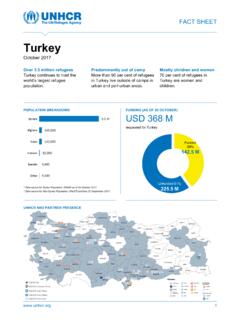
10 Refugees and displaced persons: The perception that displaced persons can only be addressedthrough humanitarian means can impede or delay the achievement of sustainable solutions, andlead to protracted displacements and a cycle of dependence on humanitarian assistance (UNHRC2010). In terms of approaches, the transitional solutions initiative and the Solutions Allianceaim to position displacement at the core of recovery and development strategies throughadvocacy, coordination, capacity building and resource mobilisation3. These approaches focus onbuilding relationships between bilateral and multilateral actors to support local processes andlocal ownership, and finding sustainable solutions for displaced persons and local communities(UNDP and UNHCR 2013).