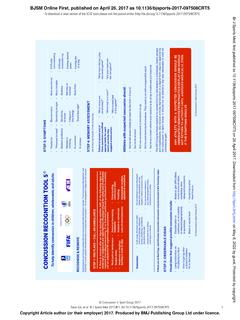
Transcription of Relative Energy Defi ciency in Sport (RED-S) Clinical ...
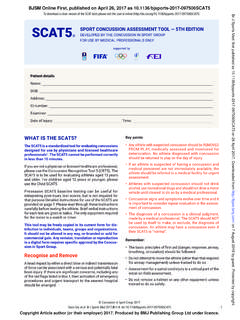
1 What is the RED-S CAT?the ReD-S cat is a Clinical assessment tool for the evaluation of athletes / active individuals suspected of having Relative Energy defi ciency and for guiding return to play decisions. the ReD-S cat is designed for use by a medical professional in the Clinical evaluation and management of athletes with this syndrome. the ReD-S cat is based on the ioc consensus Statement on ReD-S, this tool may be freely copied in its current form for use by Sport organizations and the athlete medical team entourage. alterations to the tool or reproduction for publication purposes require permission from the international olympic : the diagnosis of ReD-S is a medical diagnosis to be made by a trained health care professional.
2 Clinical management and return to play decisions for athletes with ReD-S should occur under the guidance of an experienced sports medicine team. What is Relative Energy Defi ciency in Sport ?The syndrome of RED-S refers to impaired physiological functioning caused by Relative Energy defi ciency , and includes but is not limited to impairments of metabolic rate, menstrual function, bone health, immunity, protein syn-thesis, and cardiovascular health. the cause of ReD-S is the scenario termed low Energy availability , where an in-dividual s dietary Energy intake is insuffi cient to support the Energy expenditure required for health, function, and daily living, once the cost of exercise and sporting activities is taken into potential health consequences of ReD-S are depicted in the ReD-S conceptual model (See figure 1).
3 Psychological problems can be both the result of and the cause of CAT Relative Energy Defi ciency in Sport (RED-S) Clinical Assessment Tool (CAT)for use by medical professionals onlyname Date : examiner: Screening for RED-Sthe screening and diagnosis of ReD-S is challenging, as symptomatology can be sub-tle. a special focus on the athlete at risk is needed. although any athlete can suffer from ReD-S, those at particular risk are those in judged sports with an emphasis on the aesthetic or appearance, weight category sports, and endurance sports. early detection is of importance to maintain and improve performance and prevent long-term health consequences.
4 Screening for ReD-S can be undertaken as part of an annual periodic Health exam-ination and when an athlete presents with Disordered eating (De) / eating Disorders (eD), weight loss, lack of normal growth and development, endocrine dysfunction, recurrent injuries and illnesses, decreased performance / performance variability or mood may also affect athlete Sport performance. the potential effects of ReD-S on Sport performance are illustrated in figure 2:Immuno-logicalGastro-intestinalCardio- vascularPsycho-logicalGrowth +develo-pementHermato-logicalMetabolicBo nehealthMenstrualFunctionEndocrineTRIADD ecreasedendurance performanceDecreasedmusclestrengthDecrea sedglycogen storesDepressionIrritabilityDecreasedcon centrationDecreasedcoordinationDecreased trainingresponseIncreased injuryriskImpairedjudgementTriadfigure 1figure 2 ;49:421 423.
5 On May 28, 2022 by guest. Protected by J Sports Med: first published as on 17 March 2015. Downloaded from Treatment of Relative Energy Deficiency in Sport (RED-S)athletes categorized in the red light and yellow light zones should receive medi-cal evaluation and treatment. the treatment of ReD-S should be undertaken by a team of health professionals including a sports medicine physician, sports dietician, exercise physiologist, athletic therapist or trainer, sports psychologist / sports psy-chiatrist as needed. Patient confidentiality must be maintained.
6 Treatment should focus on correcting the Relative Energy deficit through increasing Energy intake and / or decreasing Energy output. intake of nutrients and other vitamins should fol-low established guidelines. Repeat assessment of BmD should occur at intervals of 6 12 months, depending on Clinical presentation and initial use of an athlete contract is also recommended. (See Appendix) Relative Energy Deficiency in Sport (RED-S) risk assessment decision making steps for determining readiness for returning to playprior to returning an athlete to Sport / physical activity following time away for ReD-S treatment, an assessment of the athlete s health and the requirements of his / her Sport should be undertaken following the step-wise approach.
7 STEPS RISK MODIFIERSCRITERIARED-S SPECIFIC CRITERIASTEP 1evaluation of Health StatusmeDical factoRS -patient Demo-graphics - Symptoms -medical History - Signs - Diagnostic tests -psychological Health -potential Seriousness -age, sex - See yellow light column in ReD-S Risk assessment model - Recurrent dieting, menstrual health, bone health -Weight loss / fluctuations, weakness - Hormones, electrolytes, electrocardiogram, DXa - Depression, anxiety, disordered eating / eating disorder -abnormal hormonal and metabolic function -cardiac arrhythmia - Stress fractureSTEP 2evaluation of participation RiskSpoRt RiSK moDifieRS -type of Sport -position played -competitive level - Weight sensitive, leanness Sport -individual vs.
8 Team Sport -elite vs. recreationalSTEP 3 Decision ModificationDeciSion moDifieRS -timing and Season -pressure from athlete -external pressure -Conflict of Interest -fear of litigation -in / out of season, travel, environmental factors -mental readiness to compete -coach, team owner, athlete family, sponsors support -if restricted from competition Return to Play Model following Clinical reassessment utilizing the 3 step evaluation outlined above, ath-letes can be re-classified into the High Risk Red light , moderate Risk yellow light or low Risk green light categories.
9 The ReD-S Risk assessment model is adapted to aid clinicians decision making for determining an athlete s readiness to return to Sport / physical activity. the ReD-S Return to Play Model outlines the Sport activity recommended for each risk category. HIgH RISK RED LIgHTMODERATE RISK YELLOW LIgHT LOW RISKgREEN LIgHT -no competition -no training - Use of written contract -may train as long as he / she is following the treatment plan -may compete once medically cleared under supervision -full Sport participationRED-S Risk Assessment Model for Sport participation this model can be incorporated into the periodic Health examination.
10 Depending on the findings on history and physical examination, the athlete is classified into one of the 3 following categories: Red Light : High risk, Yellow Light : moderate risk, green Light : low Risk. HIgH RISK: NO START RED LIgHTMODERATE RISK: CAUTION YELLOW LIgHTLOW RISK:gREEN LIgHT -anorexia nervosa and other serious eating disorders -other serious medical (psychological and physio-logical) conditions related to low Energy availability - Use of extreme weight loss techniques leading to dehydration induced hemo-dynamic instability and other life threatening conditions.