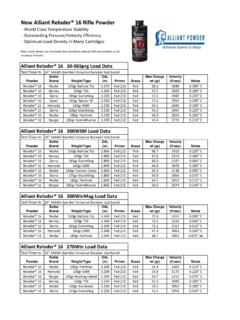
Transcription of Reloder® - AR-Comp Series Smokeless powders
1 Reloder - AR-Comp Series Smokeless powders Safety Data Sheet According To Federal Register / Vol. 77, No. 58 / Monday, March 26, 2012 / Rules And Regulations Revision Date: 03/02/2017 Version: 03/02/2017 EN (English US) 1/11 SECTION 1: IDENTIFICATION Product Identifier Product Form: Mixture Product Name: Reloder Series Smokeless powders , AR-Comp Intended Use of the Product Smokeless powder for small arms. Name, Address, and Telephone of the Responsible Party Company Alliant powder 900 Ehlen Drive Anoka, MN 55303 T 1-800-635-7656 Emergency Telephone Number Emergency Number : 1-800-424-9300 (Inside US), 01-703-527-3887 (Outside US) - (CHEMTREC, Day or Night) SECTION 2: HAZARDS IDENTIFICATION Classification of the Substance or Mixture Classification (GHS-US) Expl. H203 Acute Tox. 3 (Oral) H301 Acute Tox. 3 (Dermal) H311 Acute Tox. 3 (Inhalation:dust,mist) H331 Skin Sens.
2 1 H317 Repr. 2 H361 STOT RE 2 H373 Full text of H-phrases: see section 16 Label Elements GHS-US Labeling Hazard Pictograms (GHS-US) : GHS01 GHS06 GHS07 GHS08 Signal Word (GHS-US) : Danger Hazard Statements (GHS-US) : H203 - Explosive; fire, blast or projection hazard. H301+H311+H331 - Toxic if swallowed, in contact with skin or if inhaled. H317 - May cause an allergic skin reaction. H361 - Suspected of damaging fertility or the unborn child. H373 - May cause damage to organs through prolonged or repeated exposure. Precautionary Statements (GHS-US) : P201 - Obtain special instructions before use. P202 - Do not handle until all safety precautions have been read and understood. P210 - Keep away from extremely high or low temperatures, ignition sources, and incompatible materials. - No smoking. P240 - Ground/bond container and receiving equipment. P250 - Do not subject to friction, grinding, shock. P260 - Do not breathe dust, fume. P264 - Wash hands, forearms, and other exposed areas thoroughly after handling.
3 P270 - Do not eat, drink or smoke when using this product. P271 - Use only outdoors or in a well-ventilated area. P272 - Contaminated work clothing must not be allowed out of the workplace. Reloder - AR-Comp Series Smokeless powders Safety Data Sheet According To Federal Register / Vol. 77, No. 58 / Monday, March 26, 2012 / Rules And Regulations 03/02/2017 EN (English US) 2/11 P273 - Avoid release to the environment. P280 - Wear protective gloves, protective clothing, and eye protection. P301+P310 - IF SWALLOWED: Immediately call a poison center or doctor. P302+P352 - IF ON SKIN: Wash with plenty of water. P304+P340 - IF INHALED: Remove person to fresh air and keep at rest in a position comfortable for breathing. P308+P313 - If exposed or concerned: Get medical advice/attention. P312 - Call a poison center or doctor if you feel unwell. P321 - Specific treatment (see section 4 on this SDS). P330 - Rinse mouth. P333+P313 - If skin irritation or rash occurs: Get medical advice/attention.
4 P362+P364 - Take off contaminated clothing and wash it before reuse. P370+P380 - In case of fire: Evacuate area. P372 - Explosion risk in case of fire. P373 - DO NOT fight fire when fire reaches explosives. P391 - Collect spillage. P401 - Store as defined in the Explosives Act of Canada and the provisions of the Bureau of Alcohol, Tobacco and Firearms regulations contained in 27 CFR part 555. P403+P233 - Store in a well-ventilated place. Keep container tightly closed. P405 - Store locked up. P501 - Dispose of contents/container as defined in the Explosives Act of Canada and the provisions of the Bureau of Alcohol, Tobacco and Firearms regulations contained in 27 CFR part 555. Other Hazards Accidental firing or explosion is likely to cause severe injury or death. Electrostatic charges generated by emptying package in or near flammable vapor may cause flash fire. Overexposure may cause methemoglobinemia. Initial manifestation of methemoglobinemia is cyanosis, characterized by navy lips, tongue and mucous membranes, with skin color being slate grey.
5 Further manifestation is characterized by headache, weakness, dyspnea, dizziness, stupor, respiratory distress and death due to anoxia. Exposure may aggravate those with pre-existing eye, skin, or respiratory conditions. Unknown Acute Toxicity (GHS-US) Not available SECTION 3: COMPOSITION/INFORMATION ON INGREDIENTS Mixture Name Product Identifier % (w/w) Classification (GHS-US) Nitrocellulose (CAS No) 9004-70-0 < , - 1, 1 - 5, 5 - 10, 10 - 30, 30 - 60, 60 - 100 Expl. , H201 Nitroglycerin (CAS No) 55-63-0 < , - 1, 1 - 5, 5 - 18 Unst. Expl, H200 Acute Tox. 2 (Oral), H300 Acute Tox. 2 (Dermal), H310 Acute Tox. 2 (Inhalation:dust,mist), H330 STOT RE 2, H373 Aquatic Acute 2, H401 Aquatic Chronic 2, H411 Diisopentyl phthalate (CAS No) 605-50-5 < , - 1, 1 - 3 Skin Sens. 1, H317 Repr. 2, H361 Aquatic Acute 1, H400 Diphenylamine (CAS No) 122-39-4 < , - 1, 1 - 2 Acute Tox. 3 (Oral), H301 Acute Tox. 3 (Dermal), H311 Acute Tox. 3 (Inhalation:dust,mist), H331 Eye Irrit.
6 2A, H319 STOT RE 2, H373 Aquatic Acute 1, H400 Aquatic Chronic 1, H410 Urea, N,N'-diethyl-N,N'-diphenyl- (CAS No) 85-98-3 < , - 1, 1 - 2 Acute Tox. 4 (Oral), H302 Reloder - AR-Comp Series Smokeless powders Safety Data Sheet According To Federal Register / Vol. 77, No. 58 / Monday, March 26, 2012 / Rules And Regulations 03/02/2017 EN (English US) 3/11 Aquatic Acute 3, H402 Aquatic Chronic 3, H412 More than one of the ranges of concentration prescribed by Controlled Products Regulations has been used where necessary, due to varying composition. Full text of H-phrases: see section 16 SECTION 4: FIRST AID MEASURES Description of First Aid Measures General: Never give anything by mouth to an unconscious person. If you feel unwell, seek medical advice (show the label if possible). Inhalation: Remove to fresh air and keep at rest in a position comfortable for breathing. Obtain medical attention if breathing difficulty persists. Skin Contact: Remove contaminated clothing.
7 Drench affected area with water or soap and water for at least 15 minutes. Wash contaminated clothing before reuse. Obtain medical attention if irritation develops or persists. Eye Contact: Rinse cautiously with water for at least 15 minutes. Remove contact lenses, if present and easy to do. Continue rinsing. Obtain medical attention. Ingestion: Do NOT induce vomiting. Rinse mouth. Immediately call a POISON CENTER or doctor/physician. Most Important Symptoms and Effects Both Acute and Delayed General: Toxic if swallowed, in contact with skin or if inhaled. May cause an allergic skin reaction. Suspected of damaging fertility or the unborn child. May cause damage to organs through prolonged or repeated exposure. May cause the blood disorder methemoglobinemia, and with over exposure in predisposed individuals may cause renal problems, cardiac abnormalities, and other blood disorders. Inhalation: May cause respiratory irritation. Excessive exposure may cause central nervous system effects including headache, dizziness, loss of balance and coordination, unconsciousness, coma, respiratory failure, and death.
8 Skin Contact: Symptoms may include: Redness, pain, swelling, itching, burning, dryness, and dermatitis. When absorbed through the skin may cause narcotic effects, headaches, nausea, fatigue, loss of consciousness, and death. Eye Contact: May cause eye irritation. Ingestion: Weakness, dizziness, deadache, nausea, convulsions, unconsciousness, death. Chronic Symptoms: Repeated or prolonged exposure may damage the hematological system, liver, spleen, and kidneys. Suspected of damaging fertility or the unborn child. Indication of Any Immediate Medical Attention and Special Treatment Needed If you feel unwell, seek medical advice (show the label where possible). SECTION 5: FIRE-FIGHTING MEASURES Extinguishing Media Special Hazards Arising From the Substance or Mixture Advice for Firefighters Precautionary Measures Fire: This product is an explosive with a fire, projection, or blast hazard. DO NOT FIGHT FIRES INVOLVING EXPLOSIVE MATERIALS. Firefighting Instructions: DO NOT ATTEMPT TO FIGHT FIRE.
9 Immediately evacuate all personnel from the area to a safe distance. Guard against re-entry. Thermal decomposition can lead to release of irritating gases and vapors. Protection During Firefighting: When controlling fire before involvement of explosives, fire-fighters should wear positive pressure self-containing breathing apparatus (SCBA) and full turnout gear. Hazardous Combustion Products: Carbon oxides (CO, CO2). Nitrogen oxides. Metal oxides. Suitable Extinguishing Media: DO NOT FIGHT FIRES INVOLVING EXPLOSIVES. Water may be applied through fixed extinguishing system (sprinklers) as long as people need not be present for the system to operate. Unsuitable Extinguishing Media: DO NOT fight fires involving explosives. Fire Hazard: In case of fire involving explosives: Evacuate area. DO NOT fight fires involving explosives. Consult the most current Emergency Response Guidebook (ERG), Guide 112 for additional information. Explosion Hazard: Explosives, Division - Chemicals and items which have a fire hazard and either a minor blast hazard or a minor projection hazard or both, but not a mass explosion hazard.
10 Extreme risk of explosion from shock, friction, fire or other sources of ignition. Substance may explode when in contact with flammable or organic substances and confined during a fire. Reactivity: Reacts violently with many chemicals causing fire and explosion hazard.. Material is sensitive to friction, shock, impact, and electrostatic discharge. Reloder - AR-Comp Series Smokeless powders Safety Data Sheet According To Federal Register / Vol. 77, No. 58 / Monday, March 26, 2012 / Rules And Regulations 03/02/2017 EN (English US) 4/11 Reference to Other Sections Refer to section 9 for flammability properties. SECTION 6: ACCIDENTAL RELEASE MEASURES Personal Precautions, Protective Equipment and Emergency Procedures General Measures: Do not get in eyes, on skin, or on clothing. Do not breathe dust or fumes. Keep away from heat, sparks, open flames, hot surfaces No smoking. Eliminate every possible source of ignition. Evacuate danger area. For Non-Emergency Personnel Protective Equipment: Use appropriate personal protection equipment (PPE).