Transcription of Required Navigation Performance Authorization Required ...
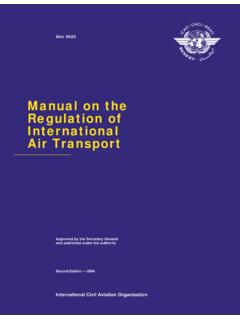
1 International Civil Aviation OrganizationApproved by the Secretary Generaland published under his authorityFirst Edition 2009 Doc 9905AN/471 Required Navigation PerformanceAuthorization Required (RNP AR)Procedure Design Manual Doc 9905 AN/471 Required Navigation Performance Authorization Required (RNP AR) Procedure Design Manual _____ Approved by the Secretary Generaland published under his authority First Edition 2009 International Civil Aviation Organization Published in separate English, Arabic, Chinese, French, Russian and Spanish editions by the INTERNATIONAL CIVIL AVIATION ORGANIZATION 999 University Street, Montr al, Quebec, Canada H3C 5H7 For ordering information and for a complete listing of sales agents and booksellers, please go to the ICAO website at First edition 2009 Doc 9905, Required Navigation Performance Authorization Required (RNP AR) Procedure Design Manual Order Number: 9905 ISBN 978-92-9194-382-1 ICAO 2009 All rights reserved.
2 No part of this publication may be reproduced, stored in a permission in writing from the International Civil Aviation Organization. (iii) AMENDMENTS Amendments are announced in the supplements to the Catalogue of ICAO Publications; the Catalogue and its supplements are available on the ICAO website at The space below is provided to keep a record of such amendments. RECORD OF AMENDMENTS AND CORRIGENDA AMENDMENTS CORRIGENDA No. Date Entered by No. Date Entered by 1 15/4/11 ICAO (v) TABLE OF CONTENTS Page FOREWORD.
3 (vii) DEFINITIONS .. (ix) ABBREVIATIONS AND ACRONYMS .. (xiii) Chapter 1. Description of Required Navigation Performance Authorization Required (RNP AR) .. 1-1 Purpose of the manual .. 1-1 Application .. 1-1 Aircraft qualification .. 1-2 Operational qualification .. 1-2 Flight operations information .. 1-3 Flight procedures .. 1-3 Chapter 2. RNP AR approach procedure design .. 2-1 Underlying 2-1 Obstacle clearance altitude/height (OCA/H) and decision altitude/height (DA/H) .. 2-1 Standard conditions .. 2-2 Terrain effects .. 2-2 Lateral protection .. 2-2 Vertical protection .. 2-3 Chapter 3. General criteria .. 3-1 Aircraft speed categories .. 3-1 Calculating turn radius and bank angle .. 3-3 Chapter 4.
4 Procedure construction .. 4-1 General principles .. 4-1 Initial approach segment .. 4-14 Holding .. 4-16 Intermediate approach segment .. 4-16 FAS .. 4-18 Missed approach segment (MAS) .. 4-36 Determination of OCA/H .. 4-43 Chapter 5. Publication and charting .. 5-1 Introduction .. 5-1 Aeronautical chart titles .. 5-1 Chart identification .. 5-1 (vi) RNP AR Procedure Design Manual Chart notes .. 5-1 Depiction .. 5-2 Minima .. 5-2 Appendix 1. Vertical error budget (VEB) minimum obstacle clearance (MOC) equation explanation (SI units) .. APP 1-1 Appendix 2. Vertical error budget (VEB) minimum obstacle clearance (MOC) equation explanation (non-SI units) .. APP 2-2 _____ (vii) FOREWORD Required Navigation Performance (RNP) was initially envisaged by the International Civil Aviation Organization (ICAO) as a means to facilitate change in airspace operation.
5 ICAO recognized that global Navigation satellite systems, the Navigation infrastructure, operations, and aircraft systems were undergoing change faster than could be supported by their traditional technical standards processes. RNP was developed to allow the specification of airspace and operation requirements without the constraints of the slow process for specifying equipment and systems. Initially, in order to support RNP operations, RNP procedure design criteria were developed and incorporated in the Procedures for Air Navigation Services Aircraft Operations (PANS-OPS) (Doc 8168). However, lacking demand and general familiarity with the change in operations and implementation paradigm possible with RNP, the initial criteria were conservative in nature and specification. Consequently, as specific locations were identified where demanding RNP solutions were needed, ICAO criteria were found to be insufficient and lacking in the necessary support guidance for approving operations.
6 At the same time, one State in collaboration with industry and a key airline operator undertook the task to develop criteria that permitted the usage of RNP-capable aircraft to address a significant problem with airport access in obstacle-rich environments or terrain, under limiting weather conditions. These criteria for RNP procedures were documented in regulatory guidance, as part of the United States Federal Aviation Administration (FAA) Advisory Circular (AC) 120-29A. The AC 120-29A RNP criteria permit a significant degree of flexibility and customization in procedure design. It extends beyond traditional procedure design guidance in its provision of criteria addressing relevant aspects of operational requirements that must be considered in the implementation of such special flight operations visual segment assessment, engine loss, extraction, tailored climb gradient and balked landing. However, such criteria can be very demanding and time-consuming as it must be evaluated and approved for every application.
7 As a result, it was determined that a degree of standardization in lieu of maximum variability would facilitate not only procedure development but implementation as well. The same State, consistent with its aviation community, derived a separate set of procedure design criteria that retained many key areas of flexibility but also set specific standards in others, so as to simplify the procedure design implementation effort while retaining the means to achieve significant operational benefits. These criteria were documented in United States FAA Order , which was initially used in that State, but was also embraced by others needing such criteria to address operational problems in their regions. ICAO has reviewed these criteria and developed equivalent criteria contained herein that was harmonized with PANS-OPS with regard to terminology, units of measurement and certain design parameters.
8 As the concepts behind the criteria contained in this manual are relatively new, it was decided not to include the criteria in PANS-OPS at this stage. In order to rationalize and support the implementation of RNP operations, ICAO established the Required Navigation Performance and Special Operational Requirements Study Group (RNPSORSG) which developed the Performance -Based Navigation (PBN) Manual (Doc 9613). The PBN Manual provides two types of Navigation specifications for approach operations: RNP approach (RNP APCH) and RNP Authorization Required approach (RNP AR APCH). The RNP APCH Navigation specification is intended to satisfy general RNP operational requirements and permit participation by aircraft with a basic level of RNP capability without a requirement for operational Authorization . The other Navigation specification, RNP AR APCH, which enables a higher level of Navigation Performance better able to address issues of airport access, such as obstacle-rich environments, and facilitate advances in air traffic management (ATM), requires the operator to meet additional aircraft and aircrew requirements and obtain operational Authorization from the State regulatory authority.
9 (viii) RNP AR Procedure Design Manual RNP AR procedures can provide significant operational and safety advantages over other area Navigation (RNAV) procedures by incorporating additional navigational accuracy, integrity and functional capabilities to permit operations using reduced obstacle clearance tolerances that enable approach and departure procedures to be implemented in circumstances where other types of approach and departure procedures are not operationally possible or satisfactory. Procedures implemented in accordance with this manual allow the exploitation of high-quality, managed lateral and vertical Navigation (VNAV) capabilities that provide improvements in operational safety and reduced controlled flight into terrain (CFIT) risks. This manual is intended for use by aircraft operators and procedure designers of instrument approaches based on RNP using RNAV avionics systems, where Authorization is Required (AR).
10 The manual includes design criteria to aid States in the implementation of RNP AR approach procedures in accordance with the PBN Manual, Volume II, Part C, Chapter 6, Implementing RNP AR APCH. Similar criteria for departure procedures will be incorporated when developed. _____ (ix) DEFINITIONS Aircraft-based augmentation system (ABAS). An augmentation system that augments and/or integrates the information obtained from the other GNSS elements with information available on board the aircraft. Note. The most common form of ABAS is receiver autonomous integrity monitoring (RAIM). Airspace concept. An airspace concept provides the outline and intended framework of operations within an airspace. An airspace concept is essentially a high-level statement of an airspace plan. Airspace concepts are developed to satisfy explicit strategic objectives such as improved safety, increased air traffic capacity and mitigation of environmental impact.