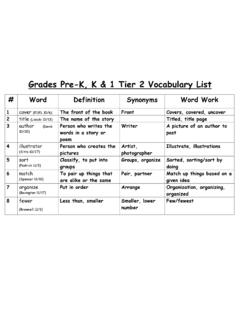
Transcription of Research-based Practices in Vocabulary Instruction
1 Research-based Practices in Vocabulary Instruction : An Analysis of What Works in Grades PreK-12 Prepared by the Studies & research Committee of the Massachusetts Reading Association August 2011 Sheelah M. Sweeny, , Committee Co-Chair Assistant Professor, Northeastern University Pamela A. Mason, , Committee Co-Chair Director, Language and Literacy Master s Program and the Jeanne Chall Reading Lab Harvard Graduate School of Education Introduction The first decade of the twenty-first century is already behind us, and it has been characterized by increased attention to student achievement due to the No Child Left Behind legislation and a persistent achievement gap for children of color, those from families with low socioeconomic status (SES), and for English Language Learners (ELLs). During this time there has been widespread acknowledgement that literacy development continues beyond elementary school, resulting in more attention to adolescents reading comprehension and the literacy demands in the content areas.
2 Two of the most important contributors to students reading comprehension and academic success are the volume of their Vocabulary upon entering school and their ability to learn new Vocabulary , with that learning enduring over time. A paucity of Vocabulary knowledge in their first language (L1) and their second language (L2) is particularly problematic for ELLs. The members of the Massachusetts Reading Association Studies and research Committee set out to determine what research from 2000 to 2010 says about Vocabulary Instruction . Our review revealed several categories of best Practices for teaching all students, and specific considerations for working with special populations including at-risk learners, ELLs, and students with learning disabilities, as well as recommendations for content-area Vocabulary Instruction . The review also prompts a suggestion of what not to do, specifically, avoid drill and practice! The commonly held understanding that wide reading and independent reading help build students Vocabulary knowledge still holds, but it is now understood that struggling readers and students with poor Vocabulary skills do not read enough and do not have enough of a Vocabulary foundation to independently learn enough Vocabulary on their own to catch up to their peers.
3 This means that Vocabulary Instruction must be deliberate, include direct Instruction , and in some instances involve small group interventional Instruction in order to adequately support and accelerate these students Vocabulary development. In general, schools should be language-rich environments where teachers and students attend to and celebrate language in all forms and contexts including orally, in writing, while reading, and in specific content areas. (For more information see Blachowicz, Ogle & Watts-Taffe, 2006; Vitale & Romance, 2008; Wood, Harmon & Hedrick, 2004). The following sections provide a synthesis of the research findings, specific suggestions teachers can use in their classrooms, recommendations for supporting the Vocabulary development of Special Needs students and English Language Learners, content area Vocabulary Instruction , and school-level considerations. A brief explanation for each category is provided and interested readers can use the Reference section to locate original research articles for more details.
4 Vocabulary Instruction Effective Vocabulary Instruction is multidimensional and intentional. It is most effective when addressed on a school-wide basis and then implemented with consistent intensity across grades or subjects and within grade level classrooms. A school-wide, or district-wide commitment to Research-based Vocabulary Instruction can ensure that there are consistent Practices in all classrooms and that there is a cumulative effect on the development of students Vocabulary across subjects and over the years. By creating language-rich learning environments where interesting, unusual, useful, emotional, controversial, and difficult words are noticed and celebrated, students become more attuned to language and accustomed to using sophisticated and academic language. A well-conceived plan for effective Vocabulary Instruction should include teacher input and will require training for all teachers. Professional development that informs teachers about Research-based alternatives to the traditional 20-word Vocabulary test will help ensure that all teachers are equipped with the knowledge to make word-learning meaningful (Baumann, Ware, & Edwards, 2007; Graves, 2009; VanDeWeghe, 2007).
5 The two biggest considerations when planning effective Vocabulary Instruction are the selection of words to teach and the instructional Practices used to help students learn. A synthesis of the research for each of these considerations follows. A. Word Selection The formal study of words has moved away from the practice of creating a large list of disconnected and de-contextualized words that is presented to students on Monday and tested on Friday, to Practices that stress conceptual knowledge of words and how words are related. research recommends that students learn fewer words but that they know how words and the English language work so that they can infer the meanings of new words. Effective Vocabulary Instruction is characterized by deliberate selection of words to be taught and frequent opportunities for students to interact with the words in meaningful contexts. Interacting with words in multiple ways and in varied contexts results in durable word learning.
6 Both teachers and students should be involved in the selection of words for study. Including students in the selection process helps to make the purpose for learning personal and therefore meaningful, it elevates their metacognition while reading and increases their awareness of words and the way language works. (Ruddell & Shearer, 2002). With so many words in the English language, it seems daunting to know which words to choose for Instruction . Teachers subject area knowledge, ability to identify important terms and concepts in texts, and knowledge of their students are all factors that impact the selection of words to be studied. A good place to start is to determine which common academic words, including content area words, students will encounter most, or that will be most crucial to their learning in a given period of time ( academic quarter, unit of study, academic year), and build from there. Choose words that apply across content areas and that represent important concepts.
7 The following six-step process can help determine which words to teach: 1. Read text selection(s) in advance to determine instructional purpose 2. Identify words or concepts students need to know 3. Identify connections and relationships between words or concepts chosen for Instruction 4. Choose words students must know prior to reading 5. Decide which words students only need to know incidentally and therefore do not require direct teaching 6. Determine what you want the children to learn Following these steps helps sharpen the instructional focus on the most important words that students must learn and it provides teachers with opportunities to form important conceptual links between units of study or subject areas. (For more information see Carreker, Thornhill & Joshi, 2007; Flanigan & Greenwood, 2007; Gardner, 2007; Graves, 2009; Kindle et. al, 2009; Ruddell & Shearer, 2002; Santoro, Chard, Howard & Baker, 2008; Townsend, 2009; VanDeWeghe, 2007; Vitale & Romance, 2008; Wood et al.)
8 , 2004). B. Instructional Practices Just like with reading Instruction , Vocabulary Instruction should involve cognitive skills Instruction . We want students to draw on their background knowledge, be metacognitive as they encounter new words, notice things about words, predict and infer meanings, question the use of specific words, analyze words and parts of words, make judgments about the selection and use of certain words, and evaluate theirs and others use of words. Instruction should include opportunities for students to work with words in multiple ways, including identifying synonyms and antonyms, looking for roots and using cognates, and connecting new words to known words. (For more information see Boulware-Gooden et al., 2007; Harmon, Wood & Kiser, 2009; Kindle et. al, 2009; Ruddell & Shearer, 2002; Santoro et al., 2008; VanDeWeghe, 2007; Vitale & Romance, 2008; Wood et al., 2004). Vocabulary Instruction should support students as independent learners by helping them develop strategies for learning words that can be applied in any context and as they move through their educational careers.
9 Instruction should include the following aspects of words and language usage: 1. Word families 2. Affixes (prefixes, suffixes), derivational affixes (affix changes part of speech joy-joyful), inflectional affixes (-s noun plural, -'s noun possessive, -s verb present tense third person singular, -ing verb present participle/gerund, -ed verb simple past tense, -en verb past perfect participle, -er adjective comparative, -est adjective superlative) 3. Synonyms and antonyms 4. Cognates (words that have similar origins) including Greek and Latin roots 5. Multiple meanings 6. Idioms and figurative speech Rote memorization does not help students retain Vocabulary knowledge over time, but activities that provide them with opportunities to work frequently with words and concepts and connect them to other words and concepts do result in more sustained learning. Teachers should create both direct and incidental word learning opportunities by using and discussing words in casual interactions as well as providing explicit Vocabulary Instruction .
10 Word learning can be fun, engaging and interesting when it involves games and hands-on strategies. Active learning strategies to support students Vocabulary growth include the following activities: 7. Reading 8. Writing 9. Listening 10. Discussing words and language 11. Acting out words 12. Visual imagery (visually representing a word and it s meaning) 13. Classifying words by parts of speech, meaning, pronunciation, endings, root, emotion, etc. 14. Semantic word mapping (connecting words or concepts using a graphic organizer) (Boulware-Gooden et al., 2007). See a description at 15. Semantic feature analysis (an examination of related concepts). See an example at 16. Morphemic analysis (finding small units of meaning in a word). See a sample lesson at Word Walls are now common fixtures in elementary classrooms as they provide a visual reminder of sight words, spelling words, concepts, and content-area words.