Transcription of Research Behind the Common Syllable Frequency …
1 Syllabication ActivitiesThe following quick, fun activities can heighten students awareness of syl-lable divisions (Carreker, 1999). Use the Common Syllable FrequencyCharts on pages 196 199 to select syllables for the Teaching Phonics & Word Study in the Intermediate Grades Scholastic Professional Read: Write words on the chalkboard Syllable by sylla-ble, leaving enough space between the word parts for students to see syllabledivisions. Ask students to use their knowledge of Common Syllable spelling pat-terns ( , closed syllables, open syllables, consonant + -le) to read each blending as necessary by discussing Syllable generalizations.
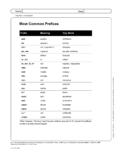
2 When there sa question about a Syllable s pronunciation, be sure to have students explain whythey pronounced it as they did. It is critical that students be able to verbalize allsix Syllable -spelling patterns. When they ve read each Syllable in a word, havestudents read the word at a natural pace (Gillingham and Stillman, 1997).fan tas ticfa bleab sentpump kinad ven turecroc o dileResearch Behind the Common Syllable Frequency ChartsOne chart contains the 100 Most Common Non-word Syllables. The other contains the322 Most Frequent Syllables in the 5,000 Most Common Words in English. Of these syl-lables, 222 or 69% are non-word syllables and 100 or 31% are word syllables.
3 These syl-lables account for over 70% of the syllables used in these 5,000 words. Sakiey andMartin (1980) have shown that 92% of the syllables found in primary-grade basal read-ers have no more than two pronunciations; 66% of the syllables have only one pronunci-ation. Therefore, because these syllables are so regular and are used so often, knowingthem will give students great flexibility and agility in reading multisyllabic words. 192 Words Manipulation: Divide words you ve selected fromupcoming reading selections into syllables. Write each Syllable on a note the syllables that make up one of the words in jumbled order ( ,tas fan tic).
4 Have students arrange the syllables to form the word. Whennecessary, discuss the pronunciation and spelling generalizations of any confusing Scoop: On a reproducible master, write 20 multisyllabic words froman upcoming story. Have students work with a partner to draw an arc, or toscoop with their finger, under each Syllable as they read each word aloud. Thenhave them code each Syllable by type ( , draw a macron over all open sylla-bles with long vowel sounds, circle all the prefixes). Alternative:Have studentscode a specific type of Syllable circle all consonant + -lesyllables or underlineall closed syllables and then read the words.
5 Visually identifying the commonsyllable-spelling pattern makes reading the entire word easier. Drills: These quick-paced, timed drills (see pages 193 194 for samples) are fun. One drill contains 20 Common syllables in random order. The other contains words with a specific Syllable -spelling pattern (consonant + -le). Before timing students, give them a chance to practicereading the syllables or words on the drill. Then, give them one minute toread as many syllables or words as they can. This must be done one-on-onewith each student. I suggest selecting five students each day to test. On acopy of the drill, mark the syllables or words the students students count the number of syllables or words read correctly and mark this on a progress chart.
6 Students find it highly motivating to track their own Phonics & Word Study in the Intermediate Grades Scholastic Professional Read: Write on the chalkboard a series of related openand closed syllables, such as re, rem, em. Have students use their knowledge ofopen and closed syllables to read each. Alternative:Create Syllable lists using allprefixes, all suffixes, all consonant + -lesyllables, or some other ter tion re ver ex bout com ple under num ble ment ture est dis im fi tureing ment er bout un ter com est der exdis ver ple re ble im tion num fi disun ing ple ble er num est ter ture com ver bout re der em ex tion ment fiuner der dis ing bout ter ture ment est imble ex num com tion re ver fi ple ter ble er re un ing fi dis der numment tion ple est ver ture comex bout imSample Syllable Speed DrillTeaching Phonics & Word Study in the Intermediate Grades Scholastic Professional Books194bubblebattle angle bridle apple ankle double bottle bugle bundle circlecrinkle fable cattle eagle fiddle maple dazzle marble
7 Gentle gigglehandle purple fizzle noble kettle jungle kindle sample muzzle pebblelittle shingle middle simple puzzle rumble mantle single needle steeplesparkle stubble rattle struggle puddle temple sprinkle tumble settle wiggle puddle uncle wrinkle title saddle vehicle bubble double battlefablebottle angletitle cattle eagle circle fiddle bundle handle middlesteeple marble apple gentle rumble giggle tumble maplekettle sample rattle needle uncle pebble vehicle purple jungle little bridlesimplesettle saddle single struggle anklestubble puzzle wrinkle wiggleSample Consonant + le Word Speed DrillTeaching Phonics & Word Study in the Intermediate Grades Scholastic Professional Books