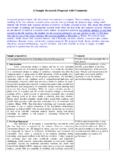
Transcription of Research Proposal Comment [A1]: Technical guidelines
1 1 Research Proposal TITLE OF THE Proposal Name and Surname: MY Name Student Number: 1000 0001 Degree: MCom Industrial Psychology Format: Mini- dissertation Contact phone: +27 Cell e-mail: Address: Postal box, Mailing address, City, Code Supervisor: Prof/Dr/Mr/Mrs Co-Supervisor: If applicable - Prof/Dr/Mr/Mrs Date of presentation: 16 March 2010 Comment [A1]: Technical guidelines : Headings: 12pt, Bold, Times New Roman, Align Left, Capital Letters Rest of text: 12, Times New Roman, Normal Text, Justified Whole document single spacing Page Numbers: Bottom Centre of page Margins: 1 inch = 2,54cm Comment [A2]: Title: Bold, Capital Letters, 14pt, Times New Roman Comment [A3]: Details: Bottom left hand corner of page, 12pt, Times New Roman 21 TITLE: Give the proposed title of the dissertation . 2 KEYWORDS: List keywords that is relevant to your topic. 3 INTRODUCTION Problem Statement Introduce the background of the study.
2 Why do you think a certain problem exists, and why are you interested in studying this problem, in this organisation, at this time? How did the problem develop/what led to/caused it? What has been the impact thereof on the employees and/or organisation that would validate addressing it with a Research project? The WHAT? and WHY? questions should be answered in your problem statement. The problem statement should include the following: The problem must be introduced in a way that will attract and retain the reader s attention. The background and setting of the problem must be provided in such a way that it sketches the context and dynamic of the problem. The motivation for the study must be given to explain the rational of the study. Current level of existing knowledge about sub-problems must be provided ( relevant literature should be provided - What has been found in previous Research ?)
3 How did previous researchers define the problem/variables, and how did they go about solving/addressing it? If you are interested in more than one variable, what are the relationships between these variables that previous Research has highlighted?). Define your main constructs from the literature. If your title is The work engagement and job satisfaction of chemical engineers , you should define work engagement, job satisfaction, and explain what a chemical engineer is. Here, it is especially important to make the link from conceptualisation to operationalisation. If you make use of the Maslach Burnout Inventory to measure burnout, then you should define burnout the same way as Christine Maslach conceptualised and defined burnout. You should have a guiding theoretical framework, therefore indicate which models and theories are relevant to the problem that you want to investigate. The introduction can be five to six pages.
4 Research questions State here the questions that you want to answer in your study. Keep the following in mind when formulating your Research questions: 1. Research questions should answer the problem statement. 2. It should be clear concepts. 3. Avoid questions that can be answered by yes or no. 4. Questions must not be too broad, too vague or too narrow. 5. Include only one topic per question. 36. Questions should facilitate an original contribution to the study. 7. Questions should focus the Research . Expected contribution of the study Describe here what the expected value or contribution of the study will be. How does this study address current limitations in theory and/or practice? This section should not be longer than 1/3 of one page. 4 Research OBJECTIVES The Research objectives are divided into a general objective and specific objectives. General objective The general objective of this Research is Here, give the essence of the study.
5 Look again at your paragraph at the end of the problem statement. There may be plenty of smaller objectives, but what is the core of the study? Specific objectives The specific objectives of this Research are: 1 2 3 These should correspond with your Research questions. For example, if one of the Research questions is How is wellness conceptualised in the literature? , the corresponding objective would be To conceptualise job insecurity from the literature . 5 Research HYPOTHESIS Briefly state your expectancy in terms of your empirical Research questions what do you expect to find? Your hypotheses should be guided by a sound theoretical framework and based on relevant literature findings. 6 Research DESIGN Research Approach Follow the guidelines of SAJIP: A brief description of the Research approach that will be followed in the study should be included.
6 Also motivate why this is the most suited design to 4use for the purpose of your study. It should for instance state that the study will follow the quantitative tradition and further explain whether it will be a cross-sectional field survey, an experiment or a factorial design and why this design will be chosen. Furthermore, it should explain what type of data (primary or secondary) will be used and which approach ( correlational) will be followed in the data analyses. This section is not similar to the description of the Research procedure. Research Method Literature review In phase 1 a complete review regarding (your constructs) will be done. The sources that will be consulted include: 1 2 Where are you going to find good information on your Research topic? Name all the different sources (journals, books, internet, etc.) that you will consult. Also provide the key words that you will use.
7 Research participants Follow the guidelines of SAJIP: A comprehensive description or estimation of the target population, sample size, sampling frame, possible characteristics of the sample and the sampling procedure should be provided here. Motivate why you will include these participants and how it will help to answer your Research questions. Measuring instrument(s) Follow the guidelines of SAJIP: This section describes the measuring instrument(s) that will be used in the study or the way in which constructs will be operationalised. Besides clearly referencing the origin of the scale this section should also clearly explain the basic scale design, the number of dimensions covered by the scale, exemplary examples of items (not the ones used in the scale) in each dimension as well as an example of the response rating scale. It should also be indicated which items are reverse scored or reflected and how total scores are calculated.
8 This section should also report on the reliability and validity of the scale (as reported in other studies) as well as the rationale for using this scale in the study. Research procedure Follow the guidelines of SAJIP: This section sets out the procedure that will be used for the collection of the data for the study. Specific attention should be given to the clarity of the Research procedure for possible replication purposes. Statistical analysis (third-level heading) Provide detail information on the statistical procedures that will be employed in the analyses of the data. In the event of unusual or new statistical techniques a brief description of each should be provided under this heading. It should also be indicated which statistical technique will be used to answer each Research question. 7 CHAPTER DIVISION The chapters in this mini- dissertation are presented as follows: Chapter 1: Introduction.
9 Chapter 2: Research article. Chapter 3: Conclusions, limitations and recommendations. If you have more than one article, you should indicate which Research questions will be answered in each Research article. 8 TIME FRAME Include a time frame of your planned Research activities. REFERENCES Cite all (and only) the sources that you used in the text above. Do this correctly according to APA- guidelines .